
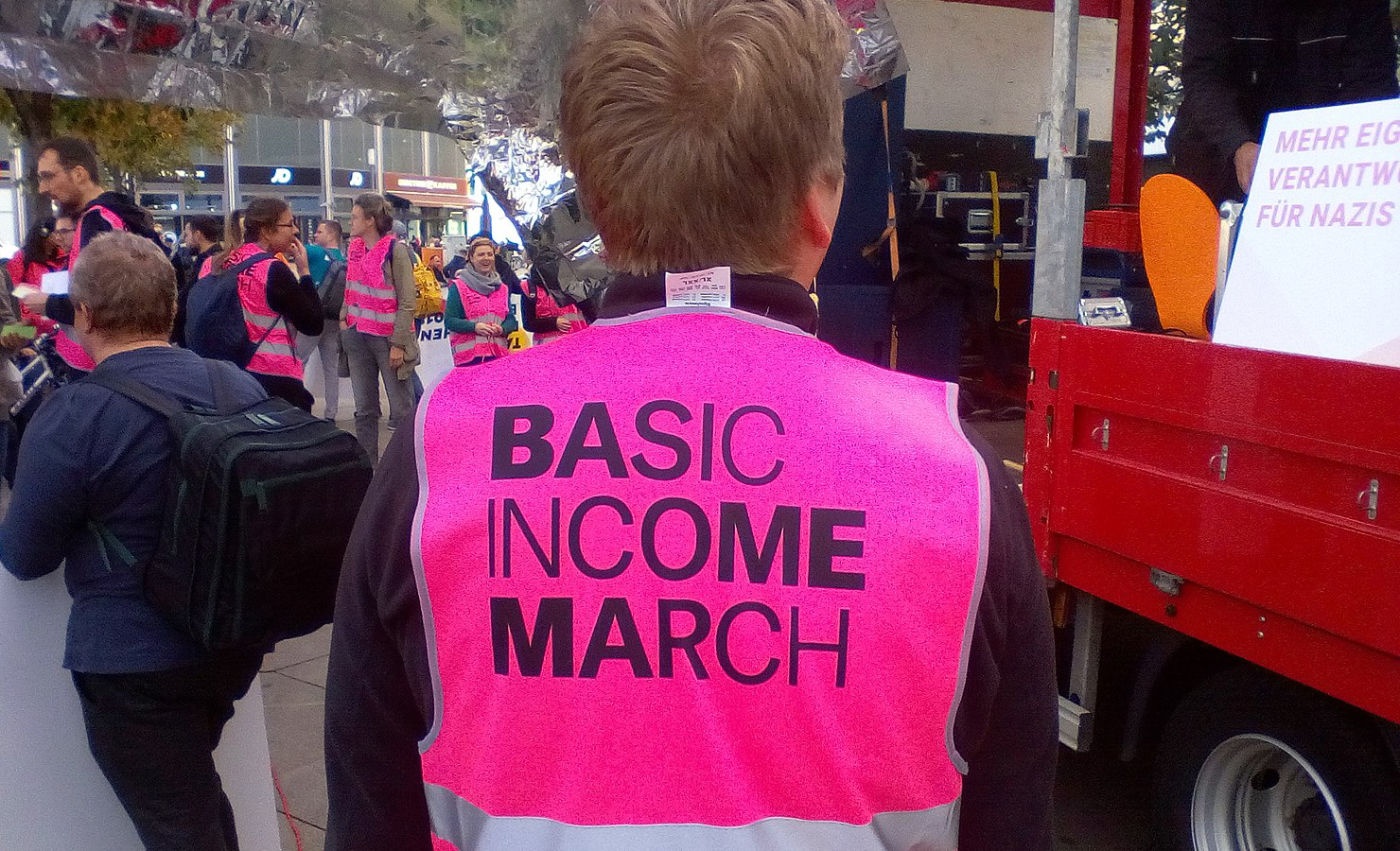
Labor Tribune publishes articles from activists across the labour movement. Here Alex Rooney, a Melbourne ALP activist, raises some questions about how the left approaches the question of a universal basic income. We publish it in the interests of prompting debate. Letters or articles in response are welcome.
Few notions have captured the imagination of the left and the broader public in quite the way the notion of a universal basic income (UBI) has. How the left approaches the concept of UBI is emblematic of its own theoretical and political infancy and unpreparedness to engage seriously in politics.
UBI – a brief overview
In his book, How to be anti-capitalist in the 21st century, Erik Olin Wright summarised what he termed “unconditional basic income” as “a fundamental redesign of the mechanisms of income distribution… [whereby] every legal resident of a territory receives an income sufficient to live above the poverty line without any work requirements or other conditions. Taxes increase to pay for UBI… [so that] income earners above a certain threshold would be net contributors.”
There are a range of UBI proposals (including that proposed by former Greek finance Minister Yanis Varoufakis of a “universal basic dividend”), but most fall within similar parameters to Wright’s, with differences focused on whether taxes or dividends from capital fund the proposal. These UBI proposals reveal to us three crucial assumptions made by their proponents:
- The sphere of distribution (not production) should be the focus of the left’s economic demands.
- The left should focus on extracting concessions through the mediation of the state.
- The state is an impartial actor that is separate from capital’s imperatives.
The decline of the left
The growth of Marxism since 1848 for the first time in human history provided humanity the possibility of overcoming domination through emancipation. This emancipation from capitalism was to come from within capitalism: from the self-conscious subject of capitalism – the proletariat. The greatest attempt to take up this task was the 1917 Russian Revolution and the revolutionary uprisings in Germany, Italy and Hungary shortly after. However, the failure of the revolution to spread and take root beyond Russia and the accommodation of the USSR to the global political stage hastened the degradation of the Marxian left.
The left at the turn of the 20th century was grappling with itself. The debate over revisionism was one Lenin took active part in, famously through his pamphlet What is to be Done? Lenin describes the foundations of revisionism (what he terms ‘trade union consciousness’) being the immanent workers’ struggle. Lenin contends it is the task of socialists to raise the consciousness of the proletariat to that of a ‘social-democratic consciousness’.
The revisionists (trade-union consciousness) were a natural outgrowth of the development of a revolutionary movement for socialism. It was these revisionists who often formed the bulwark of defence against socialist uprisings in 1917-23. It has also been these revisionists who have sought concessions from capital through the state. Not by capturing the machinery of government and subordinating it to the dictatorship of the proletariat, but by acquiring state power without thereafter throwing off the domination of capital.
UBI and today’s ‘left’
That the proponents of UBI focus on redistribution and not production is emblematic of how the left of today thinks of the proletariat. Today’s left does not believe the proletariat can ever be responsible for not only attaining state power, but for subordinating the machinery of government to its will. Instead, these revisionists, untethered from even their own history, are left to focus on technocratic redistributive policies via the state. There is no question of casting off the domination of capital over society.
In closing, consider the following quote from Marx’s Value, Price and Profit.
Instead of the conservative motto, ‘A fair day’s wage for a fair day’s work’, [the working class] out to inscribe on their banner the revolutionary watchwords, ‘Abolition of the wages system!’.”
Karl Marx, Value Price and Profit