

There is much talk of socialist unity outside the ALP in the air, but on the ground there remains sectarian competition. Bob Sparks offers a potential way forward.
The problem of a united socialist electoral challenge is not a technical but a political problem. Martin Greenfield has already made this argument in the pages of Labor Tribune. (Socialists’ election registration at an impasse). The ultimate solution is socialist unity on the basis of a common Marxist program. But years of mistrust, petty organisational competition and other political barriers stand in the way. The first step to overcoming these barriers is electoral cooperation that ends the current public spat between the Victorian Socialists and the Socialist Alliance. These groups both need to end the spectacle of socialist candidates standing against each other.
The Victorian Socialists/Socialist Party (VS/SP) project inspired by Socialist Alternative clearly has the upper hand over its socialist rivals. Signing up more than 5000 members is an impressive development. But this has backed the smaller but more established Socialist Alliance into a corner, as the very thing it has spent two decades hoping and waiting for seems to have passed it by.
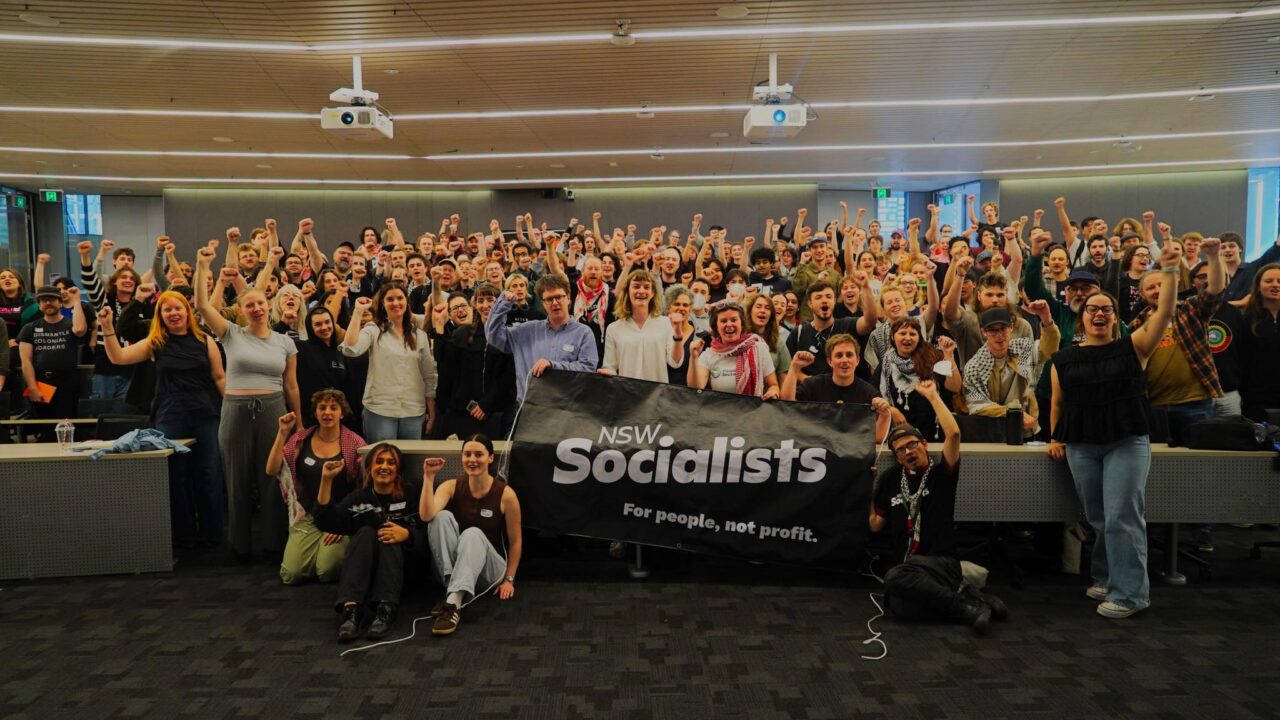
Unity in the air?
Talk of socialist unity is now in the air. But the recent Victorian Socialists/Socialist Party overtures to the Socialist Alliance have the feel of shotgun wedding about them. In a letter entitled “Now is the time for socialists to unite”, the VS/SP proposes that the Socialist Alliance can join it, as long as the latter agrees to a) not stand Socialist Alliance candidates at the next federal elections; b) change the name of its federal electoral registration if the VS/SP requires it to do so; and c) not attempt to register new state parties in its own name.
Telling a decades-old socialist electoral formation that it can no longer run its own election campaign under its name is hardly going to win it over. The leaders of the Socialist Alliance clearly have no desire to be a minority within a bigger socialist electoral project, as their resignation from the Victorian Socialists back in 2020 demonstrates.
In its public letter, the Victorian Socialists outline plans to run in every one of Victoria’s 88 lower house seats in the 2026 state elections. These plans do include a nod to possible joint electoral work in Geelong. But they appear to sideline potential Socialist Alliance candidates such as Merri-bek City Councillor Sue Bolton, who ran in the federal seat of Wills this year and scored what the Victorian Socialists themselves called an “impressive” 8 percent. Will these plans lead to a repeat of 2022, when Sue Bolton and a Victorian Socialists candidate stood against one another in the state seat of Pascoe Vale? Or of 2024, when Victorian Socialists and Socialist Alliance candidates went head to head in three of Merri-bek City Council’s eleven wards? Surely the first step towards socialist unity is ensuring that the spectacle of socialist candidates standing against each other does not happen again.
What these overtures amount to is an ultimatum: either the Socialist Alliance joins the Victorian Socialists/Socialist Party and forfeits its right to run its own candidates, or not join and face the prospect of competing against VS/SP candidates in electorates where it does stand. It should be no surprise then that the Socialist Alliance has not come to the party.
Talk of socialist unity might fill in the air, but on the ground there is only socialist competition.
Both organisations are now in a headlong race to secure electoral registration wherever they can. The VS/SP has just registered the SA Socialists in South Australia, is working to submit similar applications in the ACT, Queensland, Tasmania and Western Australia and is reapplying for registration in New South Wales after its initial application was knocked back.

A visit to the Socialist Alliance website reveals a similar push, with electoral registration for the Socialist Alliance in Queensland, South Australia, Victoria and Western Australia its number one campaign priority. And in a move akin to territorial pissing, the Socialist Alliance in WA has just announced that Sam Wainwright will be their lead WA Senate candidate in the federal elections in 2028.
This socialist competition runs the risk of blocking both parties from getting electoral registration. This is especially so in Western Australia, where the socialist movement is weaker and the number of required signatures is higher. The cancellation of Socialist Alliance’s WA state electoral registration in 2023 should serve as a warning to both parties.
Shotgun weddings and unbridled competition for a still relatively small pool of socialist signatories and voters will not bring about meaningful socialist unity. To achieve this, old barriers need to be broken down, political mistrust overcome and petty organisational competition gradually eliminated. The first step has to be socialist electoral cooperation.
Electoral cooperation would be a good idea
This most unedifying spectacle has to end. The Victorian Socialists/Socialist Party and the Socialist Alliance should be pulling out all stops to ensure that socialist electoral non-aggression pacts are in place for upcoming elections. Standing candidates against one another is not just a waste of the socialist movement’s limited resources and energy. It also makes a mockery of the idea that we can ever unite the working class around our socialist ideas and vision. We will never unite our class if we can’t unite ourselves.
Socialist electoral unity won’t come easy. And current electoral laws have been designed to make this harder. But they may also contain a provision that unwittingly aids socialist unity. Federal and state legislation makes provision for what are called “registered abbreviations” which allow an electorally registered party to nominate an abbreviation it can use along with its official name. At the moment, none of the registered socialist organisations have one – not the federal and Victorian registrations of the Victorian Socialists, the new SA Socialists or the federal and NSW electoral registrations of the Socialist Alliance.
Now I’m no lawyer, but my reading of the legislation suggests that a “registered abbreviation” allows registered political parties do two things. One, add an abbreviation such as “Socialist” or “Socialists” to its registration. Two, request that either the party’s full name or its registered abbreviation be printed next to a candidate’s name on ballot papers.
If we take next year’s Victorian state elections as an example, in which the Victorian Socialists have state registration and the Socialist Alliance currently does not, the VS could allow a Socialist Alliance candidate like Sue Bolton to stand with the word “Socialist/s” next to her name on the ballot paper, while candidates of the Victorian Socialists stand in adjacent seats with the full name of their organisation printed next to theirs. This provision is hardly a cure-all, but both parties should investigate it further.
Whether this electoral trick is viable or not, socialist electoral cooperation and non-aggression pacts are sorely needed. But they are only part of the story. Sooner or later, socialist electoral unity needs to become socialist organisational unity. The Socialist Alliance should join the Socialist Party project with guaranteed minority factional rights, the right to continue publication of Green Left and so on.
Politically, there is no fundamental reason why the two can’t be united in the one organisation. Major differences in electoral platforms certainly aren’t the problem, for as both acknowledge, the “immediate policies and demands we raise in our recent electoral material are very largely similar”. The VS/SP and Socialist Alliance platforms are indeed “largely similar” – they are both left-reformist platforms that don’t stray too far from those of the Greens.
Marxist program and party is what’s really needed
These watered down political platforms are an indication of where the fundamental problem lies. Even if the Victorian Socialists/Socialist Party, the Socialist Alliance and others united to form the one organisation, the socialist unity we need doesn’t require organisational unity alone. It requires organisational unity on the basis of an accepted common Marxist program. This is the one thing that the leaders of the VS/SP and the Socialist Alliance can’t get through their heads.
What is ultimately needed is a common organisation with a Marxist program accepted by all that organise under its banner, that is, a genuine Communist Party. We need a working class party that unites communists and revolutionary socialists with the politically advanced layers of our class. We need a party with a culture of open discussion in front of the class, a party that guarantees the right of minorities to fight for and openly publish their views, a party that accepts the rights of majorities to act and a party that takes the essence of its Marxist program to the class at election time instead of offering up platforms of left-reformist eye candy.
Socialist electoral cooperation is good. A united socialist organisation is better. Marxists need to advocate for both. But they provide no guarantee for the formation of the Communist Party we so desperately need. They only provide better conditions in which to fight for this party. The problem of socialist unity is ultimately a political problem which requires a political solution. And it’s going to require a protracted political fight to achieve it.