
The Iranian rebellion not only reveals imperialist aggression and a vicious, weakened regime, but the programmatic weaknesses of the broader left, writes David Lockwood.
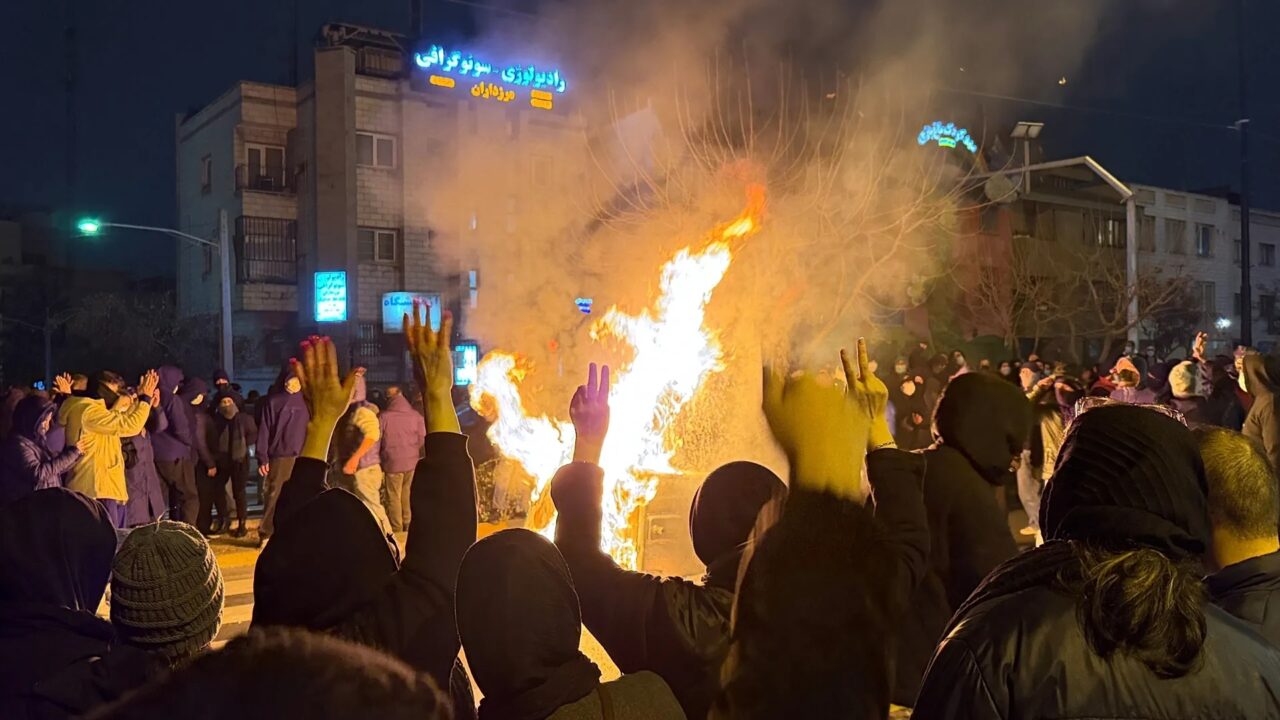
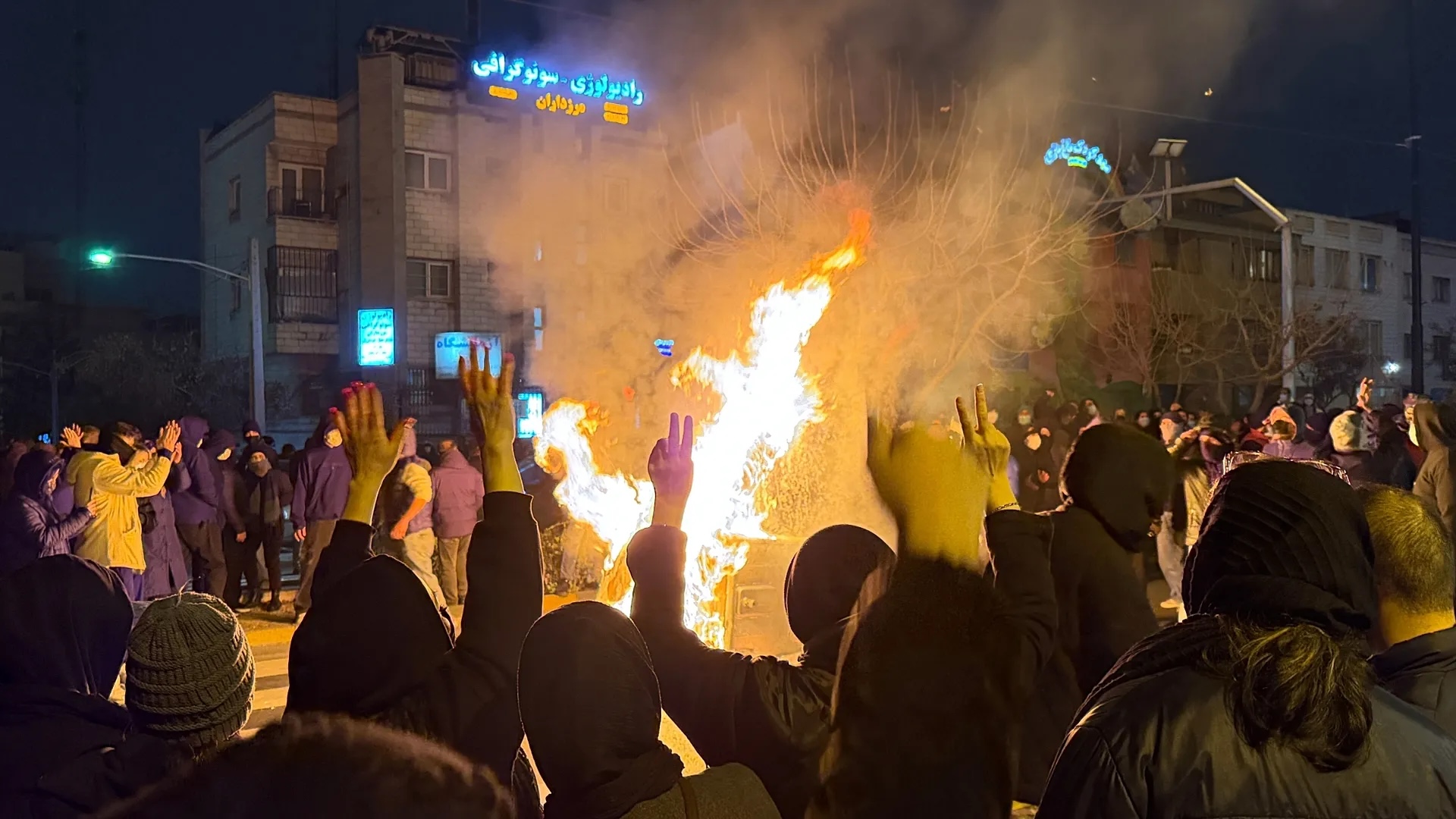
The wave of protests in Iran began with bazaar merchants mobilising against the collapsing currency, rampant inflation and the deepening cost-of-living crisis. They were quickly joined by wider layers of the population confronting the unbearable economic realities. As in every dictatorship, economic protest rapidly became political. The slogans shifted decisively: “Death to the dictator”, calls for the clerics to leave the country, and open rejection of the regime as a whole.
On 8 January, the Islamic Republic responded by imposing a nationwide shutdown of internet and phone access. This did not, as the regime may have hoped, prevent images and short clips from reaching the outside world. What it did achieve was far more insidious: it choked the flow of information from inside the country and distorted the picture internationally. By 11 January, even phone lines were cut. The internet blackout created a vacuum in which misinformation flourished. It is unclear how many thousands have been killed in the crackdown, but it is clear the regime in Tehran has responded viciously where it felt it had to.
Amid the blackout, the western media discovered the late Shah’s son and started promoting him as a possible alternative. But this simplistic narrative was even too much for US President Donald Trump.
In a move reminiscent of Trump dumping the western promoted Venezuelan oligarch Maria Machado as a credible opposition leader, the US President said of Reza Pahlavi that “he seems nice, but I don’t know how he’d play within his own country.”
Now, with a strike group led by the USS Abraham Lincoln aircraft carrier heading towards the Persian Gulf, Trump is negotiating with the Ayatollah’s regime. Whether those talks will involve military bombardment is an open question as we go to press.
A significant problem for the regime in Tehran is that, unlike during the Women, Life, Freedom movement that followed the death of Mahsa Amini at the hands of morality police in 2022, when major concessions were made regarding the compulsory hijab – it cannot do much to improve the economy. The economy cannot be reformed and attempts by the government led by Masoud Pezeshkian to reform the exchange rates for the dollar – one for the state and the Revolutionary Guards, another for the market and ordinary Iranians – did not work.
By 12 January, the religious state had managed to impose a degree of control. There were well-organised, state-sponsored, pro-government demonstrations in major cities to downplay the continuing nationwide protest movement. Tens of thousands attended these demonstrations. However, this tactic is one of the few weapons left for the regime.
Survival of the regime
The very survival of the Islamic Republic has been posed many times but the regime’s ability to suppress dissent, reinvent itself and compromise when necessary has seen it survive previous crises. But the present situation is different. Several factors – profound economic distress, a plummeting currency, severely eroded political legitimacy, external threats and what looks like institutional fatigue – are putting unprecedented strain on the system, making its long-term future more precarious than before.
We support the brave people of Iran, protesting against a theocratic regime, which while in conflict with the United States and Israel, is in no sense “anti-imperialist”. We are also implacably opposed to any attempt by the US to foist either itself or the son of the late, unlamented and blood-soaked ‘Shah’ of Iran into power.
Many on the Marxist left agree with this position. There are some outliers however, who seek to paint the Iranian regime in anti-imperialist colours and spend more time detecting US and Israeli plots than supporting the rebellion.
In Australia, the small Red Ant Collective is a case in point (see Red Ant, ‘Statement against US imperialism in Iran’, 11 January 2026). They generously concede that there are “genuine economic grievances” which are “triggered by legitimate economic dissatisfaction of people”. But this soon disappears into a flurry of concern for the regime’s struggle against imperialism – in which murderous repression become “fighting back” in an attempt to “restore order”. The order, that is, of the pro-capitalist mullahs, the military and the bureaucracy.
This is very much a minority view. Even the semi-Maoist Vanguard (CPA Marxist-Leninist) supports the right of Iranians to rebel and calls for an “anti-theocratic democratic front”. Since this would contain both ‘genuine anti-imperialist and proletarian elements’ and ‘petty bourgeois and bourgeois elements’, Vanguard is honest enough to admit that there would be struggle within.
Red Flag (Socialist Alternative), reprinting a statement from the Iranian Revolutionary Marxist Tendency, correctly points out that the Tehran regime is not “an alternative to imperial domination, but a local manager of capital accumulation and repression” (‘Iran’s uprising under fire,’ 13 January 2026). A dual struggle is going on against the Islamic state and reactionary forces that seek to replace it. Green Left meanwhile gives us a useful historical account of resistance to the Islamic regime.
There is no need for us to repeat the history here. All these groups (as well as Solidarity and ourselves) dismiss the idea that the rebellion is simply a plot by the US and Israel to remove a regime which they find uncomfortable. Undoubtedly, there are US and Israeli agents on the ground in Iran. Perhaps they are effective, perhaps not. But to be clear: we are for a successful popular overthrow of the regime. What is critical is who leads this movement and what replaces it.
Anti-imperialism of fools
The problem with the Red Ant approach is obvious: it leads to an ‘anti-imperialist’ position that takes actual anti-imperialism away from the people and delivers it into the hands of anything that can be characterised as ‘anti-American’ – the Iranian state or the BRICs lash-up or North Korea on a good day for example. In this view, the latter can take precedence over the former and can even be supported in suppressing it. Painting the enemy of my enemy as automatically my friend is the ‘anti-imperialism’ of fools.
But there are problems with what we might term the revolutionary cheer-squad attitude on display from most of the Trotskyist left. All of the recent attempts at revolt in Iran have been, somewhat breathlessly, characterised as heralding ‘the revolution’. Unfortunately, reality has shown that they have not been harbingers of ‘the revolution’.
Iranian Marxist, Yassamine Mather, living in exile in Britain, gives a somewhat more sober persective, identified even before the current crisis.
“What is an escalating crisis in the Middle East should not be understood as a struggle between an anti-imperialist Iran against western imperialism and its Israeli ally. Rather there is a conflict between rival capitalist powers, with no socialist pole in sight.”
Yassamine Mather, Iranian Marxist
“What is an escalating crisis in the Middle East should not be understood as a struggle between an anti-imperialist Iran against western imperialism and its Israeli ally. Rather there is a conflict between rival capitalist powers, with no socialist pole in sight.” (Weekly Worker 17 July 2025.)
There are of course lessons to be drawn from the most recent rebellion before it fades from the pages of the left press until the next time. The spontaneous movement – for, to our knowledge, the level of organisation on the ground is desperately thin – is caught in flight, praised and supported, urged on to greater things – but not subject to supportive criticism. The worship of spontaneity drowns out the need to build a party around a Marxist program.
Writing of the recent movement, Mather writes that there were some examples of working class self-organisation, but still desperately below what is needed. She writes: “Oil workers, bus drivers, sugarcane workers and other organised labour groups have issued statements and leaflets that are clear, principled and consistent. They reject the shah’s son, oppose foreign intervention and stand against the Islamic Republic.” (Weekly Worker 22 January 2026)
So, what next? At this stage, it appears that the demonstrations have subsided – which is not surprising given the shocking death toll in the thousands with which they were put down. This would make these protests the latest in a long line which rose and were felled. Each instance had more or less the same pattern: demonstrations, repression, wider demonstrations, more murderous repression – until finally the overwhelming strength of the state wins through.
Does this mean that the people can never win? Far from it. But for that to happen, some lessons have to be drawn and carried into the next battle. Out of the insurgent movement, a political program has to be produced which indicates what the movement will accept and what it ultimately aims for. And a vital element in producing that program and carrying it forward is a communist party. Neither program nor party will emerge spontaneously on the streets in moments of social protest – no matter how militant, prolonged or egalitarian they are. They have to be built before things reach that point.
Mather identifies the tendrils of working class self-organisation as the beginning of hope, nonetheless. “These voices point toward the only viable path forward: independent working class struggle rooted inside Iranian society itself. Everything else – media speculation, regime-change fantasies and external ‘saviours’ – lead only to defeat. That is the reality we must confront.”