
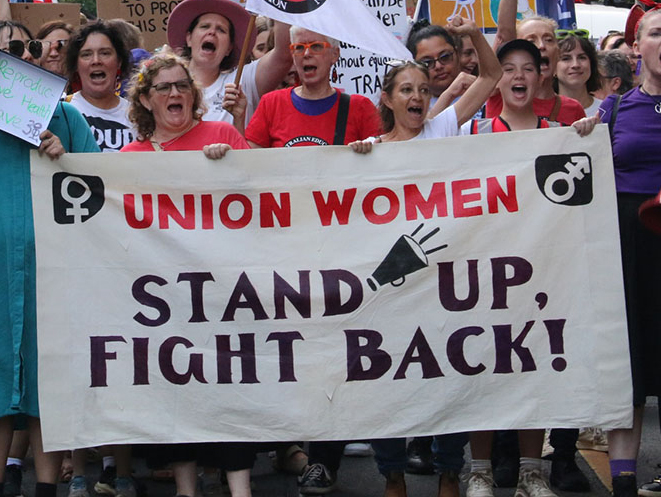
The militant working class origins of IWD can be forgotten amid the corporate breakfasts, purple-themed product launches, and “lean in” seminars. But Lea Campbell argues women’s liberation is impossible without socialism – and socialism impossible without women’s liberation.

This year as we celebrate International Women’s Day on 8 March, as we have since 1911, it is important to recognise the celebration of IWD is uneven. Some countries make it an official public holiday, in many others, it remains a day of both celebration and struggle. In some nations, women march against state, domestic, or sexual violence; in others, they receive flowers or cupcakes from management even while they fight for the right to unionise or go on strike.
In Australia, what often feels token with a commercial and corporate veneer was once connected to a revolutionary spirit that gave this day meaning. Today, we do not merely acknowledge women’s achievements but should consider what it takes to renew our commitment and capacity to organise, agitate and demand the fundamental restructuring of a society that continues to devalue the labour and lives of women and moves us closer and closer to war.
Thankfully, the origins of International Women’s Day lie firmly within the working-class and anti-war movement. It was Clara Zetkin, a German Marxist and fierce advocate for women’s rights, who proposed the idea of an international day to honour working women at the 1910 International Conference of Working Women in Copenhagen. Zetkin understood that the “woman question” was inseparable from class struggle. She argued, against the bourgeois feminists of her time, that true emancipation could only come through socialism and a classless society. Her close friend and comrade, the brilliant and staunch revolutionary Rosa Luxemburg, shared this vision. Luxemburg, who gave her life fighting for a world without war and exploitation, understood that the fight for women’s rights was a fight against the capitalist system itself. If IWD is to be resuscitated in that vein, we must follow in her footsteps as the revolutionary origins of her days are being gradually but actively erased.
As well as arguing that we cannot overcome women’s oppression without socialism, Zetkin and her comrade August Bebel, a leading light of the Second, Socialist International, made it clear that we also cannot have genuine socialism without overcoming women’s oppression; no matter how many women become CEOs or founders, receive microcredits, parenting payments or maternity leave provisions etc.
Even in a ‘socialist’ society like East Germany echoes of socialist policies remain decades after capitalism returned with a vengeance. A study taken in the reunited Germany paints some stark differences in attitudes to women and work between the former West and East Germanies:
Our research shows that migration from East into West German workplaces has brought cultural change to West German doorsteps and affected West German mothers who have never left their own area. We found that West German mothers who worked in West German firms with a large inflow of East Germans after reunification returned to work earlier than West German mothers who worked in firms without East Germans. In addition, large inflows of East German workers post 1990 appear to have made West German workplaces more family-friendly.
Anna Raute, Barbara Boelmann, Uta Schönberg
Taken together, East German culture regarding the role of women has had a lasting legacy, despite the fact that East Germany adopted West German institutions. East German women who were born into the more gender-egalitarian culture still behave accordingly decades after the fall of the wall.
Women in Work: how East Germany’s socialist past influenced West German mothers
It is also not just the sociology of labour market participation and time-use studies that help explain this gendered understanding of class and labour. Australia’s Annabel Crabb’s book The Wife Drought argued that women also need a “wife”. In other words, would benefit from a partner to support them, not just their husbands, as they continue to disproportionately face the burden of domestic labour, acting as a barrier to full participate in the workforce. Research on the US labour market by Leah Ruppaner from the University of Melbourne found that the mental load, also known as cognitive domestic labour, is consistently higher in mothers than fathers, a situation comparable with Australia.
Falling behind
In Australia we are not progressing; we are stuck or even going backwards in some areas. In the federal government’s Aboriginal and Torres Strait Islander “Closing the Gap” targets, only four out of 19 targets are on track and four are going backwards. This falls disproportionately on First Nations women.
We are facing ever earlier wage and superannuation gaps, property gaps and affordability gaps and the shocking homelessness of older women. The wealth and home ownership gaps translate for many to the “missing middle”, too rich for housing assistance, too poor for a home, and too old for a bank loan.
The recent “New Perspectives on Old Problems: Gendered Jobs, Work and Pay” study by Jobs and Skills Australia reveals that men out-earn women in 98 percent of the 688 occupations analysed. The accumulated 10-year gender pay gap is a staggering 30.7 percent, for First Nations women it is even worse – a 38.1 percent gap over a decade. Almost 70 percent of occupations have remained just as gender segregated as they were 15 years ago. It seems that the statistics justify every hour of every strike.
Industrial actions in feminised professions such as the 1986 nurses’ strike in Victoria led by Irene Bolger and personal protests such as Zelda D’Aprano chaining herself to the Commonwealth building in Melbourne in 1969 over equal pay, helped women make significant gains and narrowed the pay gap. Recently the Australian Education Union went on strike after kindergarten teachers had not had a pay rise in years, increasing the pressure on the Victorian government. So far, strikes have made a difference but are not enough as relationships are becoming ever more complex and the key question remains: How do we organise?
Unions have been very strong, culturally as well as industrially, in Australian struggles for equal pay but are still member-based organisations whose organising principles can vary vastly, from self-organising to organising the union leadership, sometimes even having to remove the union leadership in the first place. So, unions are only part of the answer albeit a very important one.
What was once a day of mass protest, a celebration of what had been achieved through militant working-class activity, is now often a day of corporate breakfasts, purple-themed product launches, and “lean in” seminars.
But it is not just the commercialisation of International Women’s Day that is concerning, it is the disconnect from a real critique of capitalism that is vital to overcome a simply reformist approach to achieving women’s equality and liberation. This is despite some significant achievements by women in all aspects of life, science, the arts, movies and other industries and in communities.
The common thread is that the fight at the heart of IWD is far from over. Whether it is the battle over who benefits from artificial intelligence or combatting the US drive to war and brute power in international relations, there is a double whammy still confronting women: combatting capitalism and protecting life while bearing the overall burden for giving life as women.
Kenysian militarism and artificial intelligence
Apart from its unimaginable death toll and the explicit targeting of civilians, Gaza is also where tech giants are governing everyday life in the most vicious ways. Nowhere is the dystopian future we face more visible than in Gaza, where we are witnessing unprecedented AI-accelerated “Keynesian militarism”. This is the era of “Where is Daddy?” , an automated system that tracks Palestinian fathers into their houses and killing them there. No longer will capitalism destroy our social fabric slowly through depression, unemployment, family displacement or incarceration. Slow is yesterday. Now, the frog is dead in seconds. No more gradual heating is required in the age of algorithmic dehumanisation.
While the ACTU has made a start to push back on this dehumanising aspect of AI by “putting corporate Australia on notice” when it comes to the use of algorithms in the workplace it is up to socialists to link this with a firm stance against its military pervasiveness.
The ACTU’s uncoupling can be easily understood by the profound insight into our collective mental state observed by Fredric Jameson: “It is now easier to imagine the end of the world than to imagine the end of capitalism.”
So, we must wake up and dare to dream again. We must realise not only that fascism was not defeated in World War II once and for all, but that liberalism and “austere fascism” have a deep affinity, as Clara E. Mattei pointed out in her 2022 book The Capital Order.
Clara Zetkin and Clara E. Mattei help us to think more clearly and remind us that it is only socialism that provides an answer to today’s problems as we aspire to imagine a different world. Maybe many do not remember that the ALP constitution calls the party a “party of democratic socialism”. The struggle for women’s liberation is the struggle for socialism, for all, including ALP members.
Happy International Women’s Day. Now, let’s get back to the revolutionary spirit of March 8 and not forget Clara Zetkin’s words: “The proletarian woman fights hand in hand with the man of her class against capitalist society.”
[2] https://onlinelibrary.wiley.com/doi/full/10.1111/jomf.13057
[4] https://www.972mag.com/lavender-ai-israeli-army-gaza/
[5] https://berlinergazette.de/algorithmic-dehumanization-lessons-from-the-use-of-ai-in-the-gaza-war/
[6] https://www.actu.org.au/media-release/ai-unions-put-corporate-australia-on-notice/
[7] https://www.marxists.org/archive/zetkin/1896/10/women.htm