
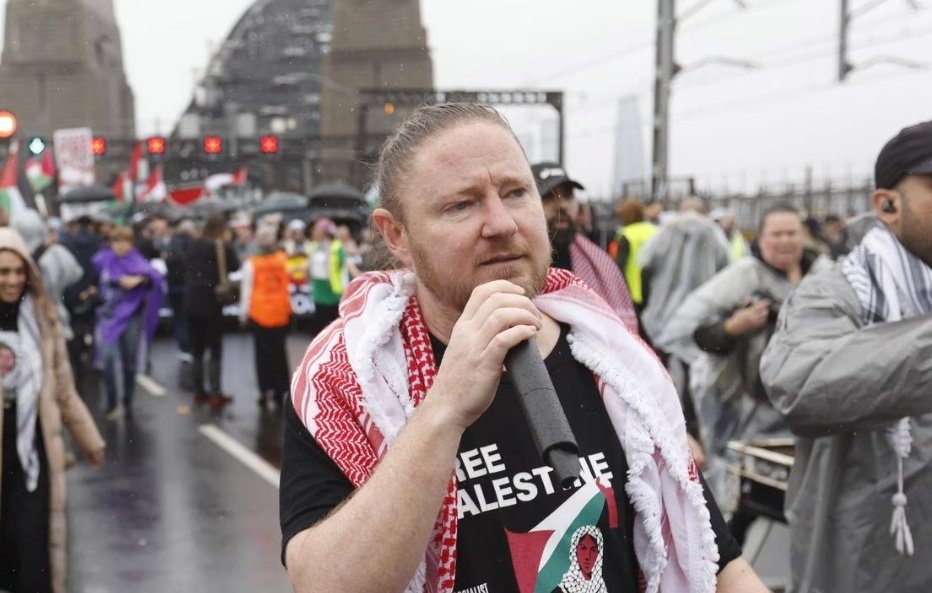
While the solidarity movement has been inspiring, the self-apppointed leadership must open up to democracy to ensure the movement can become a mass force. Martin Greenfield reports.
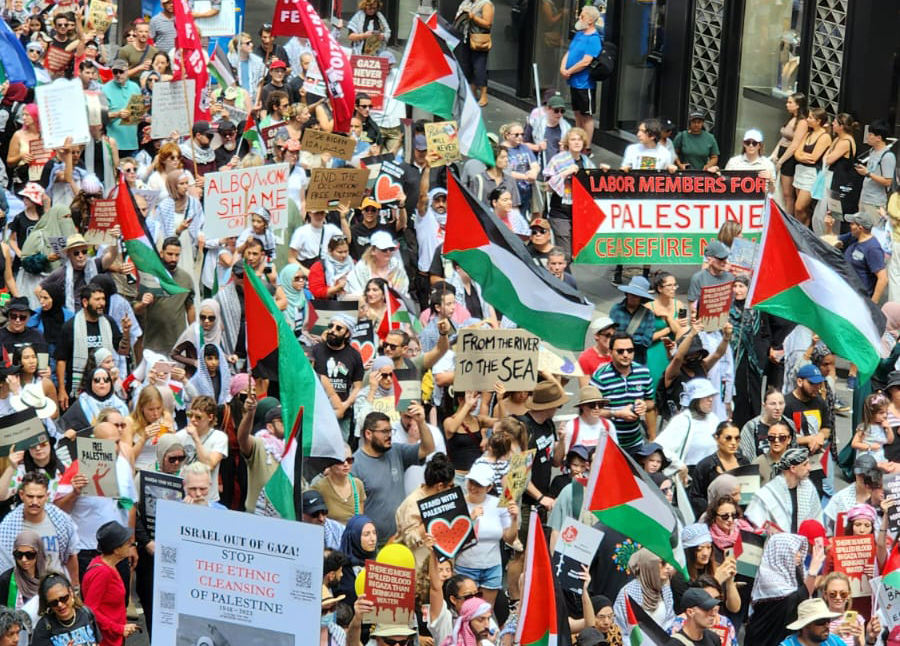
Palestine Action Group, the organisation that calls the regular Palestine solidarity demonstrations in Sydney, has not formally met this year and possibly for weeks or months before that. After talking to many activists in Sydney, it is unclear how the organisation operates other than by edict from a small number in the inner circle.
Without a clear democratic method of organisation, the group effectively operates as the political property of Socialist Alternative and its allies. This profoundly weakens the ability of the movement to become a genuine mass force to contest the increasingly difficult political terrain where Zionists are seeking to marginalise the campaign against Israel’s genocidal war on Palestine.
No one is doubting the sincerity of leading PAG activists, many of whom were campaigning for Palestine before October 2023. But the leadership of the movement has missed key pivot points where establishing the campaign on a democratic and national basis could have ensured its development into a much bigger political force.
Crucially, after the tremendous success of the March for Humanity over the Sydney Harbour Bridge in August last year, a transition was required to bring in forces like the trade union movement and other mass civil organisations committed to sanctioning Israel and cutting of Australian military and diplomatic support for the Israeli regime.
Some activists have put it to Labor Tribune that it is not in the interests of groups like Socialist Alternative to establish such a mass democratic movement as they would likely lose control of it.
Labor Tribune has spoken to multiple solidarity activists in the wake of the Sydney Town Hall demonstration against Israeli President Isaac Herzog that saw police violently attack protestors, arresting 27 and charging nine with offences.
Questions put to PAG spokesperson Josh Lees asking for details when PAG has met over the past few months gave no clear answer.
When put to Lees that PAG had not met all year, he responded by text “No, that is not true. We also held a number of broad meetings in the lead up to the Herzog rally.”
It is true that at least two broader meetings took place to organise the Herzog rally in Sydney, but the fact a broader meeting was required was tacit acceptance that PAG could not have organised this protest on its own merits.
The discussions with activists, held off the record so people could speak freely, reveal that PAG has not met beyond some limited private Facebook chats. The mechanism by which people can join and have democratic voice in PAG is unclear. Last week, a PAG activist involved with another Palestine group – Stop the War on Palestine, which was established by the Solidarity group – was unceremoniously removed from the Facebook group without warning or reason.
Another activist, who said they had previously attended PAG meetings had not been advised of one for months.
In the months after the October 2023 Hamas-led attack on Israel and Israel’s invasion of Gaza, PAG was meeting every two weeks, but people only got a vote after attending three meetings. Often the location, time and day of meetings were announced on the day they occurred, limiting participation.
Decision-making then shifted to impromptu consultation meetings after the weekly rallies. But even these fizzled out in the middle of last year.
Mass movements need democracy
It should go without saying that any mass movement requires democracy as its lifeblood – this is not only to ensure accountability and transparency in decision making, but democracy also gives multiple organisations a stake in the healthy and successful operation of a movement, ensuring it can grow and become a genuine mass political force.
It is also a window into what sort of society socialists are fighting for. If the failures of the 20th century have taught us anything it is that genuine socialism without democracy is impossible – and if we continue to act without democracy, why would people believe we want a democratic socialist society?
Democracy and transparency also mean that when decisions need to be taken quickly – such as during a demonstration – an elected and accountable leadership has the trust of the movement and can make quick collective decisions.
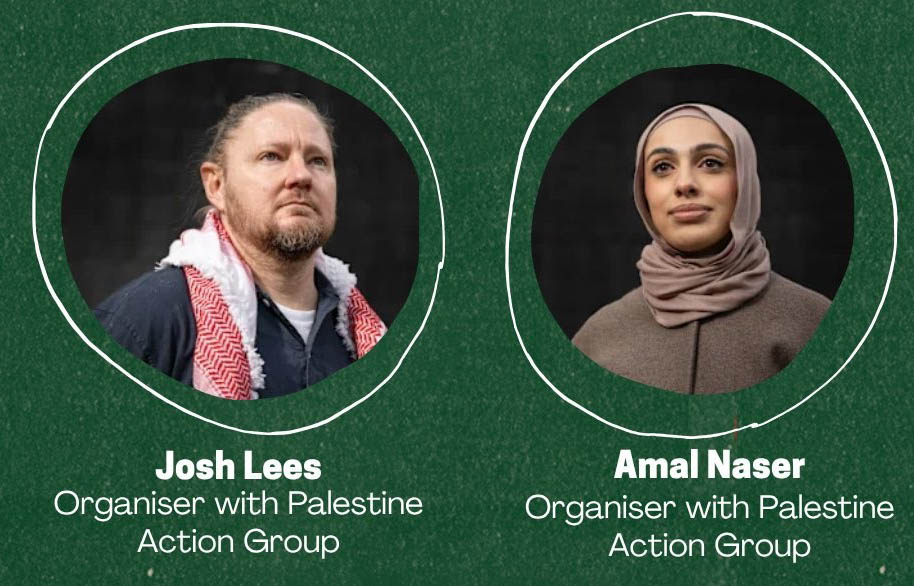
While the two most prominent spokespeople for PAG – Josh Lees and Amal Naser – have been brave, impressive and tireless campaigners, ensuring the continuity of the movement, week-in, week-out, activism is not enough to sustain and grow a mass movement.
The Harbour Bridge event was a huge success and PAG deserves credit for this. But as Labor Tribune has pointed out before, the mass character of this outpouring of solidarity forced PAG to accept much broader civil society voices – such as rebel ALP MPs – be given prominent roles, something they had refused to allow at the regular Hyde Park rallies.
Herzog rally
The ad-hoc organising committee for the demonstration included PAG representatives (who were members of the Socialist Alternative group), plus representatives from Amnesty International, Labor Friends of Palestine, the Greens/Rising Tide, Pride in Protest, Socialist Alliance, Jews Against the Occupation and Solidarity members of spin-off campaign group, Stop the War on Palestine.
If PAG was truly a democratic and representative organisation of the whole solidarity movement, such an ad hoc committee would not have been necessary. PAG would have had the democratic authority to organise it on its own merits.
Initially, the speakers list proposed by Josh Lees for the Herzog rally did not include any MPs from any party. Labor Tribune understands that a voice from the floor – not from Labor Friends of Palestine – recommended that a pro-Palestine Labor MP speak.
This was discussed and voted on, with 8 in favour, 4 against. As a result, a Greens MP was also invited to speak alongside a Labor MP.
However, on the day of the demonstration, the Labor MP Sarah Kaine was left waiting right to the end with no clarity on the speaking order. We have been told that the chair of the rally would not even introduce her, that task left to Josh Lees.
Take your bat and ball
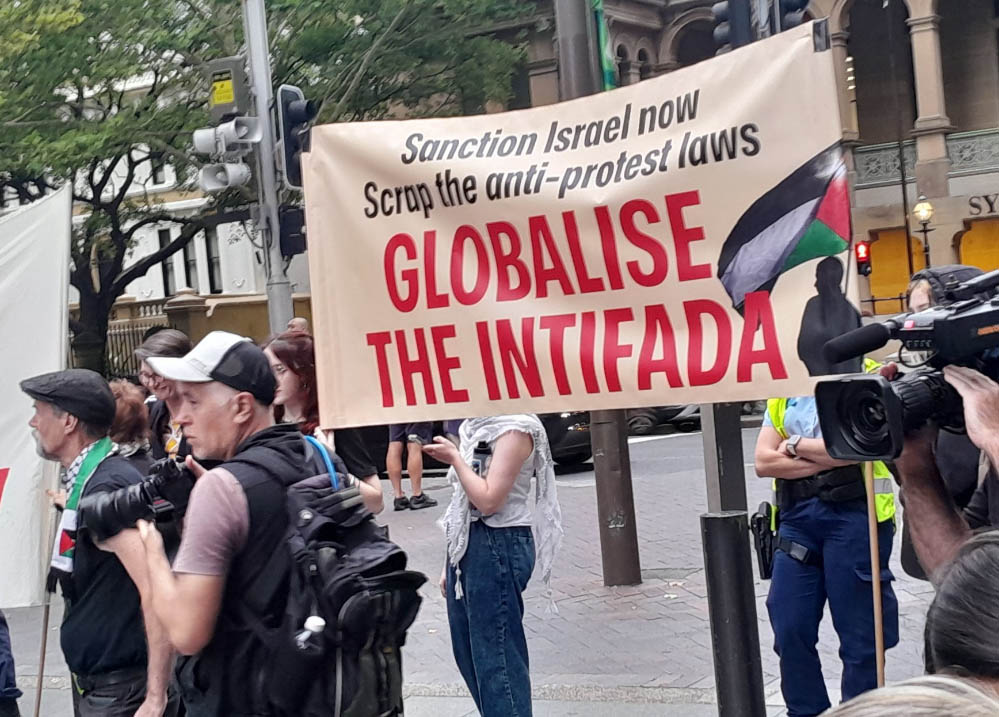
PAG is not the only problem. The front group of Solidarity – Stop the War on Palestine – has also been acting in an increasingly unhelpful manner. People who had attended the first organising meetings of SWOP (only established late last year) reported a fairly inclusive approach. Meetings in January discussed what the central slogans should be. Solidarity argued they should be ‘Globalise the Intifada’, ‘Sanction Israel’ and ‘Scrap the anti-protest laws’.
On this they lost the vote and it was agreed that the two slogans should be ‘Sanction Israel’ and ‘Scrap the anti-protest laws’. However, in the wake of the Herzog demonstration, it appears Solidarity was not satisfied with the result, at a following event at Martin Place, they turned up with a banner that highlighted ‘Globalise the Intifada’ that the organising committee had not endorsed.
While it is Solidarity’s right to take whatever banners they like to an event, not wanting to build around agreed decisions in this way when they don’t go your way is not serious.
Each of these small groups imagine they are performing ‘united front’ work. But it is just sectarian fronts. The tactics of the united front – a recognition of the early communist parties that they did not represent the majority of the working class – were exactly that; about the unity of the class. Small groups that have some broad input are not ‘united fronts’ of the working class, but largely act as recruitment funnels to this or that small grouplet.
What about the unions?
Comparisons are being made with the anti-apartheid and anti-nuclear movements of the 1980s and the Iraq war mobilisations in 2003. Those movements included active and visible backing from the unions, churches and other civil society organisations. I’m not suggesting the organisation of these events was some pristine model, but we must look at our history to understand how to organise for the future.
The 1980s also still had the echoes of mass socialist organisations, both within the ALP and in the Communist Party. Since their demise, no doubt, the hollowing out of unions through their increasing corporatisation has had an effect on their ability to organise politically.
Palestinian activists in multiple unions have had difficulty dragging their leaderships to endorse solidarity motions, let alone actions.
Even so, organising in such an undemocratic manner in the Palestine movement gives unions an excuse not to engage. Why would they commit time, resources and cadre when they have no democratic way to engage?
Part of the reason for this is that if unions and other mass organisations had a genuine stake and involvement in the Palestine solidarity movement, the petty politics of small groups like Socialist Alternative and Solidarity would likely evaporate.
For the Palestine movement to re-establish itself as a democratic and mass working-class voice committed to solidarity with the Palestinian people it must seriously change the way it operates.
It should be possible to work towards a national conference with affiliated groups sending delegates from unions and their branches, ALP branches, socialist organisations, Palestinian and Arab community organisations, churches, mosques and synagogues who will support the secular nature of the movement – and other civil society groups – should be a priority.
To succeed, transparency, democracy and accountability are not optional extras.
External pressures
However, the moment is difficult. Alongside a lack of democracy and transparency, external events are also putting pressure on the movement.
Internationally, these include:
- The ‘ceasefire’, under which Israel continues to murder Palestinians and advance settlements in the West Bank.
- A supposed Trump peace plan endorsed by UN.
- Involvement of some Arab nations and Indonesia on Trump’s ‘Board of Peace’.
Domestically, attempts to weaponise the antisemitic Bondi massacre against the solidarity movement and the ongoing move to the right around immigration, with Pauline Hanson declaring there are ‘no good Muslims’ are all having their impact.
Plus there is the exhaustion caused by a strategy of marching every week with only partial wins (including forcing the ALP government to recognise a Palestinian state).
All have taken their toll. But the achievements of the movement – and leaders like Josh and Amal – to keep the question of Palestine visible in Australian politics must be celebrated. And despite these criticisms, PAG and other activists have helped achieve this.
The problem, however, is we have a much bigger base than that we have generally mobilised. The Harbour Bridge protest showed the real size of our movement. It has also been notable that apart from a few protests, the bulk of Sydney’s large Arab community has kept away. More than 200,000 people in Sydney speak Arabic at home; even more have Arab family heritage.
While no doubt many fear backlash for attending rallies, it must be said that the movement has not fully engaged and mobilised this vital population, either.
One Palestine activist told Labor Tribune: “A real problem is you can’t ‘join’ PAG. After all these years, you have a big constituency turning up to events week after week, but there is no mechanism for people to get involved in any way.”
Despite the undemocratic leadership, the mass movement that has mobilised has been an inspiration. However, as the political pressure mounts on ordinary people just wanting to express their revulsion at ongoing ethnic cleansing against Palestinian people, the self-appointed leaders of the movement must commit to building something lasting – and that will take above all a commitment to rebuild along democratic lines.