
As South Australia goes to the polls, Professor Al Rainnie from Adelaide University looks at claims that AUKUS is a big job bonanza and finds them hype, not hope.
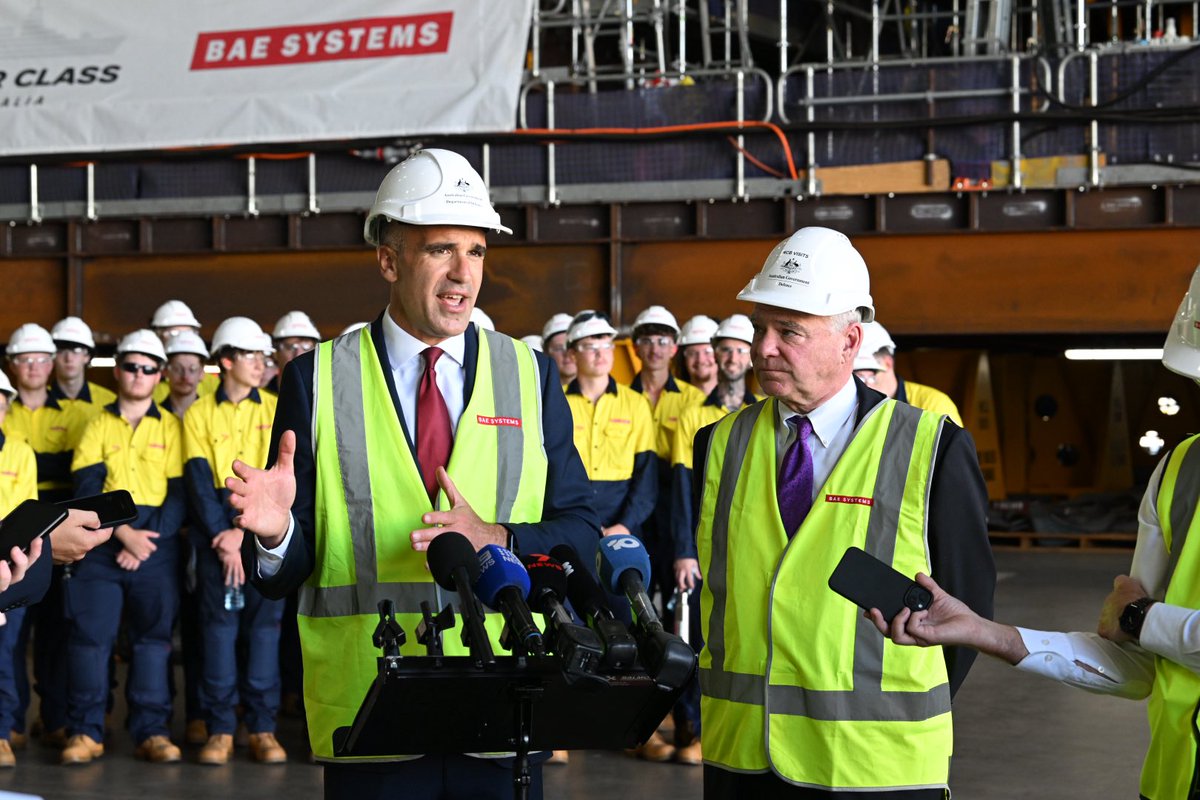
Last year I argued in Labor Tribune that claims regarding the potential AUKUS jobs bonanza were fantastically overblown, and furthermore distracted attention from where we really need skilled workers (hint – confronting climate change). That assessment has not changed, notwithstanding ongoing claims by the Malinauskus Labor government in Adelaide.
Writing in The Saturday Paper last month Jo Tarnawsky argued that AUKUS is one of the most consequential defence commitments that Australia has ever entered, binding future governments to a world that is already fading. Tarnawsky is a former chief of staff to Defence Minister Richard Marles.
She said: “The question is no longer whether American power and behaviour is changing but how long Australia can afford to behave as though it isn’t.”
Albert Palazzo, also writing last month in The Saturday Paper argued that the most important point of AUKUS was not the submarine deal, which is actually a distraction (albeit a frighteningly expensive one), the main game is the base that Australia intends to give the US at HMAS Stirling in Western Australia.
This is even more frightening given developments in Iran.
South Australian election
In the weeks ahead of the South Australian state election on 21 March, the AUKUS PR machine in both the local and national press has gone into overdrive.
Perhaps unsurprisingly then, Terry Plane reported that locals on the Lefevre Peninsula in Port Adelaide Enfield are largely optimistic about the nuclear endeavour, talking about ‘jobs for our kids’. Taperoo, the area right beside the massive white sheds (elephants?) that might house the subs is one of the most disadvantaged areas in South Australia. Furthermore, the barrage of claims regarding potential work for the community has reached tsunami proportions.
In Port Adelaide Enfield, the Greens and Socialist Alliance oppose AUKUS, while the Labor Party is an uncritical and enthusiastic cheerleader. The election result here will be a worthwhile barometer of how successful the pro-AUKUS machine has been.
In my earlier article, I questioned the job creating record of BAE Systems nuclear submarine construction site in Barrow in northwest England. This is the sister site of the Port Adelaide submarine facility.
The UK Royal United Services Institute however echoed my suspicions, arguing in a recent report that:
Framing defence spending as a path to prosperity ignores its poor economic returns, limited job creation and the opportunity costs of not making alternative public investments (‘The false promise of defence as prosperity’, Sylvia & Rogaly 2025)
In February, the Prime Minister announced a $3.9 billion downpayment on the $30 billion that the site will cost. Of the 9,500 jobs promised, 4,000 are expected to be in construction. For AUKUS as a whole, economist John Quiggin has calculated that overall this works out at roughly $18 million per job.
The federal and state governments have also announced an associated Skills and Training Academy for AUKUS, but we must ask, are these the sort of transferable skills needed for sectors of the economy not devoted to war: such as renewable energy and advanced manufacturing?
Skill shortages
The uncritical trumpeting of the skilled jobs coming to Port Adelaide ignores the growing likelihood that the submarines never will. Just as important, the sound and fury totally ignore the chronic skill shortages plaguing the construction industry and the broader renewable sector. Infrastructure Australia reports that the sector is facing a shortfall of 300,000 workers by mid 2027.
Contentiously, the Australian Strategic Policy Institute (Wright & Harris 2026) is arguing that the skill shortages will require a special ‘AUKUS visa’ to speedily import skilled workers from ‘partner countries’.
According to the authors, AUKUS is creating skill shortages that partners must help each other fill. There is however no evidence that ‘partner countries’ are any more capable of coping with chronic skill shortages than Australia is.
South Australian Premier Malinauskas made a dubious contribution to the immigration debate, suggesting that migrant workers would be needed to wipe Australian bottoms in aged-care facilities because the sons and daughters of South Australian folk would be pouring into skilled jobs on nuclear submarines.
More broadly, AUKUS in particular and defence industries in general are engaged in a process of institutional capture of large swathes of the education sector, not just the training infrastructure in South Australia and beyond (see Troath 2026)
Building an alternative
We need concrete practical examples of alternatives to AUKUS, beyond the renewable industries I pointed to in my earlier piece. In the late 20th century, workers in defence and related industries at Lucas Aerospace and Vickers in Britain produced an Alternative Corporate Plan for socially useful alternative production for their workplaces.
More recently, GKN workers in Italy occupied their plant and put forward an alternative plan for a Just Transition to a renewable energy economy.
We need to follow their example.
References
Snell, D., Dean, M., Rainnie, A. (2026) Australia’s regional and industrial future: beyond militarisation and green capitalism. Routledge
Sylvia, N. and Rogaly, K. (2025) ‘The false promise of defence as prosperity’. Royal United Services Institute.
Troath, S (2026) AUKUS and the military-industrial-academic complex. In Beeson M et al eds (2026) Search for Security. AUKUS and the new militarism. Melbourne University Press.
Wright, C. and Harris, P. (2026) ‘An AUKUS visa could ease submarine skills shortage’. Australian Strategic Policy Institute