

Clarrie Lewis from the NSW Socialists and member of the newly formed Indy Caucus, explores whether the electoral organisation offers new hope or a collision course of old sect tensions.

As Labor Tribune readers know, the Victorian Socialists went national in July last year. In early November, the inaugural NSW Socialists conference convened at the University of Technology Sydney. Around 200 members, from a total paper membership in NSW of roughly 1350, debated the party’s constitution and strategic motions. On paper, a step forward. But beneath the procedural veneer, the conference exposed the political differences within the project itself.
Marxists in the ALP should pay attention to the developments of the respective state branches of the Socialists. If the Socialists become a mass organisation (and, hopefully, unites all the sects on the left into an actual party) it could play a similar ideological role on the Labor Left as the Communist Party of Australia once did, provided the Socialists don’t adopt a completely sectarian approach to ALP activists, or adopt a theoretically-bereft reformist program.
Forces in play
Let’s be clear about the forces at play. Of those 200 attendees, about 120 were members of, or linked to, Socialist Alternative (SAlt). This isn’t just a detail; it was the central contradiction of the inaugural conference. SAlt, a (post)-Cliffite organisation dominant in campus politics, constitutes the organised core.
The remainder were a mix of non-aligned socialists and smaller groups like the Revolutionary Communist Organisation (now Communist Unity) and Red Spark along with previous members of the Australian Communist Party and small Trotskyist currents. From the outset, this wasn’t a meeting of equals. It was, at times, tense negotiations between an established Cliffite sect and disparate groupings of socialists seeking a genuine mass party.
‘Whose electoral front is this anyway?
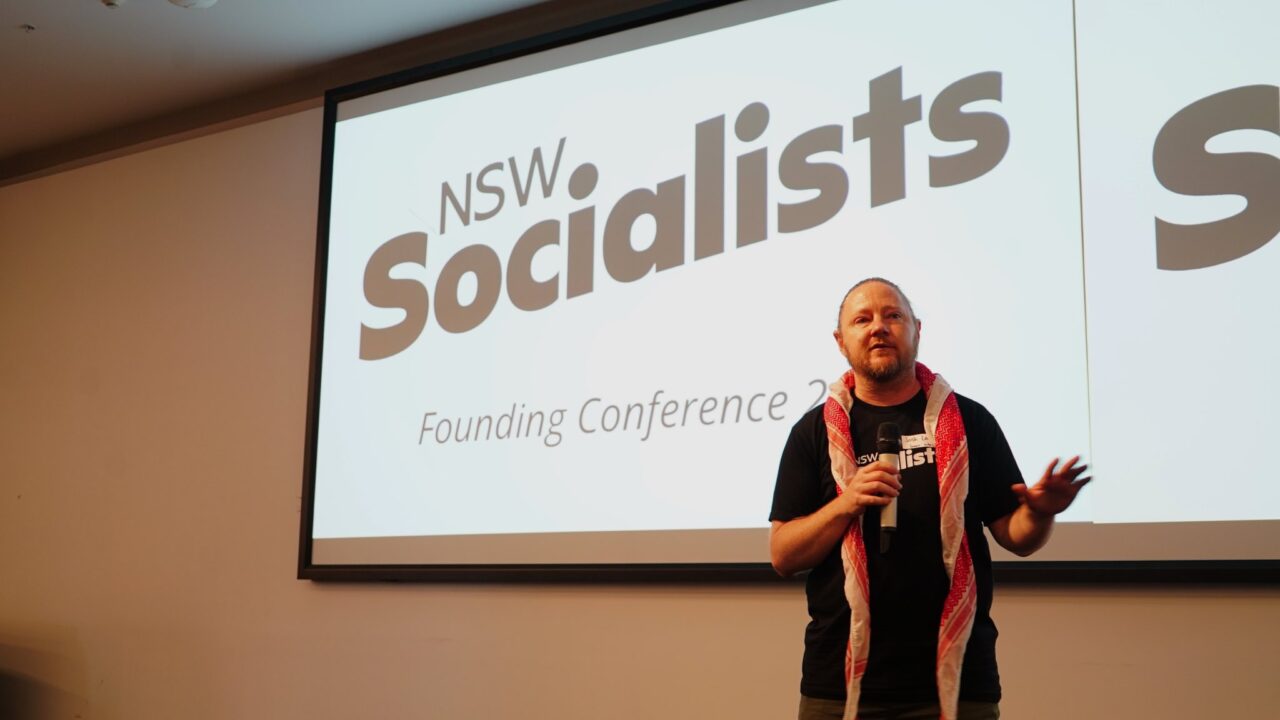
The fault lines emerged over the course of the conference. Non-aligned members spoke in favour for a party rooted in workplace power, rebuilding militant trade unionism and organising in working-class communities. Yet, during the constitution debate, many SAlt members struggled, or refused, to distinguish their own organisation’s interests from those of the NSW Socialists. The party risks becoming little more than a front for campus propagandists, a fate that has crippled the broader left for decades.
The constitution is, on balance, a decent framework to start the building of a mass-based socialist party. It articulates a clear aim of opposing capitalism and imperialism and pushing toward socialism in a broadly defined sense and it maps the strategic avenues: workplace, community, and rural and regional organising.
The rules on membership are explicit; the roles of (directly elected) officers and the executive council are laid out clearly and there are stringent criteria for party members who seek elected office at any level of government. A challenge has been to ensure that all members of SAlt are aware of the constitution itself and recognise that it is the document which lays out the structural nature and democratic norms of the party.
This tension crystallised on the second day over a motion to establish a self-determining First Nations Working Group. Drafted by Aboriginal comrades, the motion sought to create an internal body with real authority, a principled demand for Aboriginal control over Aboriginal affairs within the party.
The SAlt response? Not constructive engagement, not amendment, but a blunt replacement motion. Their text grafted on a mechanical dismissal of “identity politics,” arguing that experience of oppression alone is an inadequate basis for the development of an agreed political line. Not to suggest that lived experience is the only factor that should be considered, but to think lived experience plays no role isn’t just politically clumsy; it’s anti-dialectical. It divorces the lived, material reality of racial oppression from the analysis of class. More tellingly, it was a blunt assertion of organisational power, moved without the consent of the original movers. The episode was a stark lesson: SAlt holds significant leverage, born of its dominance in active membership.
As the Socialist Party develops, it is unclear how SAlt will respond should it ever lose such hegemonic control of the project.
There were a number of motions moved over the course of the conference that defined the political positions of NSW Socialists, including campaigning for the upcoming state elections in 2027 (stalls and doorknocking), opposing Chris Minn’s “War on Workers,” supporting refugee and migrant rights, backing net-zero carbon emissions, opposing the Inner West Council’s “Fairer Future” housing plan, showing solidarity with Palestine and endorsing the People’s Blockade in Newcastle. There was also a motion to create a Workers’ Caucus (to coordinate work in the trade unions) and another to establish an education committee.
All motions moved by non-SAlt members (apart from the Workers’ Caucus resolution) were voted down. These motions were presented by independent members and Communist Unity members.
There were elections for the four officer positions: General Secretary, Treasurer, Communications Officer and Campaigns Director and for nine ordinary members of the executive council. The officer posts were uncontested, effectively decided by the room, while the nine council seats were hotly contested through a preferential ballot.
Having officers directly elected by conference, and not therefore accountable to the executive council, could create further political tensions.
In the end, SAlt won seven of the nine executive seats, five of which are core members and the other two are politically adjacent, with Indy Caucus members securing the remaining two.
Contradictions and confusions
The party’s constitution itself grapples with necessary breadth: defining commitments to socialism, anti-imperialism and workers’ democracy. But the narrow doctrinal lens of some SAlt members threatens to strangle the project in its crib. Defining a socialist organisation on whether one thinks China is “socialist” or the “correct” theoretical line on Stalinism would be to form yet another ideological based sect, in oppostion to building a mass-based organisation.
These historical issues, which are important, should be debated through party organs, but to potentially exclude people from joining on an “anti-campist” basis will lead to a sect, not a mass organisation. The test for a mass party cannot be arcane doctrinal purity. It must be a shared, practical commitment to rebuilding working-class power outside the university quadrangle. This will require the development of a democratically agreed political program that maps out the strategic roadmap to working class power, not an ideological document that represents this or that theoretician’s interpretation of historical questions.
There was talk on the conference margins that SAlt might move a motion against “Stalinism,” with Indy Caucus members only half‑taking note of the anti‑campist motion passed at the Victorian Socialist conference. Such reflexive manoeuvres, dressed up as purity tests, do little to build a mass socialist party.
Here lies a central strategic confusion. The constitution rightly emphasises workplace organising, community struggle and party democracy. It mostly avoids ultra-left abstractions that would sabotage mass appeal. But SAlt’s ingrained model, prioritising building activists’ platforms for members of its own organisation to be busy in, is a holdover from student politics and directly undermines the struggle for a mass socialist party. You cannot build a mass workers’ party through campus recruitment drives and propaganda sales alone.
The Indy Caucus and power-building frameworks
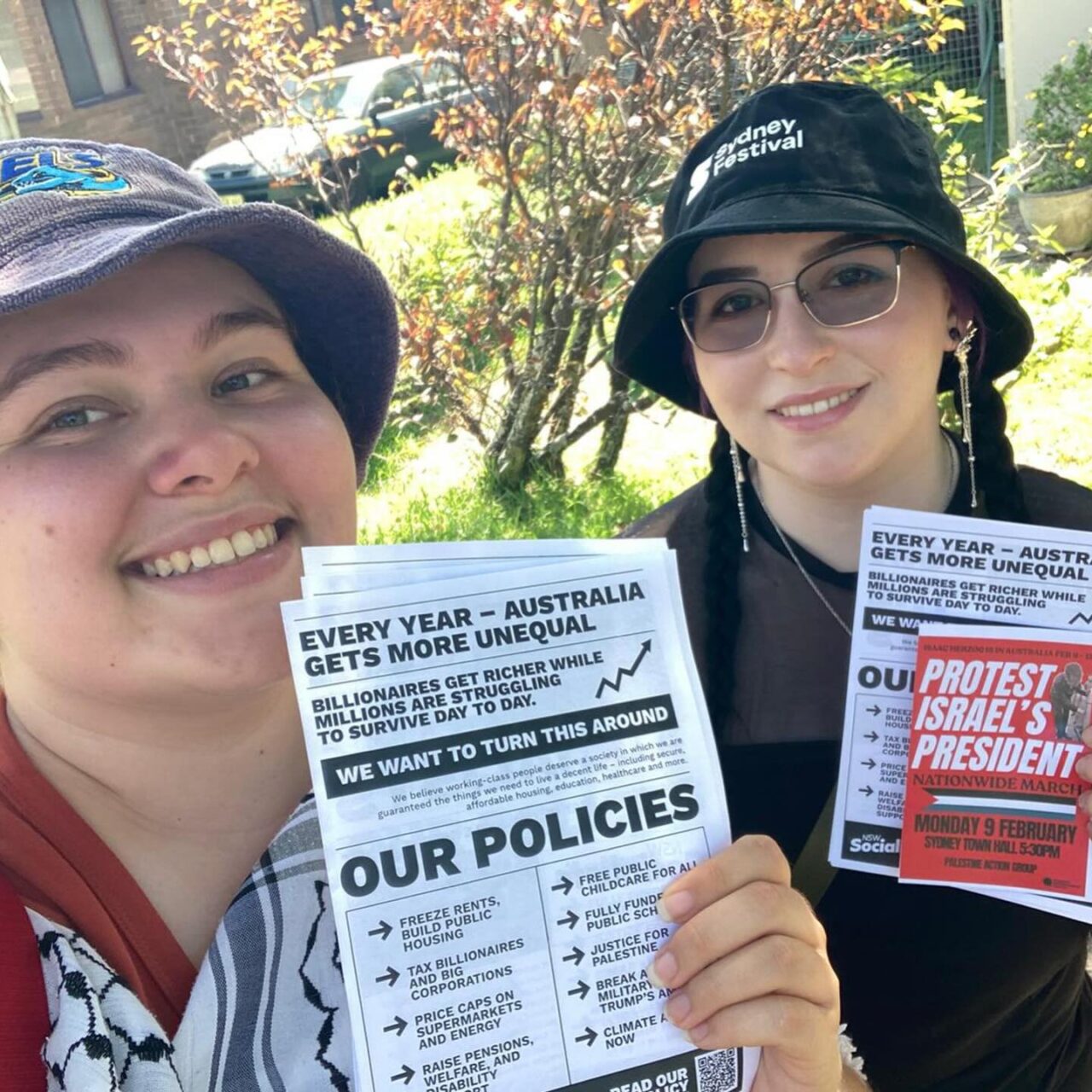
We need a different framework, one of power building. The late, great union organiser Jane McAlevey provided it: deep organising. This means structure tests, identifying organic leaders within existing workplace and community networks, and running strategic campaigns that shift power relations. It’s the painstaking work of rebuilding the capacity of unions and community groups from within. Power is built by expanding the collective ability of workers to act, not through sporadic mobilisations or media stunts. It also requires building a coherent programmatic framework in which to organise for power.
The non-aligned, or “Indy,” caucus within NSW Socialists supports this approach. Our emphasis must be on cultivating durable networks in warehouses, hospitals, schools and housing estates. The danger is that campus-based factionalism and doctrinal spats eclipse this slower, patient and essential work. McAlevey would urge us to prioritise internal capacity: training organisers, sustaining unions and aligning actions with the long arc of workers’ power. Not chasing short-term headlines or factional points.
At present, the Indy Caucus is largely based in NSW, but our reach extends to Indy comrades in South Australia and Victoria. In the Indy caucus we have members who also belong to Red Spark and Communist Unity. While our numbers are modest, our organising parameters are clear: disciplined, continuous capacity building aimed at deepening workplace and community power, with growth anchored in shared program and common struggle rather than tokenistic alliances.
So, where to from here? The contradictions are real. The party’s financial weakness means filling officer roles currently relies on SAlt’s organisational heft. The Indy Caucus position is clear: we must use this apparatus to build a mass party, not a sect. Our aim should be to recapture the militant, working-class culture of the old Communist Party of Australia and the fighting militancy that was once present in the Labor Left, anchored in the constitution this conference adopted.
Two steps forward, one step back?
The conference also confirmed an electoral turn, with an eye on the 2027 NSW state election. Seats in Sydney’s Inner West, Western Sydney and the Central Coast are in sight. However, without a vibrant internal party life: regular, substantive branch meetings where working-class members set the agenda, these decisions will be made by default by SAlt, likely reinforcing existing imbalances. There was consensus at the conference that the registration name of the party in NSW will be NSWSoc.
The call to action is unambiguous. NSW Socialists must be focused on the dual tasks of workplace organisation and community power-building. We must develop a robust, inclusive strategic discipline that can withstand factional pressure.
I urge Labor Tribune readers who are not members of the ALP, especially rank-and-file unionists and community organisers, to engage with the NSW Socialists through the Indy caucus. The task is to turn this project from a campus-leaning movement into a durable, fighting workers’ party. The alternative is another footnote in the history of the Australian left’s failures. The class struggle won’t wait for us to settle our internal debates.