
The union conference to discuss war, militarism, AUKUS, Palestine and the rise of the far right was an important gathering. But Marcus Strom says an important opportunity was missed to plant the flag.
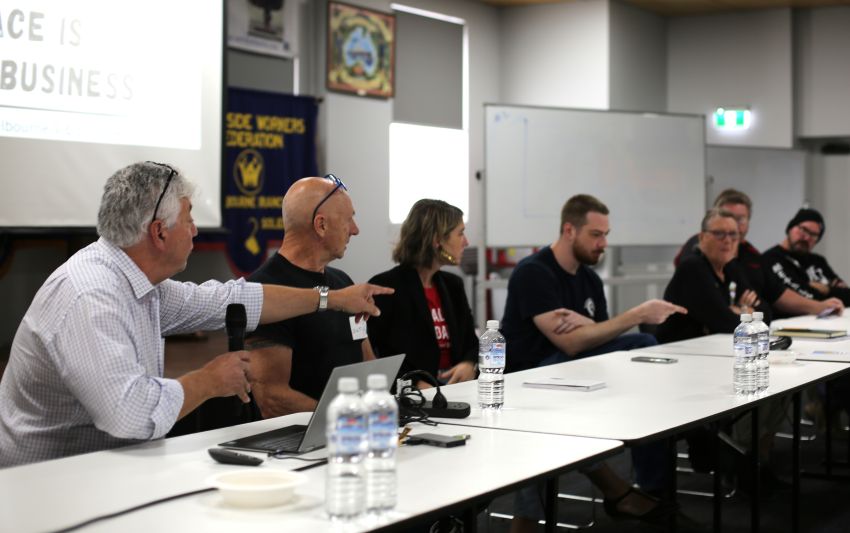
The Peace is Union Business conference, held on 9-10 December 2025 at the Victorian offices of the Maritime Union of Australia (MUA), was an important and, in many ways, overdue intervention by the labour movement. Numerous participants remarked that there had not been a union conference dedicated explicitly to peace and anti-militarism for decades. In an era of AUKUS, escalating great-power rivalry and bipartisan rearmament, that alone made the gathering significant.
However, this delegate thinks while a decent start, an opportunity to build was fumbled.
The conference set itself ambitious goals: organising union coordination against militarism, opposing AUKUS and the Force Posture Agreement, supporting Palestine solidarity, combating the far right, and backing an independent and nuclear-free Pacific alongside the Treaty on the Prohibition of Nuclear Weapons. These are not fringe concerns. They go to the heart of whether Australia continues down an increasingly dangerous militarist path, or whether the labour movement asserts its historic role as a force for peace.
It concerns the type of jobs Australian workers do, what ideas we pass on to the next generation.
Delegates attended from the Australian Education Union, Australian Manufacturing Workers Union, Australian Nurses and Midwives Federation, Electrical Trades Union, MUA, National Tertiary Education Union and Rail, Tram & Bus Union. This was alongside representatives from regional trades and labour councils in Ballarat, Geelong, Ipswich, South Coast NSW, South West Victoria and the North East Border in Victoria. Victorian Trades Hall was present. National officials, however, were sent by only three unions: the NTEU, AEU and MUA.
The involvement of Dave Sweeney from the Australian Conservation Foundation and a founding member of ICAN, excellent presentation from Sarah Schwartz from the Jewish Council of Australia, Chris Sidoti from the UN Commission of Inquiry, and support from Australia Institute was an important contribution from civil society organisations.
A good start but rank-and-file control needed
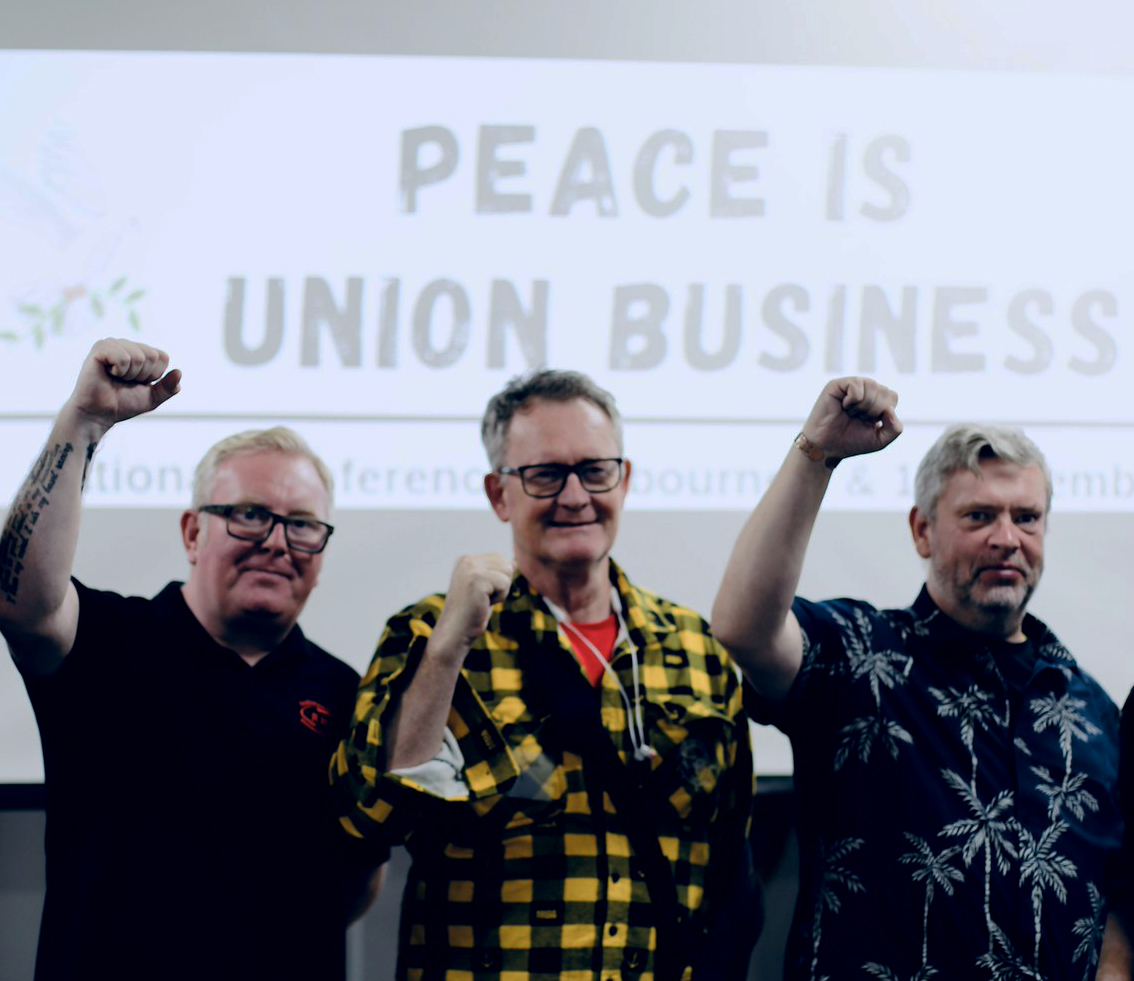
Behind the scenes, there was frank discussion that some unions and peak bodies had quietly boycotted the event, including the CPSU and others aligned with the Albanese faction of the Australian Labor Party. Notably absent were Unions NSW and most other state peak bodies. This uneven support shaped the conference’s character. It was largely an initiative of left union officials, rather than a mobilisation rooted in strong rank-and-file mandates.
That limitation was reflected most sharply in the conference’s conclusion – or lack of one. Organisers chose not to issue a communique or formal statement, citing a lack of consensus and a desire not to upset or alienate other union officials. This was a serious mistake. Planting a flag matters. A clear statement would have sent a signal to members and provided a starting point for education and organising. Avoiding clarity in the hope of preserving internal harmony is a hopeless tactic.
If opposition to AUKUS, solidarity with Palestine and resistance to militarism remain the remit of a layer of officials, they will remain weak interventions. The task is not to substitute officials’ politics for members’ views, but to win the rank and file through debate, education and collective action. Too often, members vote for “left” officials because they deliver on wages and conditions, while leaving broader political questions to a small leadership circle disconnected from everyday union life. Peace campaigning cannot survive on that basis.
The suggestion by some that this was not a “public event” and therefore should not be reported on was undermined by reality. Many unions and delegates shared the conference widely on social media, including comrades from the British rail union, the National Union of Rail, Maritime and Transport Workers (RMT). Given that most officials attended on members’ wages and funds, there is an obligation to report back. This delegate, for example, attended with flights and accommodation paid for by the NTEU. Reporting back should be mandatory, not optional.
A revealing aside came from one official who remarked that if they did not keep other union officials happy, they would be “out of a job”. That quiet comment spoke volumes about the conservatism that grips too much of the movement’s official layer.
Debate needed in the open, in front of the working class
There were genuine highlights. An address from RMT national secretary Darren Proctor was particularly important. Proctor committed to reporting back to his union’s National Executive Committee and seeking support for further campaigning in the UK against AUKUS. He argued that progress depended on “having the debate and discussion with union leaders” who fear alienating members by speaking on peace and disarmament.
Crucially, Proctor’s union represents workers in defence-related industries. Drawing on lessons from the campaign for a just transition in fossil-fuel industries, he said our campaign must embrace guaranteed employment and retraining as we campaign to move away from militarised industries: socially useful, secure and well-paid jobs as we move away from an arms economy. He echoed MUA Assistant National Secretary Warren Smith’s insistence that there are, indeed, jobs in peace.
Another great contribution came from Ipswich Trades Council president Elliott D’Arcy, who stressed that local and regional trades and labour councils can be central to rebuilding working-class political community. In discussions on the far right, Proctor and South West Trades and Labour Council representatives emphasised organising directly in workplaces – engaging workers around their concerns, rather than preaching at them – was essential if we are to win workers to democratic views and to starve reactionary ideas of oxygen.
This author circulated a draft communique to organisers, but was told there was “no consensus”. Disappointingly, no date was set for a future conference, although an ongoing committee will continue to meet. That leaves unfinished business.
The conference mattered. It showed there is a layer of the union movement willing to confront militarism, AUKUS and war. But it also showed how much further we have to go. Peace will only truly be union business when it is owned, debated and fought for by the rank and file themselves. Despite such shortcomings, the organisers must be congratulated. Building on this initiative – with clarity, confidence and mass organising – is now an urgent task.