
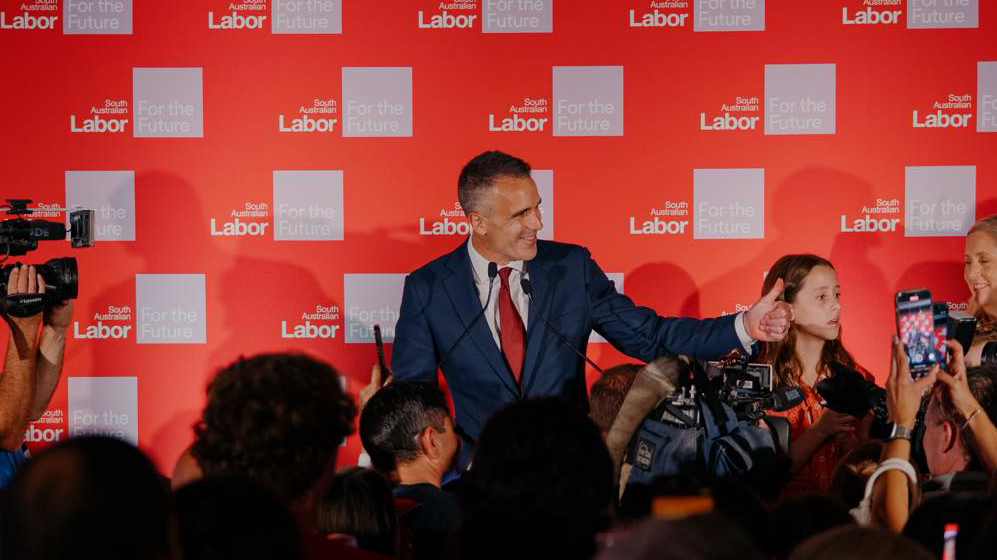
What looks like a landslide win for Labor could spell trouble down the track. Marcus Strom looks at the South Australian election.
The South Australian state election delivered what at first glance seems a remarkable parliamentary landslide for Labor. But beneath the surface, lies a potentially dangerous counter-current in Australian politics: the emergence of a far-right populism that has long simmered on the fringe.
Premier Peter Malinauskas has secured the largest lower-house majority in South Australian history, with Labor’s primary vote at 37.6%, more than two percentage points down on the 2022 election. This was not a Labor landslide built on popular enthusiasm. Instead, it reflected a dramatic split inside the conservative camp.
This split has been caused by a surge in support for Pauline Hanson’s One Nation party, from 2.63% in 2022 to 22.3% of the vote in the lower House of Assembly. Much of that vote came directly at the expense of the Liberal Party, reducing it to a parliamentary rump. But the shift was not only confined to traditional Liberal voters. There are signs that sections of Labor’s working-class voting base in outer Adelaide and regional towns were attracted by One Nation’s nationalist and right-wing populist messaging.
Post election, much of the One Nation meme fodder is highlighting the fact that despite winning nearly a quarter of the popular vote, it will not have such representation in parliament. Many responses have sneered that these ‘idiots’ don’t understand the electoral system.
But One Nation has a point. A democratic electoral system would provide for proportional representation in an elected chamber. By not championing such constitutional matters, both the ALP and the socialist candidates that stood cede the call for proportional representation to the rightwing populists.
There is considerable anger in working-class Australia, whether among Anglo-Celtic or more recent migrant communities. Many people feel marginalised, overworked, priced-out and spoken down to by entitled middle class elites – the ‘Brahmin class’ of ‘progressive’ managerial capitalism.
This alienation from the political establishment is fuelled by growing economic uncertainty, supercharged today by the ‘warflation’ effects of Trump’s war on Iran.
By ignoring the need for democratic and constitutional change, the left is unable to connect the economic estrangement of the working class with the need for radical political change. One Nation is attempting to fill this void.
Combatting nationalism …. with nationalism
Faced with a potential threat from One Nation, Victorian federal Labor MP Julian Hill – ostensibly on the ALP ‘left’ – has called on the Labor Party to embrace Australia Day and the Australian flag. SA Premier Malinauskas is also looking to outstep One Nation with ‘progressive patriotism’.
This was also a theme developed by Prime Minister Anthony Albanese in June last year at his National Press Club speech after retaining government.
But quoting Henry Lawson, as Malinauskas did in his victory speech in an attempt to frame nationalism as a ‘progressive’ force will not cut it.
The SA Premier referred to Henry Lawson’s poem, The Duty of Australians, which is a call to lend kindness and assistance to newly arrived migrants. Of course, a noble call. Lawson’s poem points to a bottom-up and working-class support for migrants, where if “his [sic] English [is] very young / To find out and take him somewhere where he’ll hear his native tongue”.
This is a spirit to support. But in Malinauskas victory speech, he turned this into a flag-waving exercise that would be unrecognisable to Henry Lawson, calling for a state that can create “new wealth and prosperity by celebrating capital as well as labour”.
This shows that nationalism – whether ‘progressive’ or chauvinist – papers over the real divisions in society, between the vast majority of people who create wealth and the tiny minority that siphons it off.
Such an approach creates space for reactionary forces to shift blame for the real divide between the haves and the have-nots onto migrants, welfare recipients and First Nations people, recasting a class divide as one based on identity and nationality. This in turn creates fertile ground for right-wing populism to flourish.
One Nation and the crumbling of liberalism
South Australia has historically been a weak state for One Nation. It ran no candidates between the 2006 and 2022 state elections. It got just 4.23% of the statewide upper house vote in 2022, giving it one seat in the Legislative Council. In 2006 it got 0.8% of the statewide vote. The fact that it has now established a significant electoral foothold is a warning sign for other parts of Australia, rather than a curiosity.
Across much of the Western world we are witnessing the breakdown of the political settlement that dominated the neoliberal era. As pollster Kos Samaras argued recently in a perceptive blogpost drawing on Thomas Piketty’s concept of the “Brahmin Left”, social-democratic parties increasingly became parties of educated professional elites during the Blair era. Meanwhile, their historic working-class base fragmented and drifted away. The Brahmin managerial class assumed this base had nowhere else to turn.
For decades this alignment was stabilised by the institutions of liberal globalisation, expanding trade and relative economic growth. In the wake of the Global Financial Crisis in 2008, that settlement has been fracturing. Strategic rivalry between states is intensifying. Economic nationalism is returning. The US empire is declining and violently lashing out. Reformist parties like Labor find it harder to provide material improvements within a tightening global system. Reformism without real reforms.
The political consequences of this rupture are visible internationally: Brexit, Donald Trump, Marine Le Pen, Viktor Orban, the push-back of the progressive ‘pink tide’ in Latin America. These developments are not isolated national accidents. They are expressions of a deeper crisis of the neoliberal political order.
Some on the left, including the Marxist group Communist Unity, suggest Australia will largely escape this trend. That confidence is misplaced. Australia does possess certain buffers – a highly urbanised population with integrated migrant communities, compulsory and preferential voting, a residual union infrastructure and elements of the welfare state. But these are sandbags, not impenetrable defences.
One Nation itself may not become the central vehicle for a right-populist breakthrough here. After three decades in politics, Pauline Hanson still struggles to project the kind of leadership authority seen in comparable movements overseas. We have seen her fortunes rise before, only for them to be squandered by incompetence and the deeply unserious nature of her party.
How solid this surge is, remains to be seen.
Emeritus Professor Clem McIntyre from Adelaide University said that One Nation remained largely a protest vehicle for voters disaffected with established politics. Talking to ABC News Radio, he said: “When those expressing support for One Nation are asked why … the most common answer is I’m fed up with the two major parties.”
Professor McIntyre went on to say there are a few tests for One Nation before we can say they are forcing a significant change to Australian politics.
“One Nation has a terrible record of electing people to parliament who then promptly leave the party,” he said. Brian Burston, Rod Culleton, Fraser Anning, David Oldfield, Mark Latham, Rod Roberts, Tania Mihailuk, and so on, and so on.
However, while One Nation might not emerge as the main vehicle for right-populism, it is possible that such politics could find expression in the Liberal and National parties.
Indeed, there are already signs of this shift. The new federal opposition leader Angus Taylor has begun striking nationalist and anti-immigrant themes in response to the economic fallout of the Iran war and fuel price instability. Far-right Liberal Party figures like Andrew Hastie and James Paterson have started repositioning themselves rhetorically in relation to global currents, arguing for Australia to prepare for more impendence from Trump’s USA.
Hastie told Sydney radio 2GB that One Nation supported Trump’s war, whereas he refused to endorse the war, saying, “I’m not going to send young Australians to die in a conflict that we don’t know an end state to, and there’s no clear strategic objective”.
Passing strange the Liberal Party is adopting a more anti-war position than the ALP leadership.
There are also warning signs of a drift to nationalist-populism within the ALP, too. During the election campaign Malinauskas distanced himself from proposed gun-law reforms following the Bondi massacre. Earlier he attempted to counter One Nation’s appeal by arguing that “local” workers would receive well-paid defence jobs while migrants would be needed to staff aged care.
“Who’s going to feed you and bathe you and wipe your bum when you’re 90?” he said at a business forum on 18 March in comments aimed at One Nation supporters.
“It ain’t going to be your kids, because if I get my way, they’re going to be working on submarines with high-paying jobs … so who’s going to do that work?”
This kind of rhetoric risks conceding ground to right-wing populism rather than confronting it. It effectively argues for an ethnically divided working class, with new migrants from places like the Philippines, China, India, doing the low-paid work that non-migrants don’t want to do.
This is a recipe for dividing the working class along lines of nationality and identity – fodder for One Nation.
Many working-class voters are experiencing housing insecurity, rising prices, long working hours and growing job instability. At the same time, sections of the “Brahmin Left” continue to foreground liberal-progressive cultural politics in ways that can feel disconnected from working-class experience. This divide in part fuelled the defeat of the referendum for an Indigenous voice to parliament.
Meanwhile people are told that everyone in Australia – worker and boss – is on the same team. So, who should be blamed for the mess we are in? This contradiction creates fertile ground for right-populist appeals to backwardness, fear and economic insecurity.
Unfortunately, the socialist and progressive left has largely failed to fill this vacuum. Too often it tails the liberal establishment politically while restricting its own intervention to narrow economic demands.
SA Socialists make initial gains
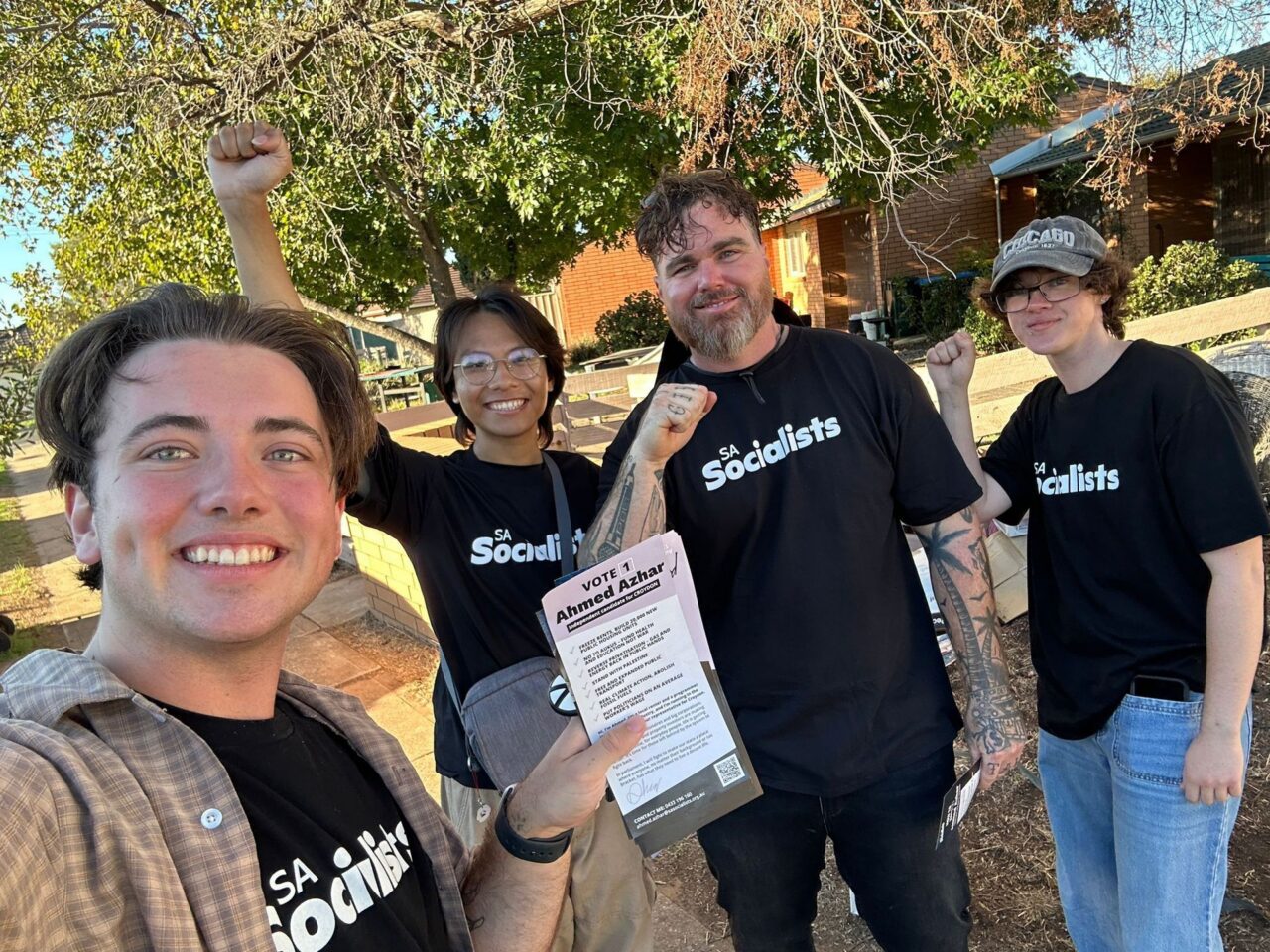
Even so, one feature of the election was the performance of South Australian Socialists. Standing in two seats without their party’s name appearing on the ballot, they nevertheless secured decent results for a first-time election foray: 7.2% for Ahmed Azhar in Croydon against the premier, and 5.6% for Leila Clendon in Enfield.
By contrast, the smaller yet longer-established Socialist Alliance stood a single candidate in Port Adelaide and secured just 1.6% of the vote, which they described as “a strong outcome”. From photos posted on social media, it appeared that Socialist Alliance had mobilised their members from around the country to campaign in Port Adelaide to achieve this result. While the Socialist Alliance is attempting to claim electoral territory, it is being outpaced by the younger, larger and more dynamic Socialist Party project. It seems unity or death can be the only realistic outcomes.
While both campaigns presented many positive socialist policies, these groups fail to challenge the current undemocratic political status quo of constitutional monarchism, upper houses and federalism
Socialist policies are laid out in terms of what is possible within the frame of the South Australian government. The Socialist Alliance election platform said “South Australia could meet people’s basic needs, and more, if priorities were changed.” Really?
SA Socialists – with a more radical ‘about us’ section – nonetheless echoed this ‘socialism in one state’ vibe, saying ,“There is plenty of wealth in South Australia. We are endowed with natural resources, farmlands and advanced technologies in every industry. There is more than enough for everyone to lead a comfortable life.”
These statements suggest an acceptance of the current state of South Australia as political entity that is permanent and contain no demands to challenge the colonial and monarchist constitution. Framing our socialism to emerge from the existing constitutional order is fantasy.
Socialists must be at the forefront of leading workers to master political questions – central to these are the democratic nature of the state itself. This must include demands for proportional representation in existing parliaments, for a thorough overhaul of a constitution drawn up by colonialists a more than a century ago, for a Treaty with First Nations and for a democratic republic and all that entails.
A century ago, the Labor Party fought to abolish federalism, the states and the various colonial upper houses that still litter this continent (Queensland the only state where Labor successfully abolished the upper house). Abolition of the senate was in the ALP platform from 1919 right up to 1979. In 1917, the Victorian branch of the ALP adopted a policy to abolish all state governments. This effectively became the national position a year later, when the ALP adopted a policy for “unlimited legislative powers in Australian affairs to be vested in the Commonwealth parliament”.
It wasn’t really until Bob Hawke and the ‘New Federalism’ that the ALP reined in these constitutional demands.
Meanwhile, championing of constitutional demands such as these is alien to the socialist left today. That must change. These are ideas relevant for the small socialist groups contesting elections, but also ideas to be fought for within the ALP.
If the left cannot champion democracy and stitch together a radical anti-liberal alternative, there is a real danger that right populism could take hold in Australia. We are not immune to the reverberations emanating from Europe, the US and the wars it is pursuing.
If Labor and the workers’ movement more generally draw the wrong lessons from this election, the risks are obvious. Parliamentary dominance achieved through a split conservative vote is not a guarantee of long-term stability.
The emergence of rightwing populism inside Australia’s political landscape demands a different response: rebuilding a working-class political project that breaks with liberalism and advances a confident socialist and democratic-republican alternative rooted in the experience and collective power of working people.