
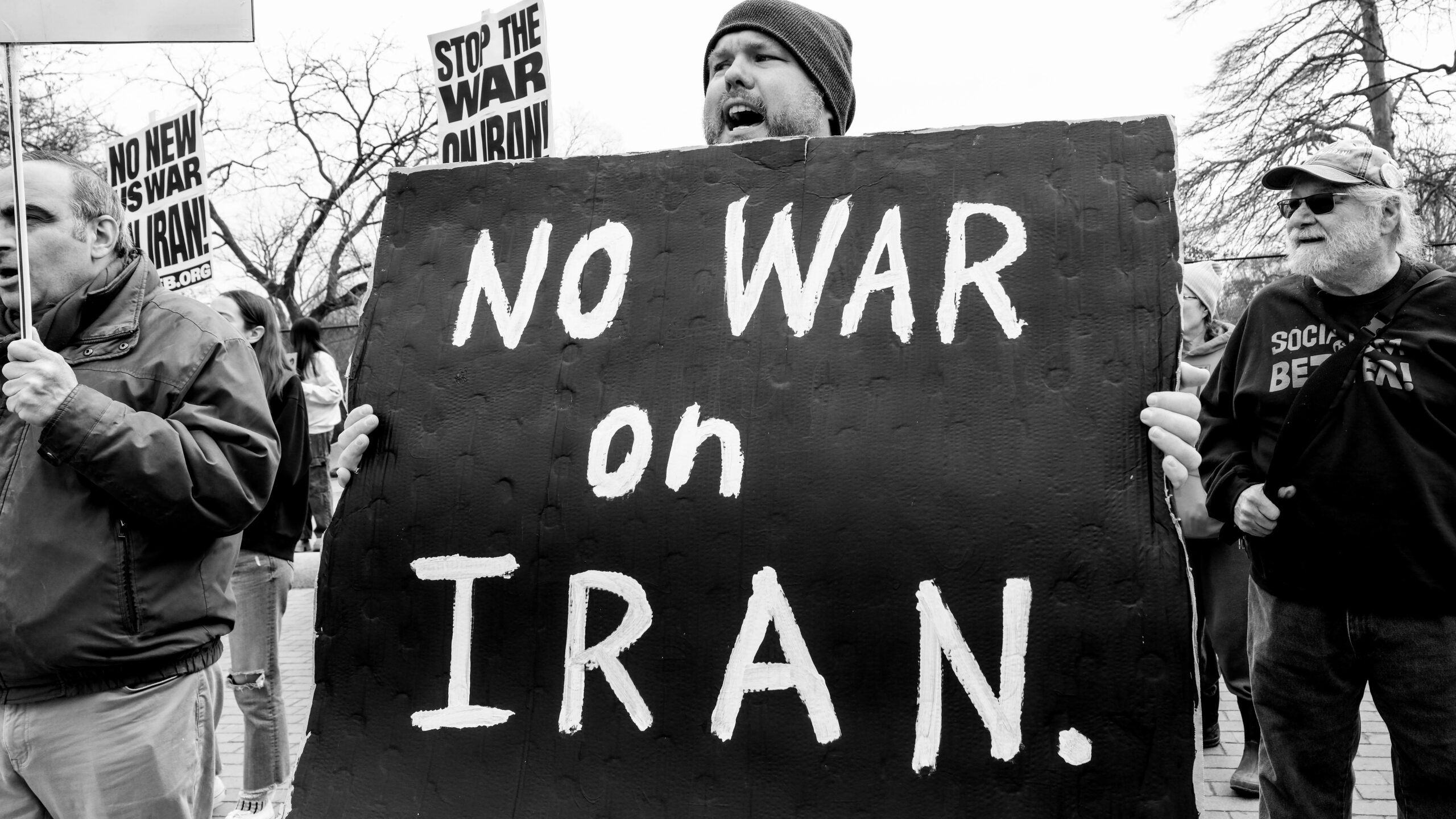
Being in lockstep with US imperialism abroad while pursuing minimalist ‘reform’ at home was always going to bite the ALP in government. Hamish McPherson looks at how the Iran war is shaping the domestic agenda.
The decision by the US and Israel to make war on Iran has caused global shock waves and a grave political and economic crisis with no clear pathway out.
The Iran war oil shock blows apart the Albanese government’s basic operating model – that it is possible to quietly manage the system and offer limited reforms to working people domestically, while at the same time actively embracing a military alliance with the US under the leadership of Trump.
According to the Pentagon, more than 7,000 military sites have been struck in efforts to destroy Iran’s naval forces and missile launching capacity. It is also clear that Iranian civilians and civil infrastructure are being targeted, with destruction of residential buildings, hospitals and schools causing at least 1,400 civilian deaths.
The war has emboldened Israel to step up its violent annexation of the West Bank. Israel has invaded Lebanon and is heavily bombing the high-rise suburbs of south Beirut, in an act of collective punishment that replicates their war crimes in Gaza. More than 900,000 Lebanese civilians have been ‘displaced’, the polite euphemism for being forced to flee one’s home in fear of death. Israel looks like it is preparing to annex southern Lebanon up to the Litani River.
However, the massive bombing of Iran and assassination of its top leadership have not led the regime to fall. This is no repeat of the rapid US conquest of Iraq in 2003.
Iran’s determination and capacity to resist foreign attack has thrown a hefty spanner into the works of the US-Israeli war machine. Predictably Iran has closed the Strait of Hormuz to oil shipments and launched retaliatory attacks on US military bases in the region, and the key infrastructure of the US allied Gulf states.
Iran is imposing a massive economic price on the US and Israeli war of aggression. The International Energy Agency has said we face the greatest “supply disruption in the history of the global oil market” and global commodity and share markets veer between fear and outright panic.
Nonetheless, US oil companies are raking in super profits and the financial bets either side of White House announcements imply that crony capitalism and profiteering is alive and well in the court of King Donald.
Economists warn of cascading impacts as the price of oil and gas, central commodities of global capitalism, continue to rise and impact the cost of fuel, shipping, aviation, road transport, industrial production, plastics and packaging, fertilizer, food production and groceries.
It’s no wonder that consumer confidence levels in Australia have hit the lowest point since records began in 1973, the same year as the first major ‘oil shock’ – caused by an Arab oil embargo to sanction Western support for Israel in its war with Egypt and Syria.
Australia, as a middle-sized trade-dependent economy is especially vulnerable to the global economic shocks caused by Trump’s war. Treasurer Jim Chalmers recently told a closed-door meeting of business leaders that the economic impacts in Australia could be as bad as the global financial crisis and the COVID pandemic, and that earlier Treasury modelling of 5% inflation this year and low growth for the rest of the decade may prove to be conservative.
Just how much worse this could get was shown when Israel crossed a red line and bombed Iran’s South Pars gas field, the largest natural gas field in the world upon which Iran depends for its domestic supply.
Iran retaliated by striking and causing major damage to Qatar’s Ras Laffan gas facility. It is the world’s largest liquified natural gas production facility and provides 20% of global LNG supplies. Qatari authorities estimate that it will take five years to fully repair the damage, a sign of the long-term impacts this war will have on the global economy.
Under mounting pressure to open the Strait of Hormuz, Trump is making dire threats to massively escalate the war by bombing Iran’s entire domestic energy infrastructure.
Trump is claiming progress in talks with Iran about a possible deal, claims Iran has openly ridiculed as a sign of desperation to manipulate oil markets and ‘escape the quagmire’. Both sides have exchanged conditions for a deal through mediators in third countries such as Pakistan. Iran is understandably suspicious, given it has now been attacked twice during previous high-level negotiations that appeared to be making progress.
While talking of peace, the US appears to be preparing for an escalating war. Trump and the US military are reported to be seriously considering a ground operation to seize Iran’s Kharg Island. The island is an export and processing hub that connects to Iran’s main oil fields and refineries, processing 90% of Iran’s oil exports.
The US Navy has moved two aircraft carriers and strike groups to the region, including 150 combat aircraft – the largest concentration of American naval aviation in the Middle East since the 2003 invasion of Iraq.
The Pentagon has confirmed they are deploying the Army’s 82nd Airborne Division of about 2,000 paratroopers to the Middle East. The US is also deploying two Marine Expeditionary Units comprising about 5,000 troops trained and equipped for maritime amphibious landing operations. These forces join the approximately 50,000 US troops already based in the Middle East.
The US has led itself and the whole world system into dire straits, provoking war with a determined adversary in Iran, which is fighting a war of national defence. That Iran has been forced to fight for its survival will make it less willing to settle for a status quo deal that preserves US power in the region.
Iran will likely seek to continue using asymmetric military tactics to humble the Western imperial aggressors. And a frustrated US may escalate its war in a desperate attempt to force capitulation and open the Strait of Hormuz.
Albanese signs-on to the war disaster
Without deeper study we can only speculate about the motives and the combination of imperial arrogance, calculation and delusion that led Trump and the US military state to reckon that launching an all-out attack Iran would achieve their goals.
What is clear, however, is that a US empire in relative decline is ratcheting up its violence and aggression, whether through trade and tariff, execution or direct military aggression.
While not all that surprising given its track record, it is still hard to fathom why the Albanese Labor government has so enthusiastically signed up to support this dangerous gamble.
The AUKUS agreement is certainly a factor, by design it has deepened the ‘interoperability’ of ADF and US military forces and cemented a strategic military alliance aimed at any powers that challenge the US as the dominant power in Eurasia, be it China or Iran.
For three years, grassroots ALP movement, Labor Against War, has warned that AUKUS would directly tie Australia into US wars of aggression. This abstract claim has now been made concrete.
The AUKUS training program literally put Royal Australian Navy sailors on the US nuclear submarine that torpedoed an Iranian frigate in the Indian Ocean, killing 182 Iranian sailors.
The Labor leadership appears to treat the US alliance as an article of faith, not to be questioned or challenged even when faced with the harsh reality of the Trump regime’s ever more reckless actions.
Without explicitly naming the problem, Albanese concedes that Trump’s unilateralism has upended the world order. He recently stated that the “stable, predictable world of ever-expanding free trade is gone – and it will not be returning anytime soon”.
However, rather than chart a new course, the Albanese government is set on proving their continued loyalty to US imperial power. As the incumbent mangers of the national interest of Australian capital, they have decided to commit and stay close to the most dominant and aggressive global power.
Faced with this foreign policy crisis Albanese and Wong responded on autopilot, rushing to support the US action, and seeking to justify it with vague claims about nuclear weaponry and criticism of the repressive character of the Iranian government.
Diplomatic support was backed in by deploying 85 ADF troops and an RAAF Wedgetail spy plane to the United Arab Emirates. This was claimed to be a ‘defensive’ stance in support of a Gulf state ally.
However, Defence Minister Richard Marles was soon forced to concede that real time battlefield data collected by the Wedgetail is being made fully available to US Air Forces Central Command based at the massive Al Dhafra Air Base in the UAE.
Ministers have obfuscated about whether Australia is at war – keen to avoid the ugly fact that we are involved in a war of aggression that breaks the most basic principles of respect for national self-determination and sovereignty.
The hypocrisy and falsehoods of the liberal Western governments know no bounds. An official statement calling for the reopening of the Strait of Hormuz signed by Australia alongside 22 other nations is heavy on condemnation of Iran’s attacks but contains not a single reference to the fact that the US and Israel started the conflict.
The government’s rhetoric, by switching the focus to the repressive character or military actions of the Iranian government, seems to cause a layer of socially influential liberals and social democrats to hesitate about clearly condemning our involvement in the war.
This liberal confusion is evident even in the otherwise constructive and welcome statements opposing the war being adopted by trade unions. Calls for ‘de-escalation and diplomacy’ in fact avoid the main issue: Australia’s support for a dangerous US war of aggression.
After an initial flurry of support, there has been a shift in the character of the Australian government’s enthusiasm for the war effort. With rising petrol prices front and centre of political debate, Albanese now declares that the war has achieved its objectives and is hopeful of a resolution, “I can see it ending, coming to an end, and us making sure that we get the world back on its normal axis.”
It sounds close to the rhetoric of George W. Bush declaring ‘Mission Accomplished’ after the first phase of the US-UK-Australian invasion of Iraq in 2003.
Treasurer Jim Chalmers, speaking to business leaders made the obvious point that the “end of the war can’t come soon enough”.
Yet none of these observations has led to the obvious decision to withdraw Australian diplomatic and military support for the US war effort.
The change in tone is partly a result of the impending economic crisis and reflects how little support there is for the war among Australians. Recent Essential polling of 1,008 people published in Guardian Australia shows that 43% disapprove of the US-Israeli attack on Iran, with only 26% in support.
Asked about Australian involvement in the war, 35% disapprove and just 32% support sending ADF troops and the spy plane to the Gulf.
It is likely that questioning of the war will grow as the economic impacts erode living standards.
Despite supporting the war, One Nation will use the economic mess it creates to sow further division as it seeks to create space for its hateful national chauvinist right-populism. Surprisingly, deputy opposition leader, Andrew Hastie, has failed to support the war.
Asked on Radio 2GB if he supported the war, he replied: “Well, I didn’t get a choice. Australians didn’t get a choice. We weren’t briefed, it just started, and now we’re dealing with the consequences.”
The war on Iran and oil price rises are driving up inflation at a time when living standards are already under pressure from the effects of a dysfunctional housing market and AI automation and restructuring.
The Iran war oil shock blows apart the Albanese government’s basic operating model. A ‘steady as she goes’ approach is now revealed to be not only naïve, but dangerous.
In simple terms, it is not possible for the government to claim that it is ‘backing Australian workers’ (to quote from recent ALP campaign materials citing IR and cost of living measures) while also backing a war of aggression that is hammering working people’s living standards. Imperialism abroad is also an assault on the working class at home.
Nor is steady managerialism of the existing economic system going to protect living standards and the wellbeing of the majority of people.
The default response of the Australian ruling class will be to seek to make working people carry the burden for this crisis. This was evident in the Reserve Bank’s decision to again raise interest rates, punishing stressed mortgage holders despite inflation largely being driven by supply pressures, public and private sector capital investment and higher profit margins.
A big test will be the substance of the May federal budget. Chalmers is under pressure from conservatives to deliver spending cuts to combat inflation. The centre left is calling for higher taxes on speculation and capital through the reform of capital gains tax and a tax on windfall profits.
Likely we will get some modest combination of both, leaving the economic levers of power firmly in the hands of the Australian capitalist class and working people left to struggle on.
The war on Iran has ended the illusion that we are safe from the aggression and chaos that the US and Israel are unleashing on the people of the Arab world. The war has come home in economic crisis and demands a clear response from unions, civil society and the left.
We need an independent working-class foreign policy linked to a program of social and economic measures that protect the living standards and wellbeing of the majority.
By supporting this criminal war Albanese, Wong and Marles have betrayed the basic interests of working people.
Australia’s support for the war on Iran can be challenged by a movement that communicates and builds support among wide sections of society. Against the falsehoods of the pro-war leaders and their apologists we say clearly:
- Defeat for US-Israeli aggression;
- Trump’s Iran war is a disaster for which we all pay the price;
- End all Australian support for the war;
- Withdraw all Australian troops and forces now;
- Cancel AUKUS and close US bases;
- Protect working class living standards;
- Make capital pay for the crisis of its system.