
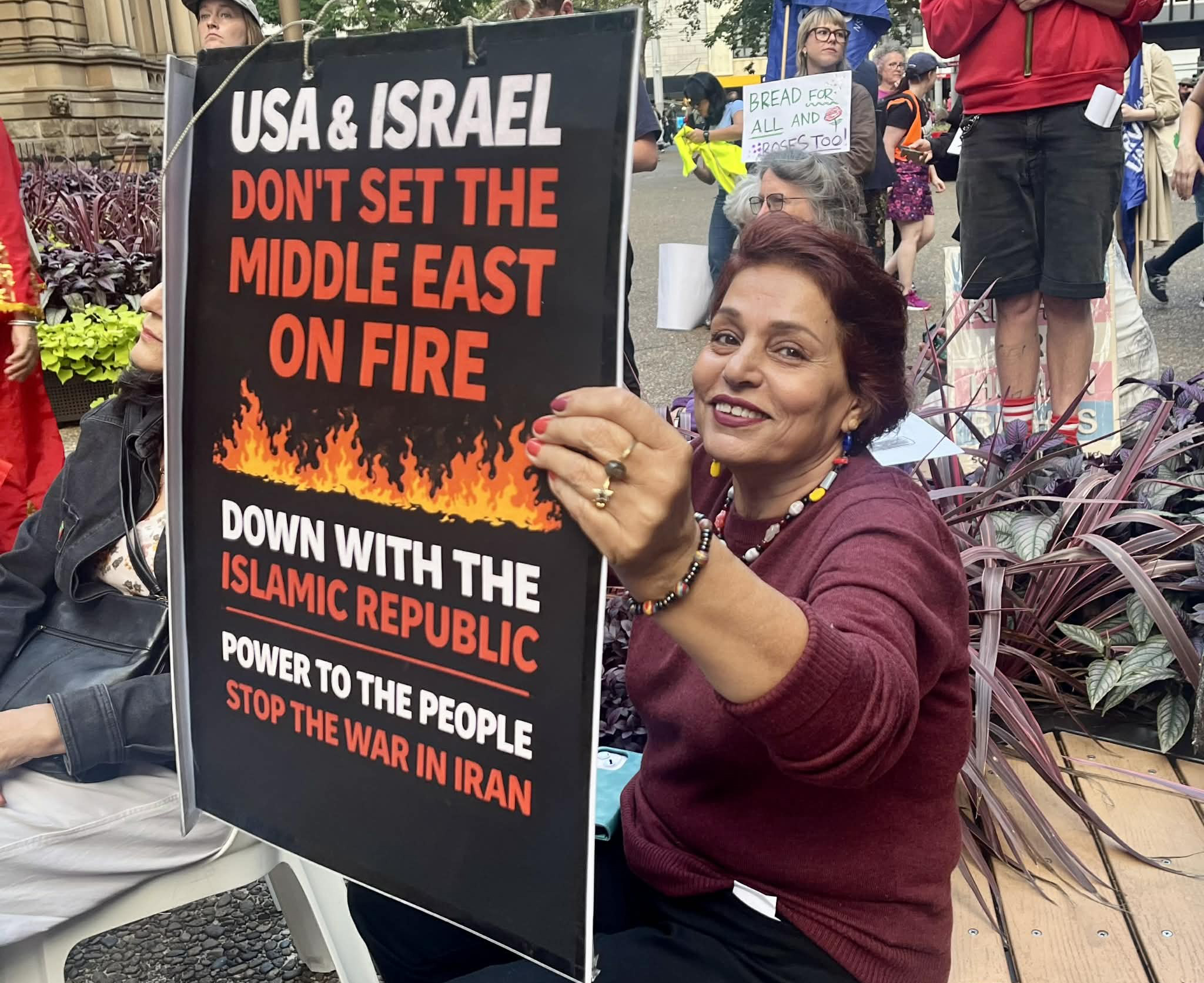
Australian-Iranian leftist Ali Keshtkar offers this contribution on how we can build a mass movement against the Iran war that is built on principled politics.
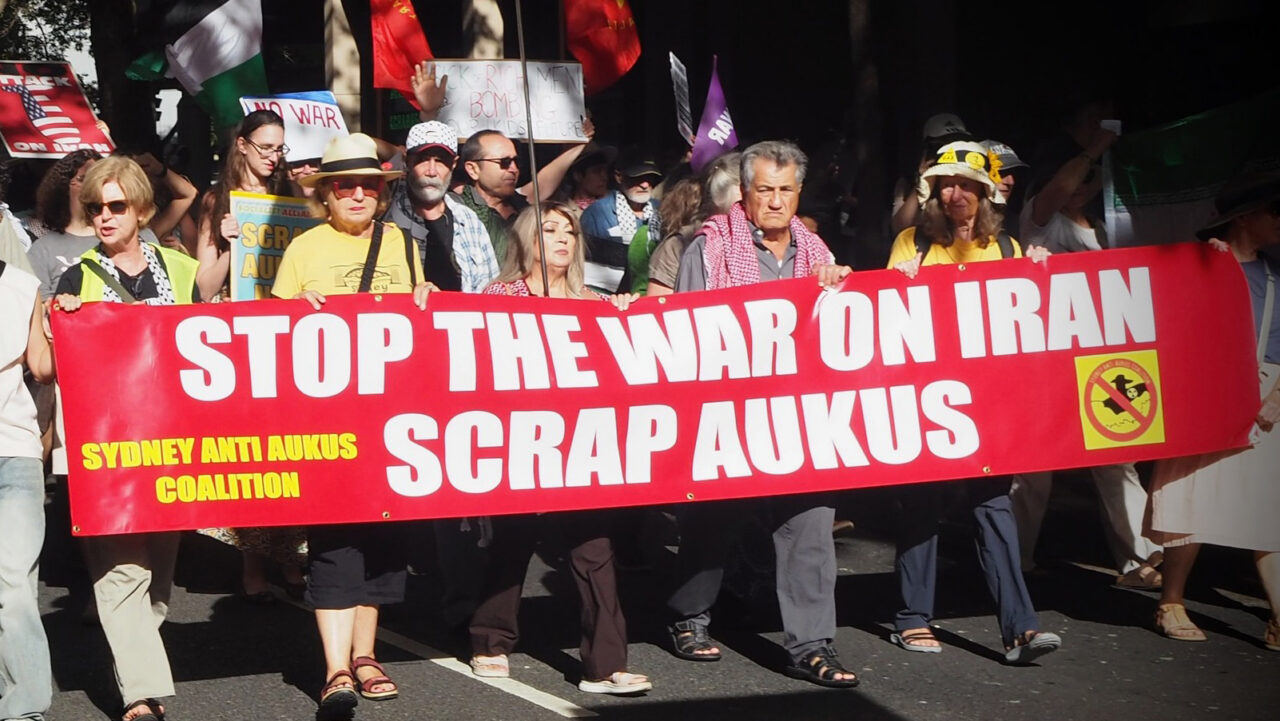
Among Iranian left-wing comrades, a pressing debate has emerged: how should we respond to the US and Israeli military attack on Iran? Should we participate in broad anti-war protests, even while pro-Iranian regime supporters participate under the Islamic Republic of Iran flag? And if so, under what conditions?
Or should we insist on only demonstrating in mobilisations that clearly oppose the regime?
First and foremost, it is clear that leftwing Iranian activists in Australia condemn the war and any form of foreign intervention in Iran, and are opposed to US and Israeli bombardment.
Second, and at the same time, these same left forces are also opposed to the Islamic Republic.
The pivotal question is: how to maintain a principled position while remaining committed to both of these premises?
How can one oppose a war that is being waged against a regime we ourselves are in political struggle against? And how can one avoid finding oneself on the same side as criminal and imperialist powers like the United States and Israel in their war against that regime?
Two tactical approaches
In navigating participation in the anti-war movement, two distinct tactics have emerged.
The first advocates for broad, inclusive unity, bringing together all forces within the anti-war movement under a single front.
The second insists that participation can only take place under the dual banner of “No to War, Down with the Islamic Republic”, and refuses to stand alongside protesters who carry the Iranian state flag.
This second position is understandable. Many activists have suffered directly under the regime, me and my family included. But before taking any tactical position, we must be clear about what kind of war this actually is.
This is not simply a conflict with a regime; it is a war that targets society as a whole under the pretext of confronting that regime. The very first strikes from the US and Israel made this unmistakably clear, including the bombing of a girls’ school in Minab that killed 168 students.
Civilian life, social infrastructure, and the cultural and economic foundations of society are all within the scope of this war. The destruction of schools, hospitals, sporting venues, historical sites, mosques and economic infrastructure is not a war of regime change, it is the systematic degradation of a society’s living conditions and future.
War, or its constant threat, is one of the regime’s most powerful shields: it suspends civil struggle, fragments social forces and enables intensified repression under the banner of national security.
War strengthens the most coercive elements of the state while weakening the capacity for organised, democratic opposition from below. Those who oppose the regime while either supporting, or downplaying, the war are strengthening the very apparatus they claim to oppose.
A genuinely anti-regime position must therefore be first and foremost an anti-imperialist and anti-war position.
The priority – defending society, not the regime
I have actively opposed the Islamic Republic for more than four decades. My brother was executed by this regime. I was imprisoned, tortured, on the brink of execution and forced into exile. I carry the scars of this regime on my body. Precisely for this reason, I believe that defending the truth must be the priority.
Defending the truth means defending the existence of Iranian society and the existence of human beings.
At this moment, regime change is the slogan of the imperialists. Under current conditions, regime change slogans are immoral and inhumane. Our slogan must be for the revolutionary defence of Iranian society.
Therefore, defending the existence of society, defending life itself, and defending the fundamental right to survival is the most important political and ethical duty of any left force that considers itself accountable to the present and future life of society.
This is not the time for radical posturing about whose socialism is more revolutionary or whose position is more radical.
The central demand of any movement committed to justice must be immediate ceasefire and opposition to US and Israeli military aggression.
This, in my view, is the central and non-negotiable slogan. And it is, in the deepest sense, a genuinely revolutionary demand, one that seeks the overthrow of oppression in the name of a better life for society, not in the service of greater profit for capital.
This is not a retreat from struggle against dictatorship. It is a necessary condition for continuing that struggle.
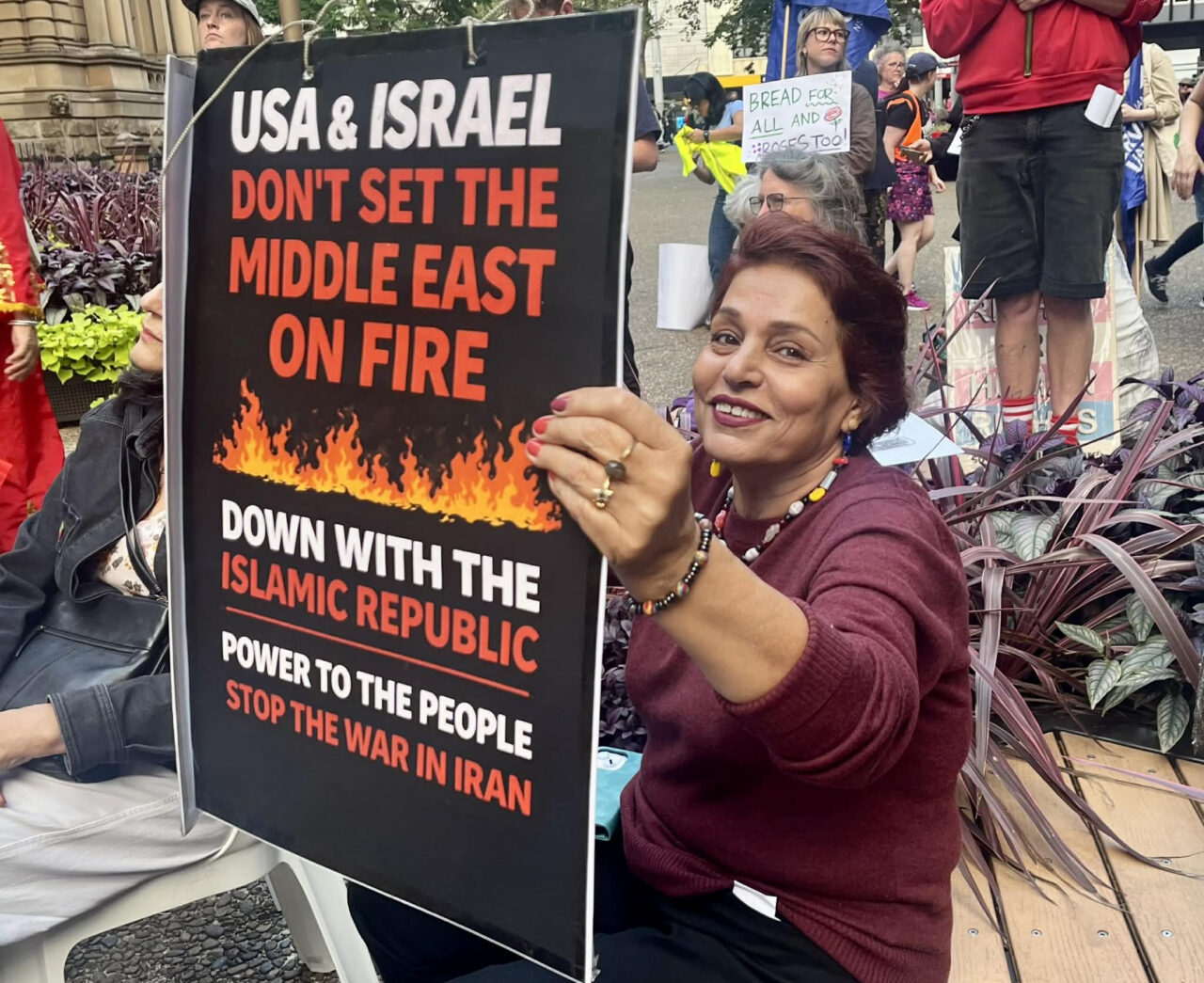
Tactics in the field: avoid a ‘flag war’
If we wish to participate in anti-war protests in Australia, however, we face serious challenges that demand careful attention.
The first is that mainstream media has for months been attempting to present the pro-war monarchists as representative of Iranian aspiration among the diaspora and those within Iran itself. This is an attempt to justify the Australian government’s support for the war and the US-Israeli attack as an act of solidarity with the Iranian people.
This is further reason the anti-war movement, including Iranians in exile and other Australians opposing the war, must fight for the highest possible unity against this imperialist aggression.
Attempts to police who comes to support anti-war demonstrations based on what flag they are carrying are both doomed to failure and risk dividing and weakening the movement.
Such internal fracture threatens to disperse and atomise the movement and can easily degenerate into a form of civil war within the anti-war camp. In turn, this produces increasingly smaller, demoralised gatherings, leaving us as spectators to the intensification of bombardment and the killing of innocent people.
What happened recently at the Sydney anti-war mobilisation on 14 March is a cautionary tale, but not in the way some might assume. At that rally, pro-regime forces were able to push their agenda to the fore.
The Sydney rally did not encounter difficulties because pro-regime forces were better organised, though they were. It was because elements of the anti-war movement allowed itself to be drawn into a confrontation with forces who, from a different political standpoint, also opposed the war. That confrontation strengthened neither the anti-regime struggle nor the anti-war movement.
Let us not forget that just months earlier, Sydney brought more than 200,000 people into the streets in defence of Palestine, under many different flags, perspectives, and political tendencies, and succeeded in exerting real pressure on the Labor government. That model of broad, mass social organising is the one Sydney should look to. Not sectarian fragmentation, but the kind of movement-building that changes the balance of forces in society.
To achieve this, we must ensure the slogans are clear and unambiguously opposed to the war, condemn the imperialist aggression of the US and Israel and call for the Australian government to withdraw support for the war.
It is a sign of some weakness that the Palestine solidarity movement has not been able to pivot significant social forces to combat this war on Iran. Lessons must be learned here.
The flag war is not the class war
The task of the movement is not to control what people carry. It is to develop clear political demands that oppose both imperialist intervention and support for repression. Within this framework, socialists can make arguments for why the Islamic Republic cannot adequately serve the needs of the people, nor fight imperialism.
We can argue for clear working class and socialist solutions to the war and society itself within a large and dynamic anti-war movement.
The flag war is the monarchists’ war. It is sacred to them precisely because the Lion & Sun is the emblem of the monarchy. For the left, it carries no such meaning, and the Iranian state flag carries no more meaning either. It is worth recalling that at past leftwing demonstrations, the Lion & Sun flag was sometimes brought along, and yet no one declared that the symbol of dictatorship and crime was standing beside the red flag of the left.
For all these reasons, the flag war is, in my view, a hollow and manufactured conflict, a diversion. No flag holds any sanctity. You cannot stop people bringing their flags, nor should you try. What you can do is build a leadership with a clear political platform and disciplined slogans that do not give comfort to the regime. That is where political energy should be directed.
Lessons from Palestinian solidarity: a model of mass unity
The global Palestine solidarity movement offers an inspiring and powerful model. Over two-and-a-half years, this movement mobilised millions of people continuously across the globe, the likes of which we haven’t seen since the anti-Vietnam War mobilisation. It has drawn in workers’ strikes, boycotts, students, schoolchildren, writers, artists, and wide layers of society. It has been a genuinely mass, social and politically potent movement.
The most important lesson it teaches is precisely this: when differences are set aside and a broad, united front is built against war and imperial aggression, the movement becomes a real social force capable of shifting the balance of power. In London, Madrid, and Berlin, this approach produced demonstrations of tens of thousands, under many different flags and with many different political tendencies present, and exerted real pressure on governments.
This is the model the movement against the war on Iran must follow. Not sectarian fragmentation. Refusing to engage with anti-war mobilisations, or fracturing them over flag disputes, risks diminishing our voice and giving space to the war agendas of the US, Israel, and the Iranian monarchist right.
We must therefore be fully vigilant and refuse to fall into these traps. On the contrary, we must strive to maximize mobilization and broaden participation across the widest possible spectrum of social forces in the anti-war movement.
The correct and principled tactic, in my view, is the one that builds the largest possible social forces against the war, a tactic that, by relying on mass social power, shifts the balance of forces in society.
Inspired by the global movement in solidarity with Palestine, we must build the largest possible united front against the war, against imperialism and against foreign intervention in Iran’s political affairs.
Such a movement must be open to all who oppose the war, while maintaining a clear platform that rejects both imperial intervention and any apologetics for the regime.
The future of Iran must be decided by the Iranian people, not American and Israeli bombers.
Ali Keshtkar is an Iranian-Australian writer and political activist based in Melbourne, who has lived in exile for over three decades. He is a former political prisoner and survivor of a death sentence in Iran, his brother was executed by the Iranian regime in 1982.
Keshtkar is a former member of the Central Committee and Political Bureau of the Worker-Communist Party.
His current literary project, a memoir reflecting on imprisonment and the final hours before execution, was shortlisted for the 2026 Hazel Rowley Literary Fellowship.