
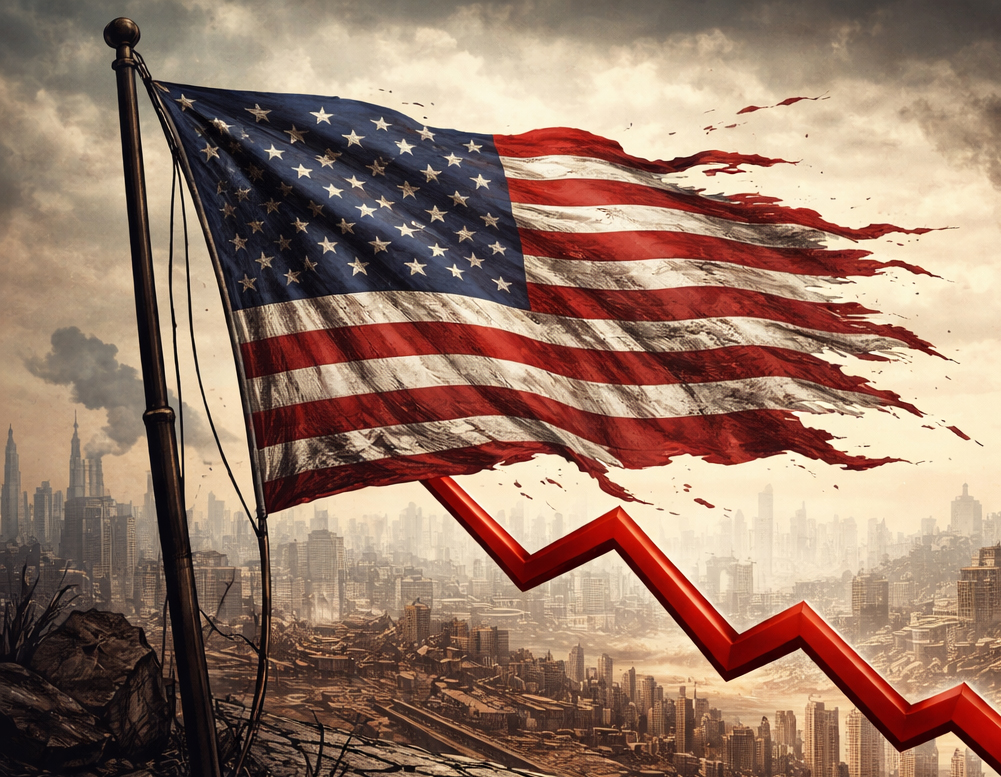
Abraham David examines the faultlines as the sun sets on another global empire.
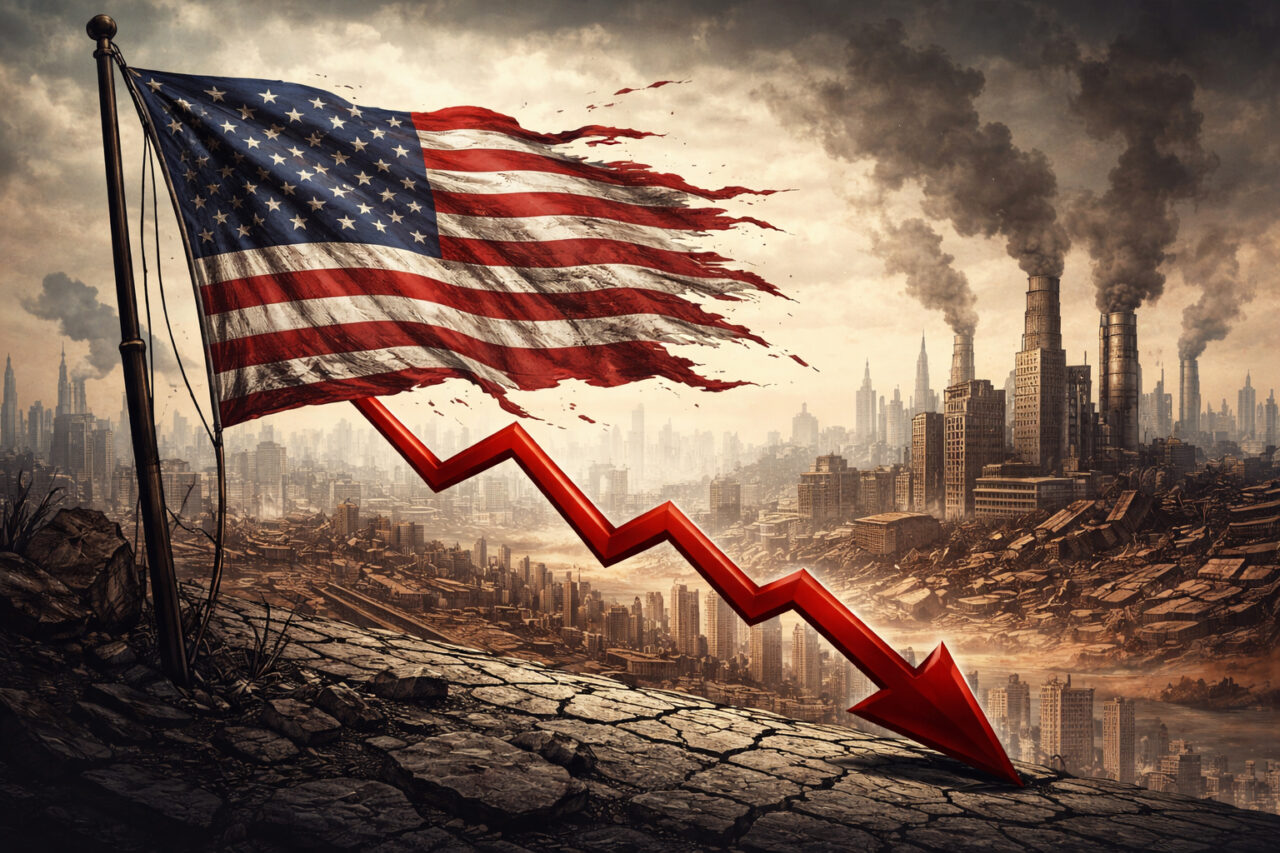
Is the long-predicted decline of the United States a temporary downturn – another cycle in a familiar pattern of overreach, crisis and recovery? Or is the erosion of its power structural, signalling a possible shift toward a world in which the US will never again enjoy unchallenged global primacy? While economics is the driver, politics will decide the outcome and pace of change.
This is not an abstract question. It is now the central political question of world affairs. Every conflict zone, every global economic shock, every tremor inside the American system itself turns on one issue: is US power still capable of reproducing itself, or has the engine of the American empire begun a long, irreversible stall?
If decline is cyclical, Washington could rebound, repair its political system, revitalise its industrial base and stabilise its alliances. If it is structural, then the US – and the web of states including Australia tied to it economically, militarily and politically – must eventually adjust to sharing global leadership with China and other emerging powers. And history shows that empires rarely accept such transitions peacefully.
To understand which of these futures is emerging, we need to examine five key dimensions of the US crisis: internal US conflict, Europe, the Middle East, Latin America and Asia. Taken together, they form a picture of an overstretched power facing simultaneous pressures from within and without.
1. Crisis in the imperial core
Great powers usually fall not simply because of external challengers, but because external shocks coincide with internal fracture. In the US today, those fractures are widening.
A republic dividing against itself
The American political system – long polarised – is now entering an era of open factionalism. Large segments of the population believe the system is illegitimate, captured by elites, or indifferent to their economic misery. The “America First” and MAGA movement, in its various forms, is not simply a right-wing phenomenon but an expression of deep social frustration at the failure of the state to provide security, stability or prosperity.
The question is not whether divisions exist – they do – but whether these divisions can be contained within democratic norms, or whether the country is drifting toward deeper confrontation. This will be tested first in the 2026 midterm elections and later in the 2028 presidential contest, which many analysts fear could trigger a constitutional crisis if disputes over electoral legitimacy resurface.
While the election of Democratic Socialist Zohran Mamdani as mayor of New York shows potential for working class resistance, as a whole, the level of consciousness for a positive outcome to this internal crisis for socialism and working class power remains at a low.
A neglected social and physical infrastructure
An empire that projects power abroad while allowing essential infrastructure at home to decay courts disaster. Roads, bridges, railways, water systems and energy grids need massive reinvestment. Public health, education and welfare systems have been hollowed out for decades.
The US model of financialised capitalism – where shareholder returns took precedence over industrial renewal – has gutted vast areas of the country. The old manufacturing heartlands were sacrificed in favour of cheap overseas labour, especially in China, accelerating social decline and political resentment.
Trump’s promise to “Make America Great Again” taps into this sense of decay. Whether tariffs and coercive industrial policy can reverse decades of deindustrialisation, however, is far from clear. But the elites around Trump clearly have a plan to attempt this. However, rebuilding a world-leading industrial base requires long-term planning, not reactive populist manoeuvres.
Debt, bubbles and the shadow of a new crisis
Federal debt is at historic highs and deficit spending continues to rise. Foreign appetite for US Treasuries – long the backbone of American financial power – is weakening as geopolitical tensions rise and alternative trading blocs form.
Meanwhile, US financial markets are being driven to extraordinary heights by speculative optimism around artificial intelligence. The “Magnificent Seven” tech giants now dominate global stock valuations to an extent that recalls earlier bubbles. Non-bank lending has exploded. Cryptocurrency markets have become politicised. Derivatives markets – barely regulated – are once again expanding.
Economists from across the spectrum warn that the preconditions for a crash larger than the 2008 Global Financial Crisis are building. If such a crash occurs during a period of political instability, the consequences would be profound.
Militarisation, policing and the erosion of democratic norms
The increase in ‘Lawfare’, or partisan use of the justice system, combined with attempts by political actors to exert influence over the military and security apparatus, is accelerating democratic fragility. Moves to expand the domestic role of the military, strengthen federal policing agencies, and centralise control over the National Guard are intensifying fears that the tools of state repression could be used internally during periods of unrest.
The United States is entering a phase where domestic conflict, contested legitimacy, and political violence are all plausible outcomes.
2. Europe: exhaustion of the transatlantic project
After the Second World War, the US became Europe’s protector and economic anchor. NATO was the key instrument of that order. The collapse of the Soviet Union gave the US unprecedented freedom to expand NATO eastward and shape the European economic architecture around Atlantic interests.
But today, the Ukraine war has revealed Europe’s enormous strategic dependence on Washington – and the structural weakness of the European project itself.
The Ukraine war and the limits of Western power
The war that began in 2014 and escalated dramatically in 2022 became a test of NATO’s capacity to impose military costs on Russia. Despite enormous sanctions and massive arms transfers, Russia has absorbed the pressure, reoriented its economy and deepened ties with China, India and the Global South. Western expectations of economic collapse in Moscow have not eventuated.
NATO, it seems, no longer believes it can win on the battlefield. What was expected to be a proxy war that would tie Moscow’s hand and break Beijing away has instead exposed Western exhaustion. Europe faces energy shocks, recessionary pressures and accelerating deindustrialisation – particularly in Germany, long the continent’s manufacturing powerhouse.
While the FSB regime in Moscow is not immune to political shocks from this war, it seems the ongoing corruption scandals in Ukraine, the exhaustion of Europe and the double-dealing by Trump are leaning towards accommodation with Putin.
Europe’s political and economic vulnerability
The crisis has revealed the EU and UK to be a collection of weak vassal states, on bended knee to Washington. Under intense US pressure, European states have:
- Agreed to increase defence spending dramatically, up to 5 percent of GDP
- Accelerated purchases of US weapons and gas
- Accepted new American tariffs
- Redirected capital investment into the US economy
But these concessions occur against a backdrop of rising inequality, far-right electoral gains, and deteriorating public services. Budget deficits in France and the UK are ballooning. Protests against austerity, war spending and falling living standards are increasing.
Europe appears less like a strategic partner and more like an anxious dependency increasingly unable to assert its own interests. The question now is whether Europe will continue binding itself to Washington’s agenda – or whether the long-term gravitational pull of Eurasian trade and Chinese investment will eventually reshape its trajectory.
3. Middle East: still the empire’s most volatile frontier
The Middle East has long been the most volatile theatre of American power. For decades Washington exerted dominance through alliances, military bases and control over energy markets. But today the region is undergoing profound reconfiguration.
Israel, Palestine and global repercussions
The devastation in Gaza has reshaped global perceptions of Israel and the United States. Public anger across the world – including significant sections of American society – has intensified. The contradiction between Western rhetoric about international law and its unconditional military and diplomatic support for Israel has eroded Washington’s credibility.
While a ‘ceasefire’ is in place, the near daily slaughter of Palestinians continues.
This also places enormous strain on the pro-US regimes across the region, where public opinion is overwhelmingly sympathetic to the Palestinians. The pressure on the Arab street against comprador elites can only be building. No doubt Trump is seeking an extension of the Abraham accords to bind Saudi Arabia with Israel, but that arrangement is yet to be sealed.
Trump came to power with the slogan of putting “America First”, but large parts of his domestic base have concluded he is putting Israel first. Americans have long memories of endless wars in the Middle East that have taken lives with little tangible results for working class Americans.
Regional power shifts
The constellation of forces resistant to US-Israeli dominance – Iran, Hezbollah, the Houthis and sections of Iraq and Syria – has been weakened under constant bombardment by Israel, which has shown it can strike them all with impunity, despite sporadic capacity to disrupt shipping lanes.
Meanwhile, China’s economic influence continues to expand. The Gulf states increasingly sell energy to Asia, not the West. They are hedging, keeping ties with Washington but diversifying partnerships.
For the first time in decades, the Middle East is no longer a region where US primacy is unquestioned. Many Middle Eastern powers will seek to wean themselves off the US and Europe should Washington’s decline continue, but this process will take time to play out, no doubt causing ongoing death and mayhem in the region.
4. Latin America: the Monroe Doctrine under strain
For two centuries the United States treated Latin America as its uncontested sphere of influence. Coups, interventions, blockades and economic coercion were deployed to ensure governments remained aligned with Washington.
But today the ground is shifting. Faced with this, Trump is trying to assert control over the region. This has now been made explicit in the new National Security Strategy published this month by the White House. Threats over the Panama Canal, military force with economic and political pressure are being applied, particularly to Venezuela, with regime change being the clear agenda as a lesson to all Latin American states.
Regional independence and new partners
China is now the largest trading partner for much of Latin America, offering infrastructure investment, credit and alternative markets. Countries like Brazil, Mexico, Argentina and Chile see economic opportunities in balancing relations between Washington and Beijing.
Even nations facing heavy US pressure – such as Venezuela, Cuba and Nicaragua – have survived by integrating into new trade and financial networks outside the American orbit.
US militarisation and the “War on Drugs”
The “war on drugs” has become the new rationale for US interventions, particularly in Mexico and Venezuela. But Latin American governments increasingly argue that domestic crises in the US – especially the opioid epidemic – cannot be solved through regional militarisation.
The deeper question is whether Washington can still enforce unilateral control over the hemisphere at a time when economic integration with China is accelerating.
5. Asia: the centre of the global power shift
Asia is the decisive front in global politics. It is here that the structural nature of US decline becomes clearest.
China: emerging as a peer competitor
While Europe and the rest of the world blinked before Trump’s tarrif tirade, China stood firm. China is now the only country capable of challenging the United States across economic, technological and military domains. However, this remains mostly a regional contestation – so far. The trade war, chip embargoes and sanctions regimes reflect Washington’s bipartisan strategy to slow China’s rise.
But China’s industrial depth, integrated supply chains, and dominance in critical minerals present counter-leverage. Its regional influence – through trade, diplomacy and the Belt and Road Initiative – continues to grow. Whether it can transfer this challenge globally is unclear and it could suffer its own internal shocks during the contestation of power.
Flashpoints: Taiwan and the South China Sea
Taiwan remains the most dangerous potential trigger for a US-China war. The Philippines – hosting expanded US bases – is another flashpoint, with Washington promising to defend Manila’s claims in the South China Sea.
A conflict in either theatre would be catastrophic. The risk is no longer abstract; military planners on all sides treat it as a real possibility.
Japan, South Korea and the limits of alliance politics
Japan and South Korea face impossible strategic dilemmas. They depend on China economically but rely on the US militarily. Tariffs, market pressure and demands for increased defence spending place enormous strain on their domestic economies.
This is being played out in Japan now, with a minor crisis emerging with new Prime Minister Sanae Takaichi tying Tokyo’s fate to Taiwan. The Japanese elite is increasingly divided and could be torn apart over this question of whether US decline is cyclical or secular.
Japan’s trillion-dollar holdings of US Treasuries symbolise the bind: deeply intertwined financially with the US while increasingly reliant on China for trade.
Australia and New Zealand: caught in the crossfire
Australia is among the most exposed states in the world. Militarily and politically tied to the US through alliances and AUKUS, its economy is deeply dependent on China – the largest market for Australian commodities, energy and agriculture.
China is by far Australia’s biggest export market and Beijing has a growing need for what Australiah as to offer (although it is diversifying its sources for iron ore and other commodities). But most of Australia’s natural resources are in the hands of US and British economic interests. Meanwhile, AUKUS and the Forward Posture Agreement locks Canberra into US military planning in Southeast Asia.
The contradiction is stark: Australia hosts an expanding US military presence aimed at China while relying on Chinese demand to sustain national prosperity.
A world on the edge of transition
The United States today faces internal political breakdown and four major theatres of external challenge. No empire in history has sustained unipolar dominance indefinitely, and the pressures now bearing down on the US system are immense.
The critical question is not simply whether American decline is happening – it is whether the decline will be managed or chaotic.
And for Marxists, the question is whether the world’s working class can enter the political theatre as an actor. So far, it is unfortunately absent.
A chaotic transition from US hegemony, driven by internal instability or external conflict, could unleash crises with global consequences – from financial collapse to great-power war.
The world stands at a crossroads. Whether the US accepts a new role among several major powers, or attempts to cling to primacy through coercion and confrontation, will shape the century.
The stakes could not be higher.