
Today’s United Workers Union wields enormous power within the ALP. This power was inherited primarily from its United Voice predecessor. But the other partner in the UWU marriage – the National Union of Workers – had its own political clout back in the day. Bob Sparks takes a look.
For decades, the National Union of Workers (NUW) and its predecessor were bastions of the Labor Party right. At its height, it formed the powerbase for a future prime minister and produced both a long-serving ACTU secretary and a federal Labor opposition leader. The institutional power once held by the NUW has since faded and been largely forgotten by many. But it hasn’t been forgotten by those NUW leaders who are now a part of the United Workers Union (UWU).
Before the NUW, there was the Federated Storemen and Packers Union (FSPU). The NUW’s main predecessor has been described as “one of the most significant unions in Australia’s industrial history in the period from the 70s to 2000” and the former “aircraft carrier of Labor Unity” [the name of the ALP right faction]. The Storemen and Packers union “kick-started the careers of a host of labour movement luminaries including Bill Kelty, Simon Crean, Bill Landeryou and Greg Sword”.
Kelty and Crean: architects of the Accord
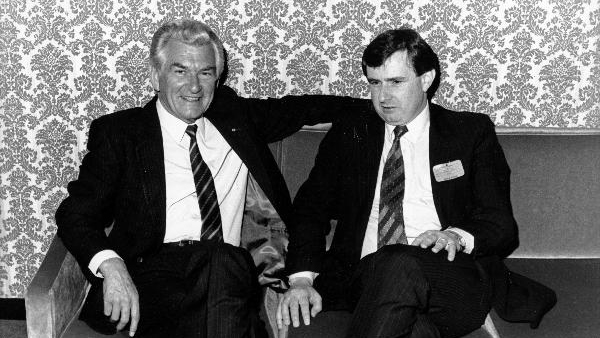
These four names provide a window into the institutional power that the FSPU once wielded. Bill Kelty and Simon Crean both started as research officers in the Victorian offices of the Storemen and Packers Union. In 1983 Kelty became the secretary of the Australian Council of Trade Unions (ACTU), a position he held until 2000. Crean became the federal secretary of the FSPU in 1979 and ACTU president in 1985. He later entered politics, taking the Melbourne seat of Hotham in 1990 and serving as the federal Labor opposition leader from 2001 to 2003 (where, to his abiding credit, he opposed the sending of Australian troops to support the 2003 US invasion of Iraq).
Crean and Kelty worked closely with Labor PM Bob Hawke to devise and enforce the Prices and Incomes Accord, a class-collaborationist agreement similar to British Labour’s earlier social contract. First implemented in 1983, the Accord aimed to reduce both industrial conflict and inflation by holding down real wages while introducing a “social wage” (measures such as the expansion of Medicare and the introduction of compulsory superannuation). Thirteen years of the Accord saw real wages fall by 15 to 25 percent, corporate profits soar, privatisation and neoliberal restructuring rip through the economy while union density declined, delegate structures withered and industrial strength decayed.
Bill Landeryou is not as well known. He was federal secretary of the Storemen and Packers Union before Crean and from 1976 a state MP in Melbourne’s outer western suburbs. Landeryou carefully built the Centre Unity [ALP right] faction that took control of Victorian Labor in the 1970s and became Bob Hawke’s power base.
The careers of Kelty, Crean and Landeryou mark the highpoint of the power once held by the Storemen and Packers union. This power never reached such heights again. But neither did it completely disappear.
Live by the Sword …
Greg Sword took over from Simon Crean as Storemen and Packers leader in 1986 and led the union until 2004. The new General Secretary orchestrated a series of amalgamations with smaller unions that saw his union become the National Union of Workers (NUW) in 1991. Sword was a leader of the Victorian ALP’s rightwing Labor Unity faction, serving two stints as the state president of the Victorian ALP and as party’s federal president from July 2000 to January 2004.
Infighting within the Victorian right marked both the beginning of the NUW’s declining institutional power and the end of Sword’s career. By the early 2000s Sword, the “smooth old warrior who ran Labor Unity for years” was in “open warfare” with the “ShortCons”, the sub-faction led by Bill Shorten of the Australian Workers Union (AWU) and Stephen Conroy of the Transport Workers Union (TWU). Sword was determined to stop them. In June 2002 he executed “the most dramatic move seen in the Victorian ALP for many years”, pulling the NUW out of Labor Unity and into a pact with the Socialist Left. But this factional manoeuvre backfired. Sword was soon obliged to step down as NUW leader and ALP federal president. The NUW then returned to Labor Unity, where power had now passed into the hands of Shorten and Conroy. Sword’s defeat all but killed off the NUW’s institutional power nationally.
Donnelly centralises power
In March 2004, Victorian NUW Branch Secretary Charlie Donnelly replaced Greg Sword as NUW general-secretary. Donnelly’s ten-year reign saw the increasing centralisation of power in the national office and the union’s Victorian branch. The Tasmanian branch was disbanded and dissolved into the union’s Central branch, then an ugly union referendum campaign in 2009 saw the NUW’s South Australian, Western Australian and Queensland branches follow suit. The Central branch (soon renamed the General branch) now spread across most states and territories. All that was left in the NUW were its national office, the General branch, the Victorian branch and the NSW branch.
Try as it might, Donnelly’s centralisation drive never fully brought the NUW NSW branch to heel. The union’s Victorian and national leadership had been at loggerheads with their NSW counterparts since the late 1980s, when Greg Sword first fell out with the maverick NSW branch secretary Frank Belan. The rift lasted for decades and was never healed. United Workers Union (UWU) leader Godfrey Moase acknowledges as much when he writes that “there were two operational units to the NUW — NSW and everywhere else … when I refer to the national union … I mean the national office and Victorian branch (which operationally did not include NSW)”.
Donnelly also tried to expand his power base via amalgamation with other unions. There were merger talks between the NUW and the Australian Workers Union (AWU) in 2005 and again in 2007. But they ultimately came to nothing.
Charlie Donnelly didn’t have the institutional power of his union predecessors, but he still carried some clout locally. He himself was state president of the Victorian ALP from late 2008 to mid-2010. The Victorian NUW was also able to bump a few local officials into state parliament: Martin Pakula and Jaala Pulford in 2006, Tim Pallas in 2014 and Gary Maas in 2018. All bar Maas served as ministers under Labor premier Dan Andrews.
Donnelly retired from the NUW’s top job in June 2014. Just months later, he was forced to explain to the Trade Union Royal Commission what he knew about the election slush fund called IR21 Limited. The company organised expensive fundraising events for employers and union officials to help fund union and ALP election campaigns. Donnelly described himself as the “driving force behind IR21”, the fund that raised between $200,000 and $300,000 a year. Labor Tribune does not suggest there was any malfeasance whatsoever, but it was an ugly way for Donnelly to bow out.
Kennedy takes over
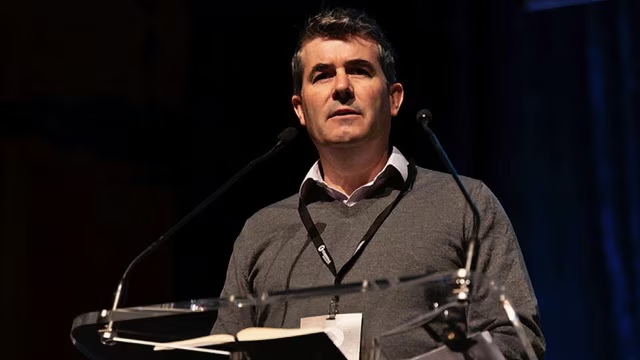
Tim Kennedy took over as NUW general-secretary in July 2014. He was first hired by Greg Sword in 1995 to work at the Victorian NUW as an industrial officer and organiser. Then from 2004, Kennedy was rotated through various national positions: assistant general-secretary, general vice-president and then general president. Along with these national positions, he was also promoted to the position of Victorian NUW branch secretary in 2010.
Kennedy has followed in the footsteps of Sword and Donnelly. He never publically opposed Donnelly’s campaign to centralise power and close down state NUW branches. And according to at least one report, he actively took part in it. Donnelly, Kennedy and a third NUW official reportedly gatecrashed a NUW Queensland branch delegate training day in 2009. Donnelly wanted to address the assembled delegates and hand out NUW ballot material in favour of closing down the Queensland and other NUW branches. Despite the delegates voting to not allow the national NUW officials to address the meeting, the three allegedly tried to force their way in before police were called to remove them.
The new NUW state secretary soon became a player within the Victorian Labor right. In 2011, Kennedy joined with the now infamous Kathy Jackson from the Health Services Union (HSU), Michael Donovan from the “Shoppies” union (SDA) and others of the so-called “Rebel Right” to throw their weight around in at least one state preselection contest. Just one year later, Kennedy distanced himself from the increasingly disgraced HSU leader.
After becoming NUW general secretary, the Labor right elected Kennedy to the Labor Party’s all-powerful National Executive in 2015. It was only a split within the right that thwarted his reelection in December 2018 (with the upcoming United Voice-NUW merger cited as the reason why he missed out).
Kennedy has been a part of the Victorian Labor right for more than two decades. And like several other former Victorian NUW counterparts, he is said to have his own parliamentary ambitions. Kennedy and others from the NUW have not forgotten the institutional power that their union and its Storemen and Packers predecessor once wielded. And a motivating factor in the upcoming UWU elections appears to be their desire to have it back.