
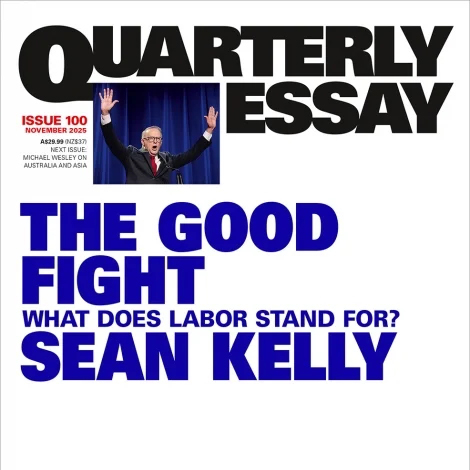
Hamish McPherson reviews Sean Kelly’s essay examining exactly what the point is of the Albanese Labor government.
Sean Kelly, ‘The Good Fight: What Does Labor Stand For?’, Quarterly Essay, Issue 100, November 2025.
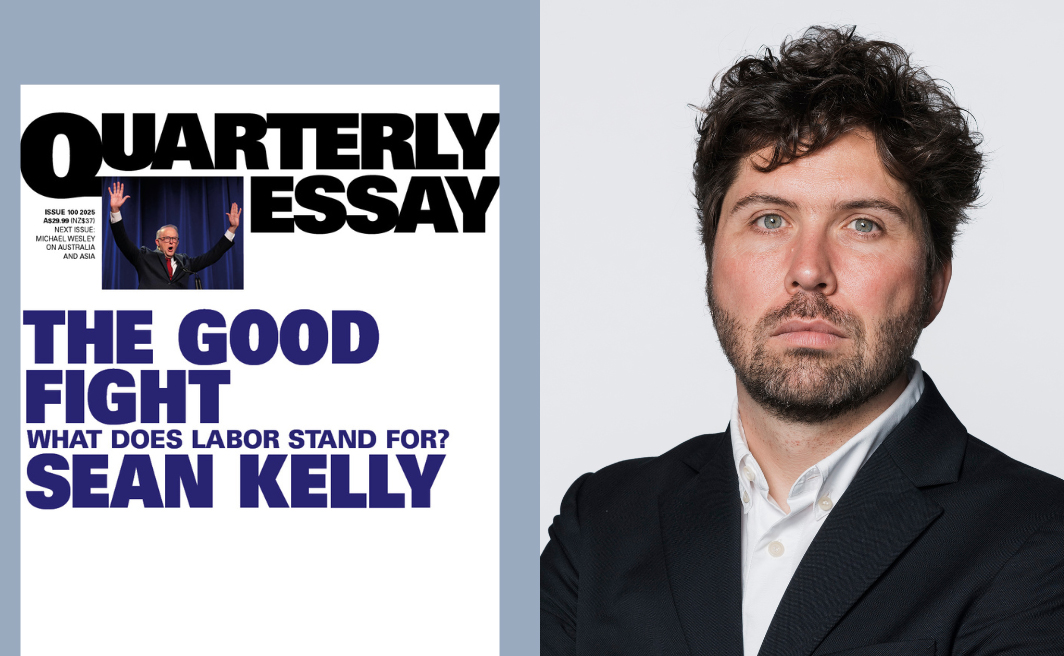
This essay seeks answers to a question that many Labor members and supporters and voters are rightly asking. As Sean Kelly makes clear, a full year into the second term of the Albanese government it is still not obvious what Labor in government stands for – what core beliefs guide it and what it seeks to achieve through holding power. To put it bluntly – what is the point of this Labor government?
Kelly writes from the viewpoint of a Labor partisan and a parliamentary ‘insider’ who advised both Kevin Rudd and Julia Gillard when they were prime minister, and this influences his analysis as he weighs up both the possibilities and constraints facing centre-left reformist parties and governments.
Initially the essay emphasises the real and imagined institutional constraints on government agency and power and to some extent excuses the timidity of the Albanese government. However, as he moves to interrogate the stated beliefs and actions of Albanese and his ministry his criticisms become more general and sharper.
Kelly highlights the apparent difficulty that current Labor leaders have in clearly articulating general political goals for the government and nation, the lack of a coherent and expansive vision for society. Albanese states that he wants Labor to supplant the conservatives as the ‘natural party of government’ but seems either reluctant or unable to explain for what purpose.
Likewise, Kelly states that both the parliamentary Caucus and official Left are noteworthy for their lack of debate or constructive criticism of government policy, for the absence of a ‘creative tension’ that has sometimes characterised reforming Labor governments.
He links this poverty of political vision to a more general decline in leftwing political ideology and capacity of the left to openly argue for a redistribution of social and economic power, and a different social order.
As Kelly notes, within Labor circles this is linked to a clear acceptance of neoliberal capitalism and the operation of market forces as the only general mode for society. The existing social order firmly constrains what is considered possible to achieve, leaving managerialism and incremental reforms seemingly as the only way forward.
Kelly explores how this general view underpins the political methodology of the Albanese government, especially the focus on consensus and the avoidance of conflict at all costs. He argues that this approach comes with a specific cost; a series of compromises and lack of actions that amount to an avoidance of any redistribution of economic resources, any challenge to the social class of asset holders and capital owners who have benefited so richly from the neoliberal order.
The essay critically examines the limited goals of the Albanese government. The widely used ‘No one held back and no one left behind’ maxim is found to contain a glaring contradiction: the government consistently honours its goal of not ‘holding back’ individual aspiration through asset accumulation or market ‘choice’, for example in relation to housing and tax measures or private health and education. But to the extent it does, it preserves the very neoliberal capitalist order that is ‘holding back’ the many working-class Australians in a casualised labour market, reliant on declining universal services and struggling to afford housing.
The essay draws on a wider set of ideas than is usual in Labor discussions, even favourably quoting socialist theorists such as Vere Gordon Childe and Antonio Gramsci. However, the essay does not attempt to offer a coherent political alternative to modern Labor.
By focusing on the intentions of Albanese, Kelly largely avoids a critical analysis of Laborism itself, the project of winning and holding state power to manage and somewhat reform the existing capitalist economic relations, not challenge the social order. This drives the ALP’s obsession with caution and moderation: to win a parliamentary majority with support from all social classes, to govern in the capitalist ‘national interest’, to constantly prove one’s ‘legitimacy’ and loyalty to the ruling class and the existing order.
Kelly illustrates this approach with his account of government back-downs in the face of vested capitalist interests (supermarkets, private service providers, fossil fuel industry, gambling) and his critical appraisal of Albanese’s limited goals, for example his self-description as a ‘social democrat who believes in markets’ which Kelly calls out as a case of “a dreadful blandness” that “should shock us”.
Albanese’s shortcomings and failures are in fact those of a wider political project that ties its ambitions and fortunes to what is considered acceptable by the existing capitalist ruling class. Modern Labor is willing to deliver modest reforms to workers in the form of higher wages, childcare subsidies, parental leave provisions and the like. However, it is not willing to directly challenge the core structures or distribution of wealth and power.
Without a more systematic analysis, Kelly tends to return to a somewhat plaintive and misplaced hope or appeal for Albanese and other Labor leaders in Cabinet, to find political imagination and courage that has thus far been missing in action.
Searching for signs of hope, Kelly identifies two areas for optimism, Albanese’s rhetoric about a ‘kinder’ Australia and a supposed shift to greater independence from the United States. While the former may inform some modest policy reforms, the latter is plainly contradicted by the government’s wholehearted embrace of AUKUS and the US military agenda in the Asia-Pacific.
Kelly’s essay is a timely and pointed critique of the gradualism and managerialism of the Albanese government and a welcome attempt to provoke some critical thinking about the overall purpose and direction, or lack thereof.
Our movement can only benefit from more critical and deeper thinking – to motivate a break from the timid reformism of Albanese and the Labor leadership and inform the building of a more ambitious anti-capitalist labour movement and left that is fully equipped to change society in the interests of the great majority.
Hamish McPherson is a member of the Labor Tribune editorial board and is Victorian Convenor of Labor Against War.