
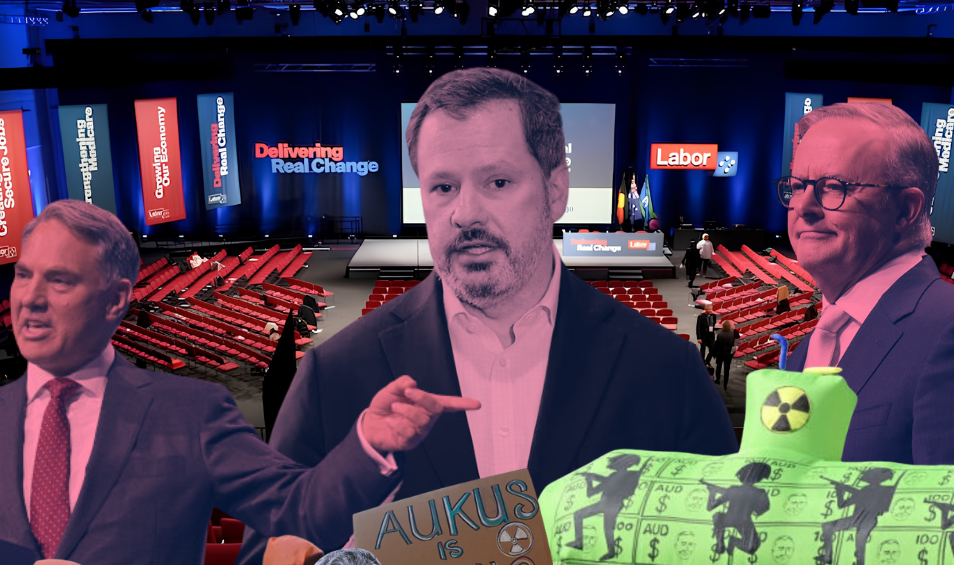
William Yang says that factional divides are not based on ideological lines, and haven’t been for some time. The modern ALP is ruled by a group transcending factions that is philosophically authoritarian and Neo-Keynesian at a the best of times.
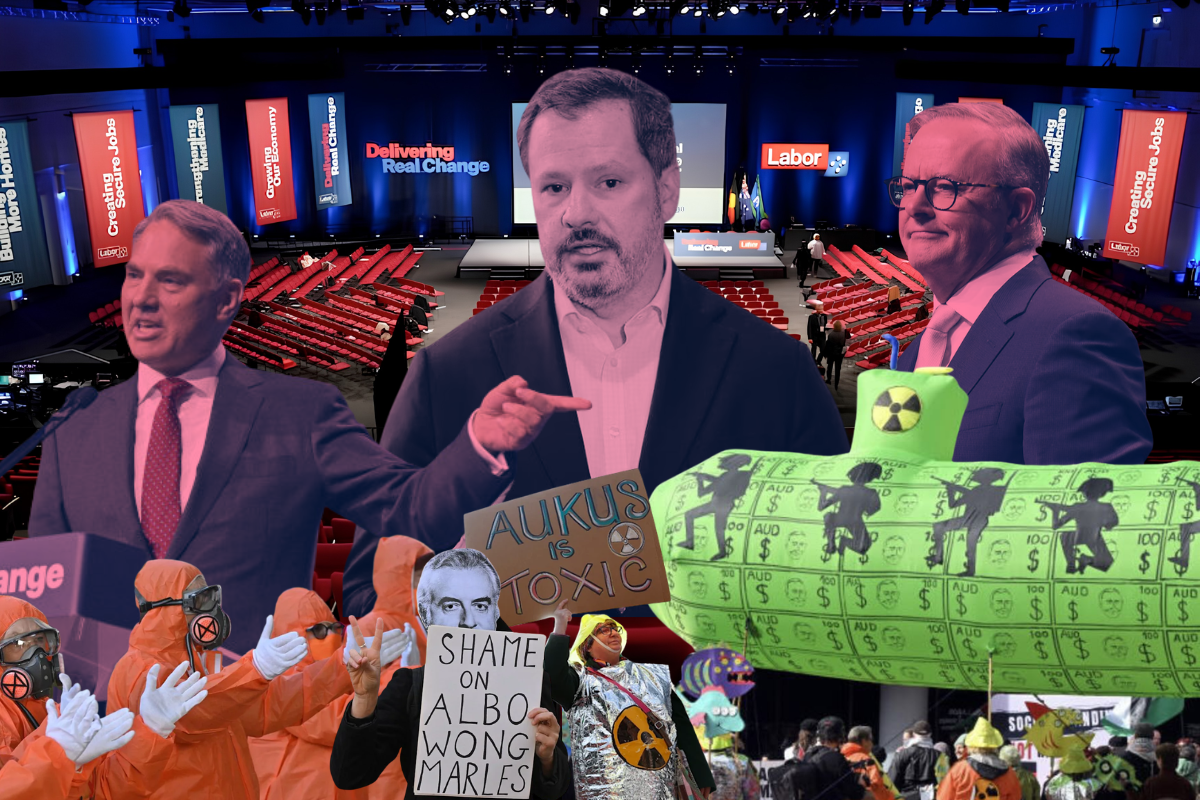
More festival than conference
Straight after landing in Adelaide Airport on the 22nd of July, I headed to The Hotel Metropolitan, where a senior Government Minister, Tony Burke, and the Prime Minister’s speech writer, thought the best use of their time the night before the ALP’s 50th National Conference was to host a ticketed pub gig.
I later found out that the Financial Review reported pre-booked tickets to this gig were initially being sold online at an absurd price of $1,000. Disappointingly for Minister Burke’s band, it seemingly had to reduce ticket prices gradually to fill the venue, dropping the cost of entry to just $50 later that night. I didn’t pay to see Burke’s band and instead chose to just try all the different drink sizes in South Australia. Sources claim the band was “surprisingly good”.
The ALP National Conference is a triennial event where 400 delegates from trade unions and Labor Party branches across states and territories come together to elect the party’s National Executive and shape its National Platform. Despite the National Conference receiving far more media attention, within the party, the respective state conferences are considered higher stakes as it is the state conferences that preselects and effectively determines Labor’s members in the Senate and State Parliamentary Upper Houses.
However, National Conferences have an importance unique to themselves: the process of the conference embodies the spirit of the Labor Party and much of the labour movement at a moment in time. When large numbers of apparatchiks, ministers, and union secretaries gather in one spot, the feeling that comes to mind would be tension. The atmosphere at ‘the Met’ was anything but that, most people knew this would be a conference where nothing happens.
On the first day of the Conference, attendees were greeted in the early morning by rows of protesters that the South Australian Police moved into a neatly organised space running alongside the main walkway into the entrance of the Adelaide Convention Centre. Some protesters gave out stubby holders with ‘Tax Gas Not Beer” printed on them, which I made sure to take a few.
In the middle of the convention centre, a merchandise store was set up. Most interesting were the mugs made specifically for this Conference. There were different mugs for the last six Labor Prime Ministers: Albanese, Gillard, Rudd, Keating, Hawke, and Whitlam. Gillard’s mugs sold out first, and almost instantly, followed by Keating’s. Whitlam’s sold out at a distant third (I bought the last one). Then Albanese’s and Hawke’s sold out, Rudd’s were the noticeable last. The popularity of these mugs is probably the closest thing we have to a contemporary internal ALP poll of these Labor Prime Ministers.
The Conference proper was far less interesting, starting with speeches by the party organisation’s executive, South Australian Premier Peter Malinauskas and then Prime Minister Anthony Albanese.
Barely an hour after the Conference commenced — around the time Albo finished speaking and before Deputy Prime Minister Marles even got the chance to walk up to the podium — about a third of the attendees left. As much as I wish I could say people walked off in protest against Marles or AUKUS, it would be more accurate to say that most people weren’t interested in hearing the Government praise itself for another hour.
The number of delegates that just went off to do their own thing is quite shocking considering the context that the Left faction only has a small majority on the floor. Typically, when control of Conference floor is marginal, delegate discipline is tightly enforced, and the factional whips flood the floor with proxies and alternates before a single person is allowed to leave.
On that morning, Chinese diplomats protested the presence of Taiwan’s de-facto diplomats, who attended as “General Observers”. I feel the need to question claims that the Chinese diplomats walked out hours afterwards due to that incident. As Albo’s speech finished, the columns that cleared out the fastest were those reserved for “Diplomatic and International Attendees”. In fact soon afterwards, the conference organisers removed the sign that reserved those columns for diplomatic attendees. Although I can’t say for certain, I think there is a decent chance that Chinese diplomats, alongside most other diplomats, left mainly because they were bored.
‘Fringe Conference’ and funny moments
I spent most of the first and second day of the Conference exploring the Fringe Conference opposed to listening to the politburo praise itself for days. Fringe ended up exceeding expectations and produced some of the most entertaining parts of the Conference as a whole.
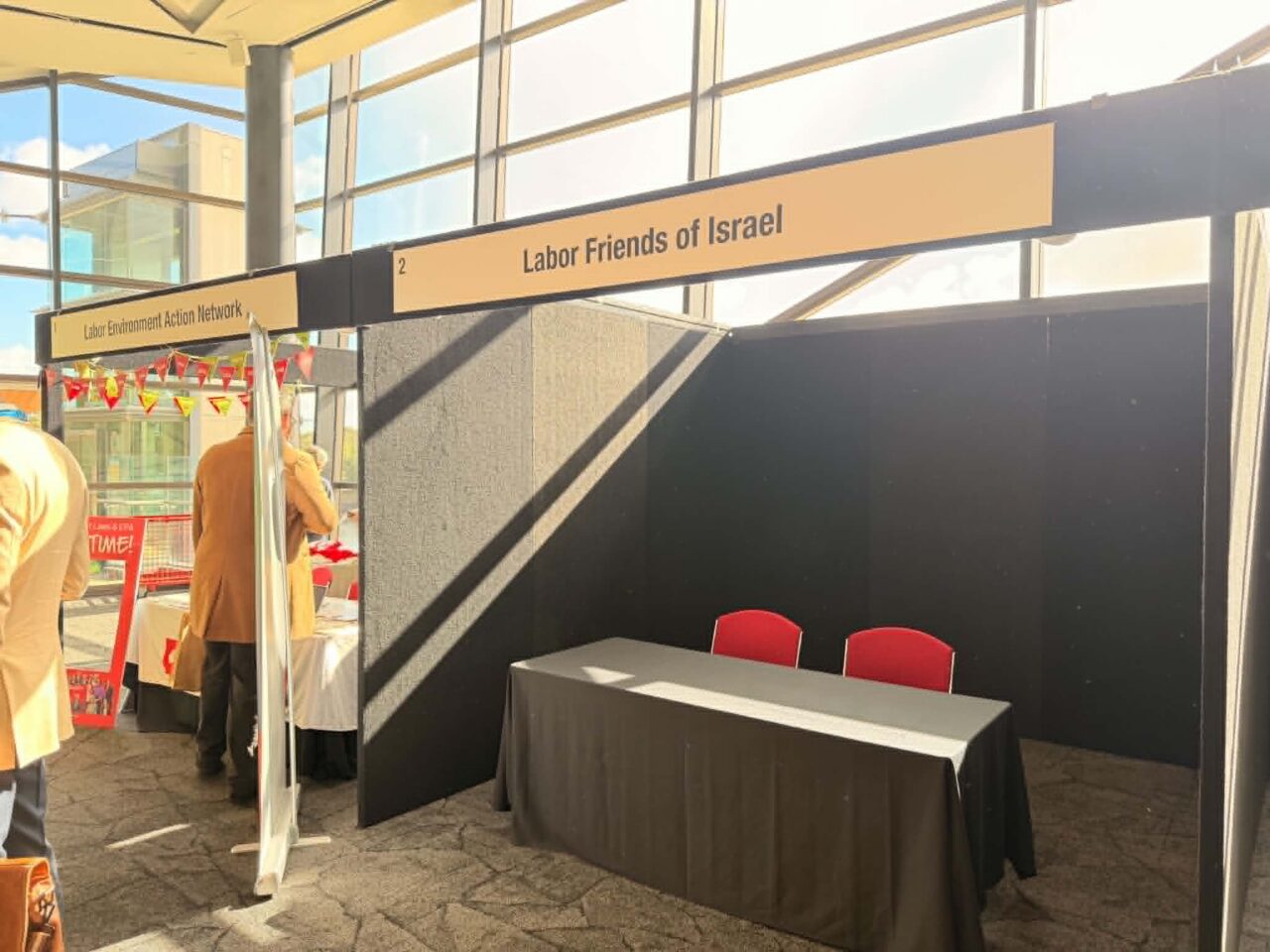
With 24 stalls and 63 events scheduled, the ‘Labor Friends of Israel’ stall was one of the most talked about. The stall was completely empty and unstaffed for the entirety of the first day despite all the attention it had gotten just from its name alone.
By the second day the ‘Labor Friends of Israel’ sign was gone and the stall was given over to Gambling Harm Lived Experience Experts (GHLEE). Paying for a space in Fringe was not cheap, it should be questioned how ‘Labor Friends of Israel’ booked and paid for a stall but managed to not organise a single person to set it up or staff it.
The Chifley Research Centre was contacted about what was charged and how it was financed, no response has been provided. However, organisers verified that to run the standard one hour events at Fringe costs $5,000 plus GST, and a stall costs $825 for not-for-profits, with prices potentially varying depending on the organisation.
Former Liberal MP Trent Zimmer and Former Liberal Defence Minister turned arms lobbyist, Christopher Pyne, were both in attendance at the ‘Fringe Conference’. Pyne also attended as a speaker to a Fringe event, comically his event ran at the same time and right next door to the Australia Institute and Anti-AUKUS group, Labor Against War’s (LAW) event. LAW convenor Marcus Strom humorously referred to Pyne as “the enemy next door.”
The funniest moment of the Conference occurred at the LAW event, when an attendee, completely missing the mark on the anti-imperialist reasons for opposing AUKUS, suggested we pursue AUKUS but just with renewable energy submarines. Part of me thinks that person was an ASIO plant to make us look ridiculous.
The schedule for the second day in Fringe was filled with events about AI, ranging from an event paid for by Google to Union-ran panels on AI in the workplace. Google’s Fringe event was presented by a government-relations manager who kept finding herself at odds with an attendee that she conceded ‘knew more’ about the subject matter than she did.
The funniest part of the second day was when Google’s presenter made a claim that one of their models could do research at “PhD levels”, which triggered another back and forth between her and that attendee. After a couple of minutes, Google’s presenter conceded that the model’s research may only be at an “undergrad level”.
Highlights
For a three day ordeal, there are unfortunately only meagre points I look back on as ‘highlights’. In honesty, my hopes were so low that these ‘highlights’ were actually more than I had initially expected. Of all the ‘highlights’, I am most hopeful for the Fair AI Taskforce.
It might be overly optimistic, but at the least it is comforting to know that the Australian Government is preparing to respond to AI sooner than later. The principles behind ‘Fair AI’ outlined by Dr Andrew Charlton MP in an address afterwards can be summarised as a ‘different path’, distinct from letting AI rip through the workforce, and requiring a nuanced response that can’t be as blunt as an outright ban.
I’d personally be happy with AI if formal employment is abolished on the condition productivity gains from AI gets redistributed in the form of an UBI. Another Union-centric ‘highlight’ was the announcement the Government will establish a ‘Fair Work Court’ to streamline underpayment claims. Unions and NGOs, like the Migrant Justice Institute, have been calling on the Government for years to streamline processes for workers to recover stolen wages. If done right, the Fair Work Court will finally reduce some of the exploitation experienced by migrant workers disproportionately.
The only amendment to the National Platform that was debated and contested through a vote was about voluntary assisted dying (VAD) accessibility and lifting the ban on remote VAD consultations. The push, which came primarily from the Left, with some support in the Right, serves as an example of what can be achieved when the Left chooses to use its majority and stand firm despite opposition from the ‘Left’ Prime Minister it holds so dear.
The morning ahead of the debate on VAD, Dom Ofner, senior Right figure and NSW Labor General Secretary, addressed the National Right Caucus and called for a conscience vote on the issue according to a source. In a move uncharacteristic for someone in the NSW Right, he then extended an open invite to the room to speak against his proposal, not one person objected.
‘All about Ed’
On the third and final day, Albanese complained to the media room that the press would make the conference “all about Ed”. The reality was, for everyone there, the final day was truly “all about Ed”. The only resolution on Palestine the party machine wanted on the conference floor was one ticked off by Foreign Minister Wong’s office, which Bassem Abdo MP and Josh Burns MP spoke to. The joint statement by a MP of Palestinian descent from the Left, and a Jewish MP in the Right was meant to display to the public a veneer of unity the party machine desperately wanted to show off. Husic’s renegade motion threw a spanner in the works.
As is standard with most Labor Party conferences, the final day was a half day. Attendee numbers usually drop through a hole on the final day with the casualties most visible the hours ahead in the morning caucus rooms. I had never seen a caucus room as packed as the Left caucus at 8am on the final day of this conference. Husic’s motion did better turnout than any apparatchik could. The Right’s caucus room was similarly impacted reportedly, despite the noticeable absence of Husic himself. The Right’s meeting lasted only for 30 to 40 minutes, finishing not long past 9am. While the Left’s took well over an hour, finishing about 15 minutes before conference resumed at 10am.
The tone in both caucus rooms completely changed from jovial and relaxed in all previous days to an atmosphere filled with the tension that’d be expected at a conference of the party in Government. In the Right’s caucus, delegates were told the only resolution that would have the support of their caucus was the joint statement from Burns and Abdo. According to one source, Marles proclaimed to the Right’s delegates “There will be no mention of the G-word”. It is disappointing, but unsurprising the aversion to offend Israel is so great that the Deputy Prime Minister cannot even bring himself to say the word ‘genocide’ properly in a context such as that.
The contents of Husic’s motion summarised was a call to “withdraw defence cooperation” with Israel, establish “full diplomatic ties” with Palestine and acknowledge UN and ICJ findings on the genocide. The motion (which can be found in full on Labor Tribune) cannot be considered radical by any sensible means.
Compared to the Right, the Left took a lighter hand approach. Abdo spoke to the caucus, noting he personally believes Husic is acting in “‘good faith” before implying that voting for Husic’s motion would undermine all the work put into getting agreement on the joint statement.
The Left caucus room was then treated to “gentle” but also received numerous reminders from Ministers and the factional executive of the importance of “solidarity” and “what it means to be a majority”. The soft approach did not extend to two people who were allegedly seen filming speakers in the caucus room. The Left caucus room, unlike the Right’s, was decorated with corflutes and merchandise, partially for the exact reason of photographing and filming the speakers, with no shortage of people recording on their phones in previous days. However, the two people allegedly seen filming on the final day were subjected to a tirade of denunciations resembling a Maoist struggle session. Given the Left has a majority and all speakers on conference floor are recorded, I found the no recording rule in the final caucus ridiculous.
Around 9am, a representative of the Maritime Union of Australia (MUA) addressed the Left caucus. The MUA reiterated its view on the moral obligation of the labour movement in standing up against injustice and genocide. Which only added to the surprise when at the end of his speech, the MUA announced they will withdraw their second-ing of Husic’s motion. A few minutes later, we were informed Husic’s motion would not make it to conference floor.
Later that morning, the Israeli Ambassador Dr Hillel Newman, was seen having a conversation with a prominent member of the Zionist lobby in South Australia (attending as a ‘General Observer’) and a News Corp journalist by the free coffee station.
When asked what he thought of the result, the Israeli Ambassador was heard saying words to the effect of “It’s not everything we wanted, but we’re satisfied.” It was as if they were bragging.
When I later asked Stephen Lawrence if Israeli diplomats and/or non-party attendees played a part in the pressure campaign he and Husic spoke of, Lawrence said “I very much doubt the Israeli Ambassador would have been directly part of any pressure campaign around the withdrawal of motions or seconders. I say that because their involvement would have backfired”.
However, Lawrence suspects their “best strategy” is to “work through sympathetic proxies who push misleading narratives”. The Israeli Government’s lack of reservation towards intervening in Labor Party politics is evident from their published statement before the Conference even started.
Disorganisation or conspiracy?
In the process of writing this article, I ended up in contact with a number of surprisingly senior sources. One senior source that directly contacted this writer oversaw the campaign to support Husic’s motion from the perspective of the Unions, and their insight expanded upon the question of why wasn’t Husic’s motion debated?
The short answer to the question is that by Saturday morning, just prior to the Conference discussing its foreign policy chapter, Husic’s motion no longer had a seconder due to the Unions withdrawing. An alternate seconder could not be obtained as the deadline to register a seconder for motions was Friday midday.
Husic’s strategy, which Labor Friends of Palestine (LFOP) supported, was to have a Left Union second the motion to demonstrate an institutional and broad level of support for the push to recognise the genocide. However, this strategy had limitations as it was expected any union that seconds Husic’s motion would be opening themselves up to significant pressure. To reduce this vulnerability, two copies of the motion were submitted and seconded by the MUA and Electrical Trades Union (ETU) respectively, the two unions are considered amongst the most politically militant Left Unions.
Most onlookers have come to the reasonable conclusion that the MUA and ETU withdrew their support due to pressure from the ‘factional powerbrokers’ and ‘heavyweights’ Husic spoke of in the presser he did moments after it was confirmed his motion was scuttled. While that is likely true for Husic’s lack of support in the Right, the senior union source claimed not a single ‘heavyweight’ or Government Minister tried to pressure the Left Unions, and not a single one of their deals or member issues were threatened.
This source instead claims, the Left Unions were only approached by senior ‘pro-Palestine’ figures, allegedly including LFOP figures, which lobbied them to withdraw their support for Husic’s motion. The Unions were led to believe that LFOP was divided on the issue and Husic’s push did not have support in LFOP outside of NSW. Consequently, this source claims the Unions withdrew their support out of respect for what was believed to be the wishes of LFOP delegates in Victoria and Queensland.
When LFOP was contacted by the SMH about the Conference, they declined to comment. Nonetheless, an anonymous senior source in LFOP told this writer, delegates in the LFOP group met the afternoon before Husic’s motion was due to be debated and unanimously resolved to support the motion and campaign to convince undecided delegates. Furthermore, it was denied there were any internal divisions in LFOP between state branches on Husic’s motion. Additional sources in Victoria and Queensland LFOP said their delegates would have supported Husic’s motion should it have been debated on the conference floor.
Reflections
I’m inclined to believe that the Left Unions weren’t directly threatened by Ministers or factional powerbrokers. The outlined account of the Union’s perspective is believable considering multiple senior figures told the Guardian they “denied a coordinated effort by factional leaders to block the resolution”, no factional leaders were directly involved per the account I received. The account also mirrors the lighter hand approach taken in the Left caucus room. It would be far too scandalous, if leaked, for any Minister to threaten deals benefitting Australian workers, even for the interests of Israel. The one point that doesn’t add up is the conflicting accounts of LFOP’s supposed internal divisions on the issue, which LFOP themselves did not help by refraining to comment. When speaking to sources in LFOP, most indicated a level of uncertainty in the positions of LFOP members from different states. However, all were united in their independent support for Husic’s motion.
Was it disorganisation or conspiracy that left Husic out to dry? I believe it to be a combination of both in this case. While some delegates who are also involved in LFOP may have had reservations, the leadership of LFOP were united on the issue. It is likely that the Left Unions were partially misled by certain actors claiming to represent LFOP and partially mistook the reservations of individual delegates to represent the wider views of LFOP and other supposedly ‘pro-Palestine’ figures. It wouldn’t have helped that the only person of Palestinian descent in Parliament expressed a clear preference for Husic’s motion not getting debated.
The contemporary National Left faction and the draft amendments its delegates advocate for are anything but revolutionary, and the reality is a good number of the Right’s delegates would be in support of those pluralist measures if given the choice. The contested vote and victory of the Left on VAD shows clearly the Left can use its majority to wedge the Right and stand up against the Prime Minister at the same time should it choose to. Unfortunately, it is more complicated than that.
If anything, this Conference has shown that factional divides are not based on ideological lines, and haven’t been for some time. The modern ALP is ruled by a group transcending factions that is philosophically authoritarian and Neo-Keynesian in the best of times. The current top down culture is embodied by the party’s National Executive, which in theory has near limitless power over preselections and state branches. That being said, the subgroups within the ALP’s elite are not stagnant: people fall in and out of favour constantly. The catch is, change within the ALP currently requires permission from its elites and any exception is more a miracle or fluke rather than anything else.
However, there is hope for change. Albeit with limitations, LFOP has demonstrated it is possible for those in the Labor Party to create evergrowing, long lasting, and institutionally democratic coalitions. Such a project faces two ultimate tests. Firstly, whether those against the current ALP establishment seek to transformatively change the party’s culture and governance as opposed to just replacing those in control. Secondly, if it is capable of overcoming the ideological variability that allows even a credible doubt to exist when it comes to, for example, LFOP’s position on a motion as moderate as Husic’s.
This article first appeared in Honi Soit. It appears here with the permission of the author and Honi Soit editors.