
The debate over immigration represents a division in the ruling capitalist class. The task of socialists is to unite workers around a political program to challenge capital’s control of migration, argues Marcus Strom.

When Australia’s immigration minister Tony Burke addressed the National Press Club this month, he intended to demonstrate that the Albanese government was running the agenda on migration. Instead, he demonstrated that the Labor government is running scared.
The weeks-long delayed “reset” on immigration will do little to settle the issue. The question of “who comes to this country and the circumstances in which they come” is set to dominate the political agenda up to the next election.
Burke’s “crackdown” on “visa hopping” by international students, restrictions on students bringing family members, and measures targeting backpackers and people overstaying visas are cut-and-paste jobs from One Nation’s platform. Burke has not adopted the whole One Nation platform, but he has ceded more of the floor to its agenda. His answers about how the crackdown would be enforced were vague, while he denied it would involve ICE-style (US Immigration and Customs Enforcement) raids on migrant workers.
Since the National Press Club speech, Burke has responded to complaints by farmers and other businesses reliant on a seasonal workforce that they can look to employ Pacific Islander workers through the PALM (Pacific Australia Labour Mobility) scheme.
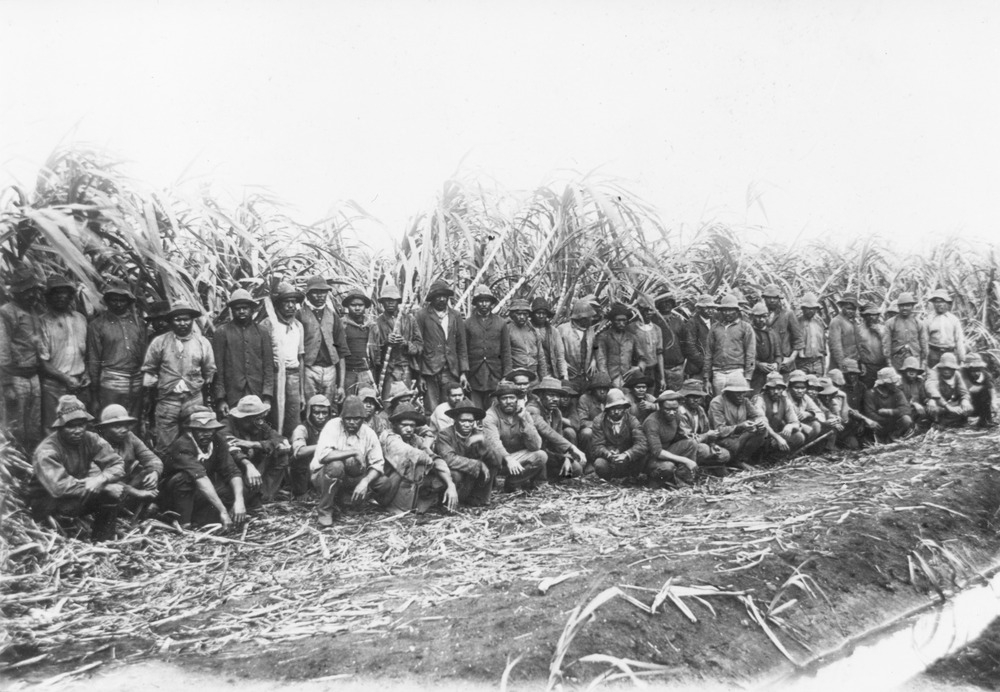
The scheme, reminiscent of blackbirding Pacific Island workers into the sugar industry in the 19th century, is designed to offer temporary visas from a few months up to four years for low-paid and low-skilled jobs in agriculture, meat processing and aged care.
“We have the Pacific Workers Scheme, which is there and waiting,” Burke told ABC Radio National earlier this month. “If they’re [farmers] willing to use the Pacific workers, then everything that they want picked, every job they want done, is completely there and able to be done.”
One Nation’s spokessquawker, Barnaby Joyce, wants backpackers excluded from the crackdown. He openly calls for temporary workers to be employed in low-paid jobs, while insulting young workers.
“There are a lot of jobs that just cannot be filled with Australians because … they’ve basically risen above the bottom level. Or they’re just bung lazy and are not capable of work,” he said as reported in the Sydney Morning Herald.
The adoption of elements of the far right’s anti-immigration platform by parties of the pro-capitalist centre does not stop the drift to the right. This month’s elections in Germany provide just the latest example, where the far-right Alternative für Deutschland (AfD) won between 38 to almost 44 percent in the states of Mecklenburg and Saxony.
Burke’s adoption of parts of the One Nation platform will not stop the drift to the right. It will only add fuel to the fire.

A guest worker economy already exists
Ahead of his Press Club address, Burke told the Sydney Morning Herald that he was “very worried” about Australia becoming a guest worker economy, responding to former Department of Prime Minister and Cabinet secretary Martin Parkinson’s warning that Australia was becoming a guest worker economy. Burke said he did not have “an immediate fix”.
A similar sentiment was expressed by Julian Hill MP in parliament in 2023: “we don’t want our country to become a guest worker society where there’s this temporary underclass that is exploited”.
Unfortunately, it is already too late.
More than 16 percent of Australia’s working-age population is here on a temporary visa of one kind or another. While the permanent migration intake remains relatively steady at around 200,000, the temporary visa program has grown dramatically. This has created what Parkinson called an “underclass of the permanently temporary”.
Australia’s reliance on temporary workers is among the highest in the OECD.
The prevarication around immigration, which is fuelling the rise of One Nation, reflects a fundamental division within the capitalist class over the nature and character of labour entering Australia. Australia is not alone. As the neoliberal order crumbles, this division is driving political conflict across the advanced capitalist world.
Without its own political agenda and independent political organisation, the working class partly reflects this division.
Yet the socialist left, by and large, reduces the whole argument to a question of racism. This misses the bigger picture.
Divisions within the ruling class
In the age of universal suffrage, the ruling capitalist class must cohere the working class around its rule through national chauvinism via a mixture of positive identity and negatively, by promoting division among workers.
With massive shifts in the global economy, the ruling class is divided over what form of national chauvinism to promote and how to cohere the working class around it. The question is not simply whether Pauline Hanson or Gina Rinehart are racist. It is about how different sections of capital seek to control the supply of labour and divide workers from their own interests.
That division is only going to increase. As global capital demands greater access to Australian resources, so too will there be demands for increased labour immigration.
To simply say “No to racists” and leave it at that effectively aligns those socialists with the liberal-progressive wing of the capitalist class, which advocates an orderly, non-racist immigration program. It also risks pushing workers materially affected by the growth of a guest worker economy into the arms of the reactionary wing of the ruling class and its political operatives in One Nation and the Liberal Party.
Photo: Michael Coghlan/Flickr/CC
To deny that an “underclass of the permanently temporary” on lower wages puts downward pressure on wages overall is to deny reality.
The most reactionary elements of the capitalist class certainly attempt to whip up anti-immigrant sentiment. But they can do so because an increasingly unregulated guest worker economy creates downward pressure on wages. That is the point.
A settler economy like Australia requires migration to fuel growth and capital accumulation. The impetus behind the growth in temporary work visas came in large part from sections of capital requiring low-paid labour – farmers, hospitality businesses and others.
As Eryk Bagshaw reported, the Howard-Ruddock government established a minimum annual income for temporary migrant workers and tied it to inflation. In 2014, Tony Abbott’s immigration minister Scott Morrison froze that minimum at $53,900. Two years later, the guest worker program had tripled to 260,000, fuelling employment of temporary visa holders on below-average wages. This has taken the form of international student visa holders, those on working holiday visas and those with skilled worker visas.
Since coming to power, the Albanese government has abolished the minimum pay freeze for sponsored workers and has reindexed the minimum. However, this does not deal with the black economy employing hundreds of thousands on student and other temporary visas.
In May, the Australian Anti-Slavery Commissioner reported “structural” and “deliberate” under payment.
“Two-thirds of migrant workers are paid less than they are owed under the Fair Work Act. More than a third are paid below the National Minimum Wage. High rates of casualisation, sham contracting through ABNs, falsified payslips and unpaid superannuation are leveraged by employers to conceal underpayment.”
Australian Anti-Slavery Commissioner
The dilemma facing the Albanese government – and any future government – is that Australian capital requires more labour. This is why large sections of the capitalist class have come out against One Nation’s proposed cuts to migration.
The National Farmers Federation warned that cutting temporary and migrant workers would “kill the economy”. The Business Council of Australia said One Nation’s proposal to cut migration by more than 750,000 people risked “holding back economic growth and worsening skills shortages”.
The Australian Industry Group warned of “severe economic self-harm”, while the Australian Chamber of Commerce and Industry argued that “major cuts to skilled migration would damage the economy and weaken Australia’s capacity to provide services and raise living standards”.
Most big capital is opposing migration cuts, but other sections are supporting One Nation. This points to real divisions within the Australian ruling class. Sections of urban capital promote multiculturalism and even “anti-racist” unity around national chauvinism. Other, more reactionary sections – particularly in primary resources – seek to limit the inflow of labour. One Nation seeks to cohere voters around a more explicitly monocultural form of national chauvinism that limits migration.
The fact that One Nation is attempting to appeal to sections of the migrant vote further demonstrates the inadequacy of reducing the question simply to racism.
The divisions within the working class on this question reflect in part those divisions among capitalists. Without its own independent party and program, why would we expect anything else than division among workers on this question.
A socialist program for migration
With the capitalist class divided over migration, our task is not to tail the more “liberal” and “anti-racist” wing, but to develop an independent working-class program around which to unite a divided working class.
Immigration laws were introduced more than a century ago to control the movement of labour as capitalism globalised. Historically, this was intertwined with racist laws associated with colonialism, including the White Australia policy. Today, multiculturalism and official state anti-racism have increasingly substituted for those older ideological forms, but the need for capital to control the movement of labour remains.
Globally, capitalism seeks to control labour supply while promoting the relative free movement of capital. With the collapse of the postwar Keynesian settlement and the crumbling neoliberal consensus, the question of how this is achieved has become a source of division within the ruling class.
This is our opportunity.
The ruling class (mostly) promotes the free movement of capital while the state regulates and restricts the movement of labour. We oppose that. The capitalists generally allow for the free movement of its own class – irrespective of nationality or ethnicity – while denying this freedom to us. We oppose that.
Our principle is simple: we are for the free movement of people.
Our maximum program is for a world without borders.
Our minimum program should give migrant workers full citizenship after six months, establish a living minimum wage for all, and integrate migrant workers into a reborn, militant trade union movement. Temporary visa holders in Australia should be given the opportunity to become permanent residents and citizens with full democratic rights.
Migrant workers coming into the country must receive trade union rates of pay and be integrated into the labour movement. We oppose the use of migrant labour to plug low-paid jobs.
More than that, we are for the democratic integration of our collective humanity. Migration brings the richness of humanity to the new country.
Free movement of people cannot be achieved with the wave of a magic wand. It is unlikely to be fully realised until we have a global socialist commonwealth. But it is a demand we put to the capitalist class to reveal its limitations. It is an aim realisable only with a global socialist economy.
Furthermore, a world that is based on common solidarity, without war, would not produce the negative drivers of migration associated with war and famine. In the main, people prefer to stay with their families, their communities and in the places they grew up in. But we should welcome migration as a completely normal human endeavour as it has been for millennia.
This position on migration has to be understood as part of our whole program. A working-class socialist government would ensure a living wage for all, housing for all, free education and medical treatment, and laws on wages and conditions in the interests of workers. Migration would not undermine wages under such conditions.
By taking political power, the working class begins the process of suppressing the law of value and replacing it with the law of planning. Our task is to develop the program and organisation capable of contributing to that transformation.