
With many unions on political strike ahead of Saturday’s election, Hamish McPherson examines what went wrong and the challenges facing the left.
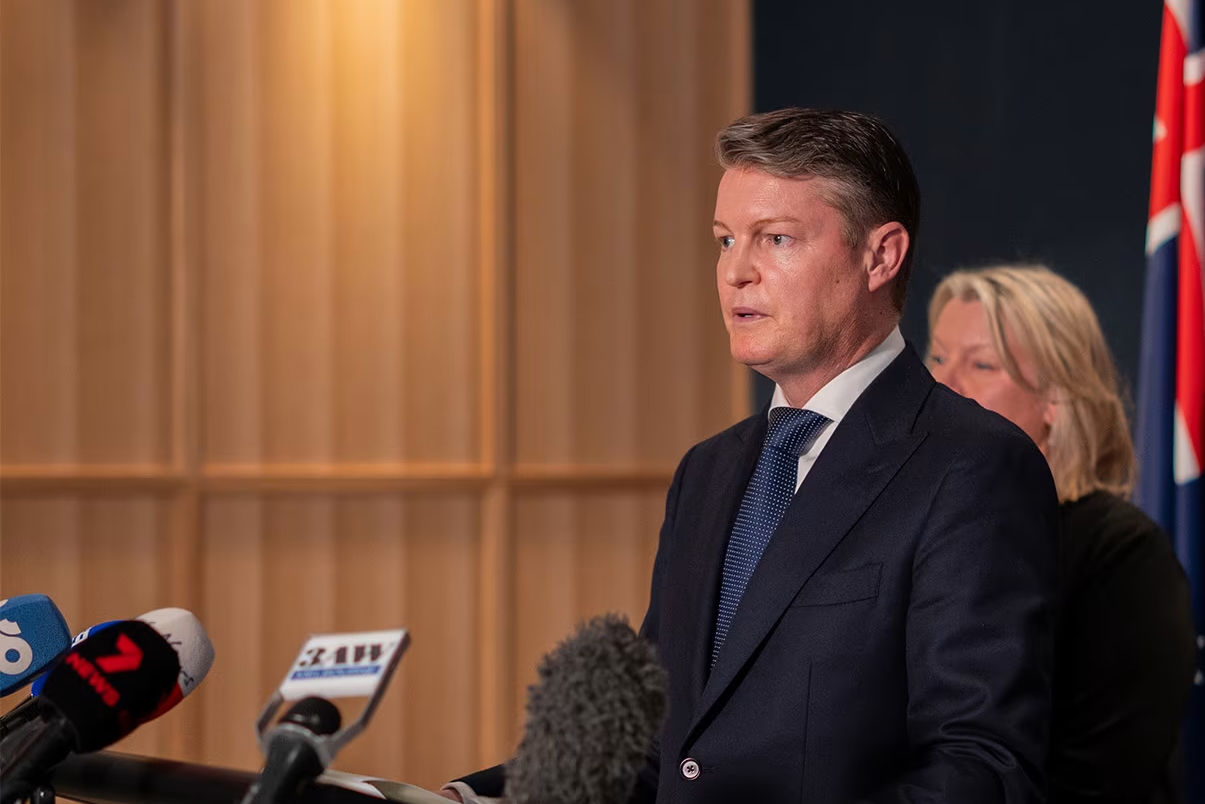
Victoria is in a state of angst and uncertainty leading into the state election this Saturday. General disillusionment with Labor looks set to deliver power to the Liberals, possibly in alliance with One Nation.
The major parties are polling historically low primary votes; Liberals about 30%, Labor in the mid-twenties. One Nation has swept up an ‘anti-establishment’ vote also in the mid-twenties, while the Greens are polling about 15%.
The Coalition will need to win an additional 16 seats to form majority government. Labor is fighting to hold seats previously considered safe and is mostly running a negative campaign warning voters of the risk of a Liberal-One Nation government and their supposed intention to privatise or Americanise the public health system.
It’s a harsh reversal of fortune for Labor which has governed since 2014, winning an increased majority at the 2022 election. The collapse in support is raising difficult questions and arguments within the labour movement about what exactly went wrong.
The Labor campaign slogan is “fighting for working people” but in recent weeks a series of affiliated trade unions, including the Australian Services Union (ASU), Electrical Trades Union (ETU) and Health Workers Union (HWU), have withdrawn support from Labor. The specific grievances vary, but all point to a growing disconnect between the government, the ALP and its working-class base.
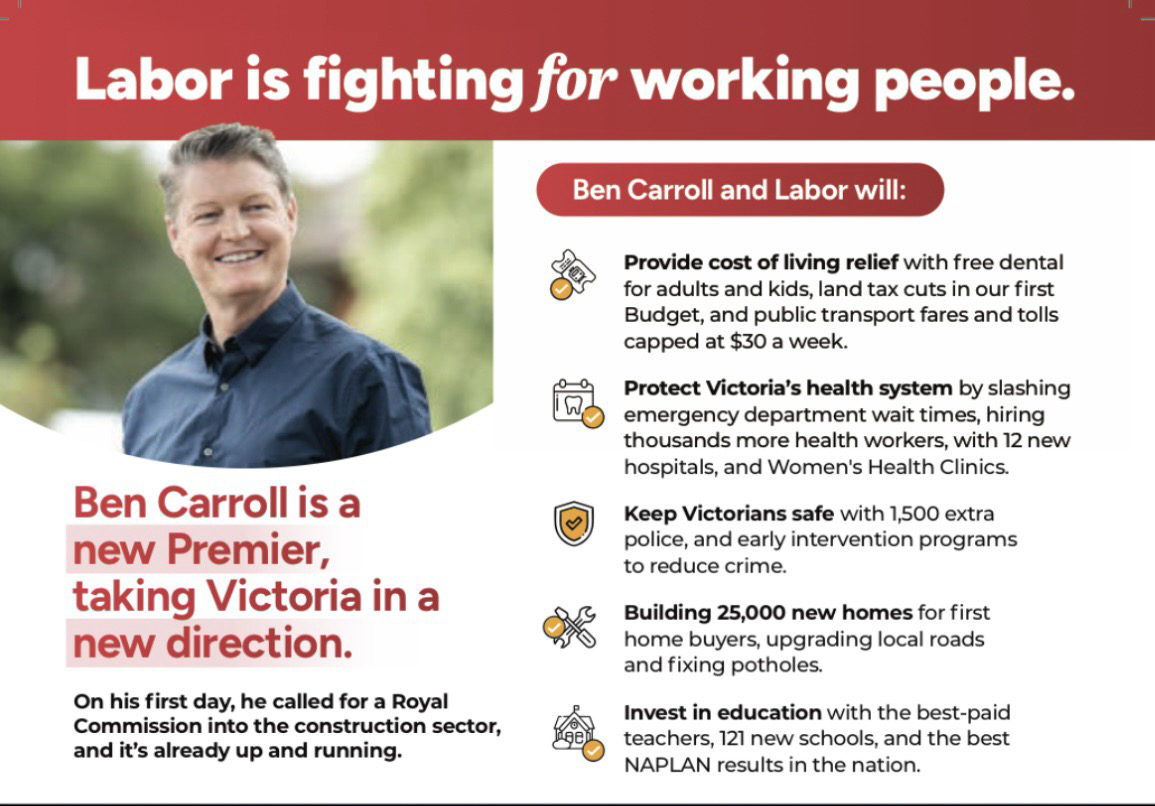
Victorian Trades Hall Council has been mobilising union members to doorknock to “put the Liberals and One Nation last” – replicating previous successful efforts. That didn’t stop VTHC coming out swinging against Labor’s decision to bolster the state budget surplus by taking $1.3 billion from the public WorkCover insurance scheme, having boosted the scheme by both restricting mental health claim criteria and raising employer premiums.
VTHC Secretary Luke Hilakari said: “This surplus is built by once again ripping money from injured workers. Workers want a Labor Party that stands by your side – especially at your hardest moments – like when you get injured doing your job.”
The ASU public division, representing local government workers, is furious that Labor has refused to lift the rates cap policy, limiting the scope for councils to pay better wages and conditions. They say that Premier Ben Carroll broke a previous commitment made by former premier Jacinta Allan to lift the rates cap. And, in an extraordinary move, the ASU has funded a “Ben lies. Labor lies’ online ad campaign targeting Carroll’s marginal seat of Niddrie.
The ETU State Council has voted not to fund Labor’s campaign, instead devoting the funds to support members who may be called before the Royal Commission into the Big Build. In 2022 the ETU spent $1.4 million to support Labor’s re-election.
The Health Workers Union state secretary Jake McGuinness wrote to 15,000 members accusing Carroll of repeatedly ignoring requests for a meeting to discuss the “spiralling healthcare crisis” despite finding time “to DJ a Minecraft concert” and contrasting that to a positive meeting he held with Liberal opposition leader Jess Wilson, who apparently was “open to working with us on practical changes if she forms government”.
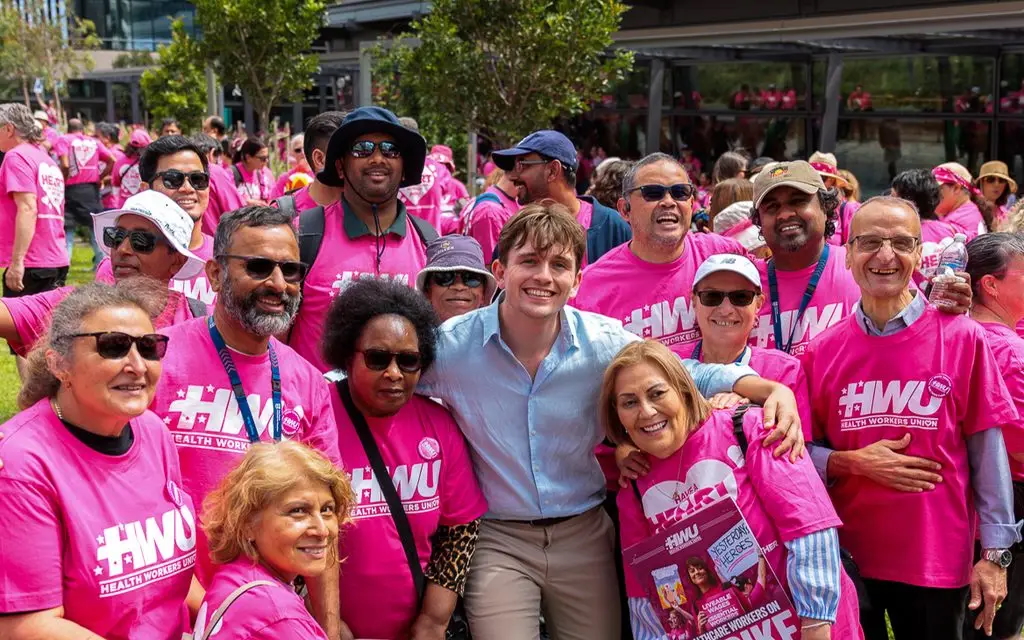
McGuiness is a 27-year-old ALP member who has been elected on a reform ticket replacing the former HWU leadership. As a union official he is positioning to deal with an incoming Liberal government, while also imploring that “working people and their unions must reclaim their party and remind every Labor MP and staffer who they are there to represent” and condemning the “arrogance that has developed within the Victorian Labor government”.
This all reflects a build-up of frustration and increased distance between the political and industrial wing that has been building for a while. The past few ALP Victorian State Conferences have essentially been about union and branch delegates trying to use policy motions to bring social and industrial matters to the attention of the government, and to hold them accountable for previous commitments not acted on. Numerous were the complaints of legitimate concerns being ignored or managed-away in the offices of power.
The causes of disillusionment are best illustrated by the government’s record in public education. While a lot has been invested in new school buildings and upgrades, the government badly underfunded public schools by delaying signing the national schools funding agreement.
The agreement was only signed at the eleventh hour, following a series of teacher strikes driven forward by a rank-and-file revolt. The pay dispute was won by the Australian Education Union (Victoria) securing high pay rises and some improved conditions. The funding agreement still delays full funding to 2031 (state share) and 2034 (Commonwealth share).
However, any residual goodwill among public school educators has been quickly undone by a pre-election decision to cut the funding granted to students with a disability. This will impact the most vulnerable students and is already leading to job losses for the teacher aides employed to support them. The AEU is taking the education department to the Fair Work Commission to challenge the decision.
There is ongoing debate within the union movement about Labor’s overall record and how to approach this election. However, the views of union leaders tend to reflect a sectional viewpoint, depending on their success or leverage in achieving specific gains for their members.
Some calls for reform have been acted on. The Health and Community Services Union (HACSU) and the Australian Nursing and Midwifery Federation (ANMF) have used social media to promote Labor’s recent commitment to legislate staff-to-patient ratios in the mental health sector.
The Australian Manufacturing Workers Union (AMWU), while not directly recommending a vote for Labor, is distributing material highlighting the achievements of unions over the 12 years that Labor has been in government, such as free TAFE, criminalising wage theft, industrial manslaughter laws and portable long service leave.
AMWU state secretary Tony Mavromatis says that people are angry and “they don’t remember all the good stuff. It’s important to remind members what unions have achieved with a Labor government since 2014.” He warned any unionists thinking that workers would be better off under the Coalition or One Nation were “mad” and that “If the mop does flop that way, I will look them in the eye and say, ‘Well this is what you wanted’.”
Mavromatis is partly right. The next government of Victoria will either be formed by Labor or the Liberal and National parties, either with a majority of seats, or in minority with the support of the Greens or One Nation respectively.
Given this reality, it is in the overall best interests of working people that Labor retains government, if only to prevent the conservatives taking power and to defend the moderate social and industrial reforms Labor has made.
With no coherent mass working-class alternative, workers vote Labor as a partial expression of their class interest.
However, this should not prevent us critically examining and challenging Labor’s record, and fighting for a consistently pro-working class and socialist program of change. This will be required to make sense of the coming defeat.
The disillusionment with Labor has real causes that must be understood and acted on. We can’t let the disillusionment just feed the rise of fake ‘anti-establishment’ outfits like One Nation. A stronger left based on the working class, inside and outside of Labor, needs to be built.
Ideally, there would be a political reckoning inside Labor that is based on coherent political analysis and a political program. Unfortunately, the Socialist Left faction does not currently have coherent politics, being focused on manoeuvres to secure positions and pre-selections. Aside from pre-conference periods in which motions are drafted and presented, the faction never convenes political discussions, attempts to articulate a general program or holds the faction’s MPs or ministers to account.
The Socialist Left faction may be ready to criticise Carroll’s failures on a factional or case-by-case basis but will be unlikely to critically examine the whole record of Labor in government or present a meaningful way forward for the working class.
It is a positive development that Labor in Victoria faces a political challenge from the Left, and not just from the progressive-liberal Greens. The fact that Victorian Socialists are standing candidates in all 88 electorates and have the prospect of winning one or two upper house seats could be a step forward for the left. At a basic level it is good to see socialist politics being openly campaigned for out of the inner city and in the working class northern and western suburbs of Melbourne. Many in the labour movement are watching this development with interest and some comrades may legitimately decide to vote Victorian Socialist first and preference Labor.
What has gone wrong?
The headline issue for months has been corruption on Big Build projects, a body blow for a government that put the massive investment – about $150 billion – in roads and rail at the centre of its agenda.
Jacinta Allan inherited power from Daniel Andrews and loyally followed his big project, corporatist model in which decision-making power was concentrated in the Premier’s office. Massive ‘state building’ transport projects like the Metro Tunnel, West Gate Tunnel, East Link and the Suburban Rail Loop were locked in, along with the demolition of all 44 public housing tower blocks, to be replaced with some form of public-private development. All providing a huge pipeline of capital for profitable work by private construction companies.
There was also no honest reckoning with the social impact of wielding state power during the COVID pandemic in the form of mandatory lockdowns, or how to best support people and communities to recover from this traumatic period. A general view among people that the measures had been necessary but also excessive, was dismissed and ignored. Rebuilding post-pandemic morphed from much needed social and health services to infrastructure construction. Big business lapped it up.
Carroll’s recent pledge to open 20 free public dental clinics should have been the type of actions taken four years ago, along with investment in mental health services and public housing. Instead, it is a policy thrown at an election the party expects to lose. A policy not designed to be implemented but one aimed at ‘saving the furniture’.
From 2014, Labor stubbornly pursued a centrist agenda of being a competent party of government, managing capitalism, growing state investment in public services and infrastructure and delivering moderate reforms to workers.
Economically the Labor government never really broke with neoliberalism, as shown by its underhand use of long-term leases to effectively privatise the Port of Melbourne, Land Titles office and VicRoads licensing.
However, Labor rejected the austerity that scarred the state under Liberal premier Jeff Kennett and used expansionary government borrowing and spending to fund social services and build public infrastructure, including 121 new public schools and 12 new or expanded public hospitals.
It all came badly unstuck during this term of government, as the flagship Big Build road and rail infrastructure program became mired in serious allegations of corruption by organised criminals and the Setka cabal of CFMEU officials.
Being the party willing to spend big worked when people saw the direct benefit; in level crossing removals, free TAFE courses, new hospitals or cheap statewide train fares.
But for working people increasingly struggling with higher inflation and mortgages, the Big Build fiasco highlighted the sense that someone else was benefiting from the spending – either big developers or someone associated with Mick Gatto or the Bandidos.
The limits of centrist Laborism
The current crisis faced by Labor shows the limitations and pitfalls of a centrist approach that essentially aims to safely manage the existing economic system, in a corporatist alliance of big government, big capital and big unions, while granting only moderate reforms that while welcomed by workers are acceptable to the ruling class.
Partial measures, such as the 2022 re-creation of a publicly owned State Electricity Commission (SEC) or the current pledge to cap road tolls and public transport fares at $30 a week for one and two years respectively show the problem.
The SEC is really another player in a still privatised market – full renationalisation of the energy sector would be better for consumers and the environment. Likewise, the fare and toll cap is not based on a price reduction by private operators, but effectively a $397 million public payment to private rail and road companies like Metro Trains, Transurban and East Connect. Again, the questions of public ownership and democratic control are avoided.
It is a similar case with constitutional questions. Labor negotiated and legislated a Treaty with the elected First People’s Assembly. The conservatives are all committed to abolish the Treaty regardless of the damage to Aboriginal people. And they can, because it was a piece of legislation, not actually a change to Victoria’s colonial-era constitution. A true Treaty could not be ripped up by an incoming government.
Labor has recently reformed the voting system for the upper house Legislative Council, abolishing party-controlled group voting that enabled dodgy ‘preference harvesting’ to elect micro-parties. All well and good. But why do we persist with having an upper house – a body always intended by the propertied classes to be handbrake on the popular democracy?
A related fact, never questioned by the socialist left inside or outside Labor, is that Victoria’s head of state is unelected – King Charles III’s representative the Governor of Victoria, Margaret Gardner, who grants ‘royal assent’ to legislation. What an undemocratic block to popular power that is ripe for removal.
The point is that centrist Laborism, without a clear and coherent platform for fundamental economic, social and political change, tends to short-term managerialism, overseeing but not overcoming the dysfunctions of capitalism faced daily by working people. It drifts without a compass, sometimes tacking left, sometimes right, but without clear purpose.
It suits the ruling class if Labor and the labour movement contain themselves to being a tame alternative set of managers to the Liberals. If the main political intent becomes ‘competent management’ then at some point the general public or the established powers, or both, can easily decide the ‘other team’ will do ‘a better job’. Especially when the conservatives are still very much the preferred ‘natural party of government’ for the ruling class.
As Marx noted in his preamble to the French Workers’ Party program as far back as 1880, it is only through working class organisation that universal suffrage can be “transformed from the instrument of deception that it has been until now into an instrument of emancipation”.
Post-election analysis, both in the media and within the Labor Party will likely centre on the relative strengths, mistakes and flaws of the political contenders and their policy offerings. At some point, Carroll’s flaws as a right faction operative will no doubt be highlighted by Socialist Left faction operatives and so on.
Working people and all of us involved in the labour and socialist movements need a higher level of discussion and analysis, to understand what has occurred and to chart a way forward.
Finally, it’s worth noting that if the Liberals do form government, it will not be based on any groundswell of popular support. Under the leadership of first term MP Jess Wilson, they offer only a return to ‘business as usual’ governance and austerity, alongside pledges to abolish Treaty, restrict protest rights and generally ‘restore’ law and order.
For all their bluster, One Nation Party’s anti-establishment and ‘we’re not politicians’ image will surely be tested by the reality of lining up with the Tories to cut government spending and programs.
The business and media establishment have swung in hard behind the Liberals and are applying pressure for strong measures to cut government spending and state debt levels. But any agenda of Kennett style cutbacks will trigger buyer’s remorse among voters and risk a popular political backlash.
We will be ready to take up the fight.