
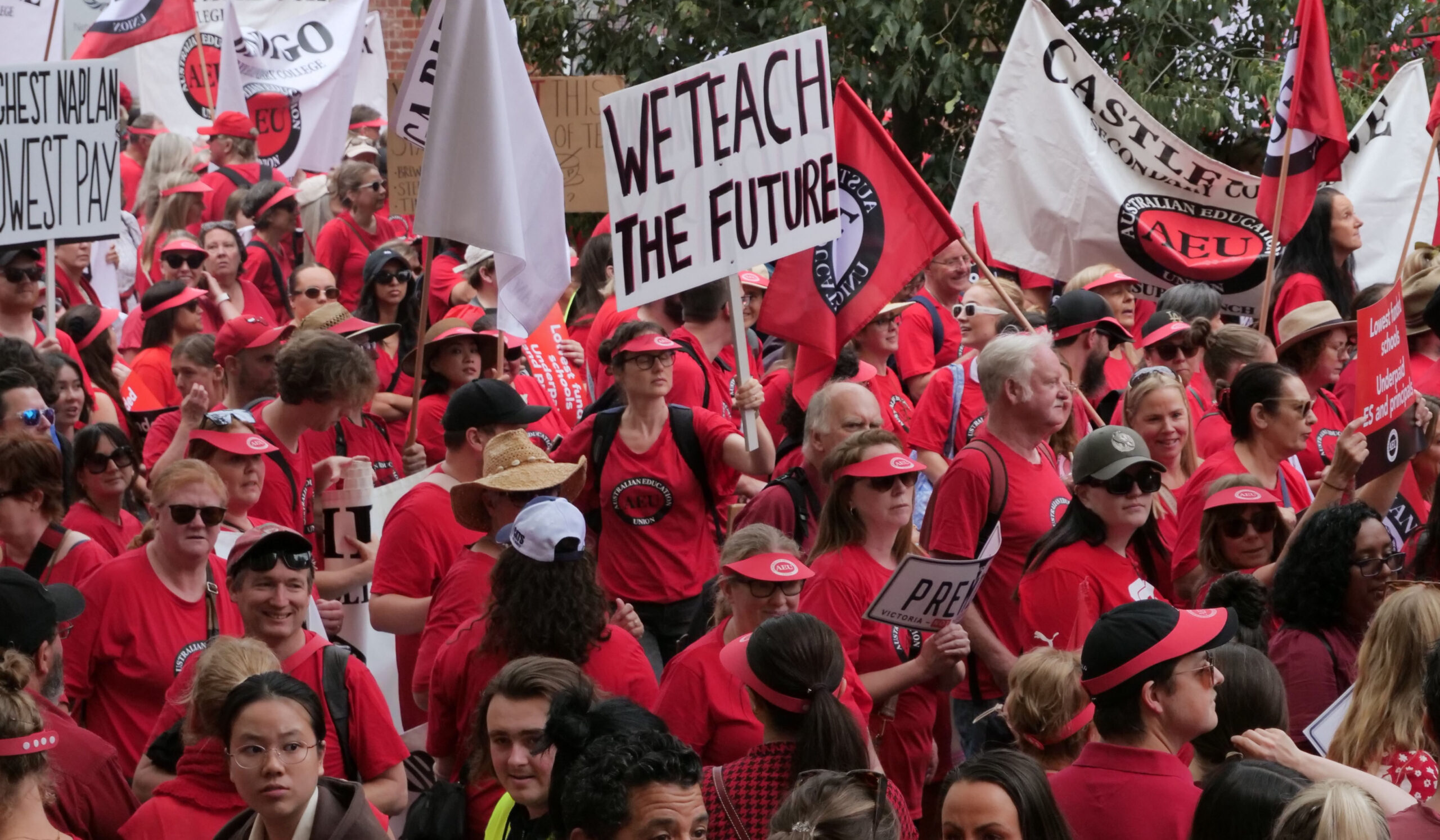
Hamish McPherson – an AEU member in Victoria – offers his assessment of the rank-and-file insurgency and the need for political campaigning.
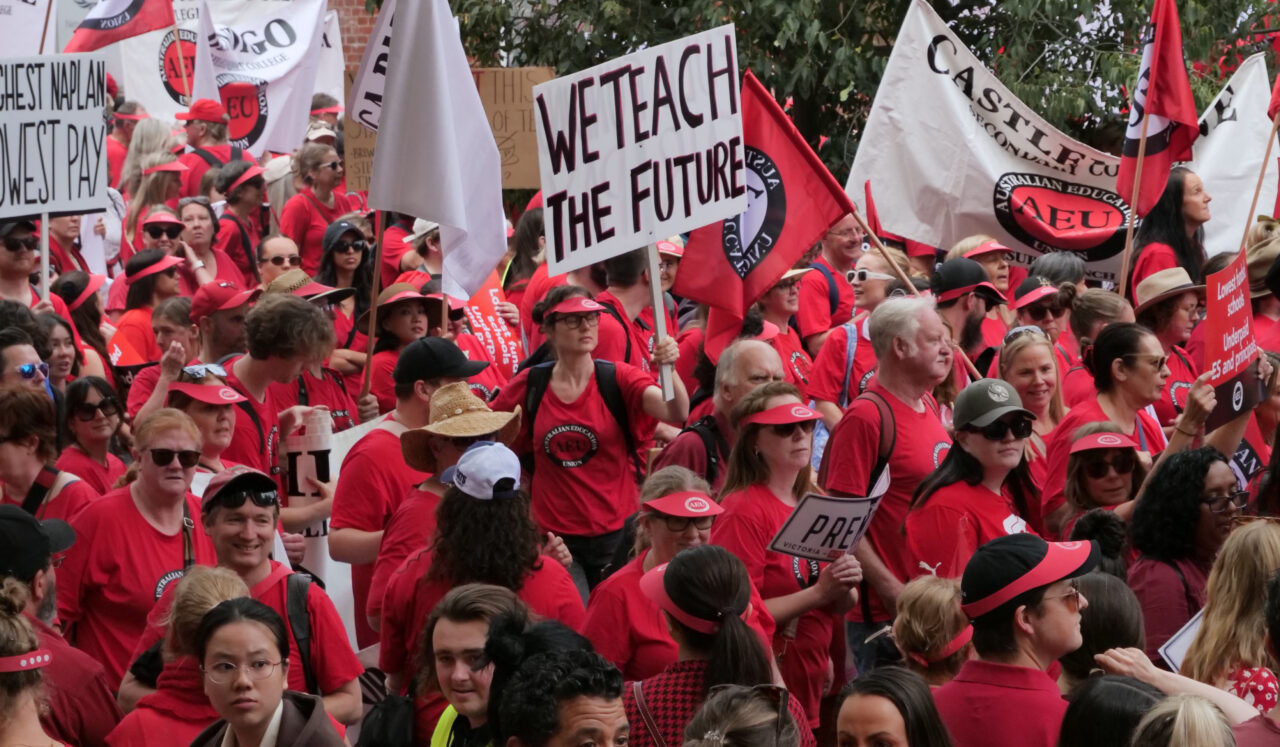
An insurgent movement of rank-and-file Australian Education Union (AEU) members in Victorian public schools has upended the usual certainties of a union enterprise bargaining campaign and won significant gains in pay, conditions and funding.
The AEU held two official statewide strikes and mass rallies (24 March and 23 July) that filled city streets with educators seeking change after years of post-COVID workload pressures, crippling staff shortages and pay rates not keeping pace with housing costs.
Further ratcheting up the pressure on then Education Minister, now Premier Ben Carrol, and the AEU officials, was that AEU members twice voted down proposed agreement offers endorsed by the AEU leadership. Two rank-and-file networks, Fight the Crisis and Socialists in Schools, led this opposition, which was combined with a series of unofficial actions at a school level including lunchtime walk offs and speak-outs. The networks also made full use of the democratic school and regional branch structures of the union, which are in better shape than in most large unions.
While the gains made by this rank-and-file campaigning shows the strength in membership control of campaigns, the aims of this insurgency never moved beyond economic demands around wages and conditions, as Labor Tribune has reported on previously (‘Victorian teachers’ fight must go beyond wages’).
The first ballot, taken through school-based AEU sub-branches was 58% against the leadership endorsed agreement. The second ballot, in which the Department of Education initially attempted to bypass the union, was an individual online ballot of AEU members, with a narrower 51% rejection. After each rejection, the Department of Education returned with an improved offer.
The third and final ballot of AEU members gave 79% endorsement to a new Victorian Government Schools Agreement that, according to the union, includes upfront pay rises of between 13% and 16% for all teachers – and further rises each year of between 4% and 4.9% through to 2029.
Conditions to address excessive workload include halving meetings from 80 to 40 hours a year or an average 1 hour a week, four non-teaching professional practice days, centrally funded overnight camp allowances and time release to complete student funding applications.
Critics of the final deal point out that it fails to address outstanding matters such as reducing class sizes, face-to-face teaching time and paid lunch breaks for support staff.
A key factor shifting the final vote was the public commitment by now Premier Carrol and new Education Minister Gabrielle Williams to negotiate and sign the full school funding agreement with the Commonwealth before the November election.
The failure of Jacinta Allen to sign Victorian up public schools to the Commonwealth funding agreement became emblematic of the distorted priorities of the Labor Government she led and has been cited as an issue in the minds of caucus members when they shifted support to Ben Carrol. While Victoria has invested an estimated $109 billion in Big Build infrastructure projects, it was the only state not to sign onto the Commonwealth school funding deal.
This long overdue shift is a sign of the pressure created by collective action and the rank-and-file rebellion. It is significant that union action resolved a policy matter outside the usual strict boundaries of wages and conditions negotiations.
The impressive rank-and-file organising seized the momentum of the campaign and challenged the hesitant and weak stance of the AEU officials, who above all else sought a resolution before the November state election. The 12-year-old Labor Government is in real danger of losing office to a coalition of the conservatives, possibly including One Nation who appear to be making inroads in regional and outer suburban areas.
The prospect of dealing with a conservative government was raised by AEU officials in meetings. This was dismissed as fear mongering by the rank-and-file left campaign groups. It was certainly a factor being weighed up by many union members themselves who are well aware of the outright hostility of conservative governments in Victoria. The previous one term Baillieu-Napthine Government, just ignored and refused to negotiate with the union for most of their short time on office.
The rank-and-file campaign has been led by two separate groupings that have both built a genuine base among teachers and staff in schools. Fight the Crisis (FTC) has eight elected representatives out of 120 on AEU State Council and a few key leading members are from the socialist group Solidarity. Formed somewhat later, Socialists in Schools is openly aligned to the Victorian Socialists and leading members are part of Socialist Alternative. It decided not to join FTC and has operated independently.
Both groups have taken similar approaches, emphasising adherence to the union’s maximum log of claim demands and arguing for escalating industrial action to achieve them outright. They both articulate the politics of militant trade unionism; Fight the Crisis with a more ‘rank and file’ emphasis and Socialists in Schools, as the name suggests, with a somewhat more political colouration.
Socialists in Schools are now highlighting that eight teacher members are standing as candidates for the Victorian Socialists and make some reference to the need for wider political changes, calling for ‘the return of $16 billion in stolen education funding, the end of public funding for private schools, the abolition of NAPLAN and the immediate implementation of the AEU’s 2026 log of claims.’ (Red Flag article “Rebel teachers taking their campaign against the Labor government all the way to parliament” 12/8/26)
Throughout the campaign Fight the Crisis has argued that achieving the full of union claims is needed to solve the crisis facing public schools. This crisis has been building over decades and is characterised by factors such as high teacher workload and stress, poor retention and attrition rates, chronic staff shortages, reduced student engagement and learning outcomes and more challenging behaviours.
It is a widespread but not a uniform crisis, tending to be concentrated in the many schools serving more working-class, low-income, outer-suburban and regional areas. The causes are complex and not simply a product of inadequate funding or wages and working conditions. The causes are systemic; the product of a divided and partly privatised education system, that effectively segregates students by social class, by postcode and often also by cultural or religious background. This concentrates the challenges of educating working-class and socially disadvantaged students in public schools that are not socially comprehensive.
A union industrial campaign can certainly make gains to alleviate the pressures faced by school teachers and staff. However, by its very nature it is limited mainly to wages and conditions, at some point, depending on the balance of forces, an agreement is reached.
It is very unusual for a union to win all its claims in an industrial campaign around a wages and conditions agreement. Some claims are ambit; some are laying down a marker for future campaigns and struggles. To turn the winning of all claims into a principle is muddled-headed economism. It turns a tactical question into a principle.
The rhetorical stance of Fight the Crisis is for maximum action to achieve a ‘transformative’ agreement that will ‘end the crisis’ in schools. But even winning all the demands in this campaign would not have ‘ended the crisis’. It ignores the need for a much deeper structural transformation of education and the need for a political program that dismantles the segregated and privatised schooling system in favour of truly universal and free education from early childhood to tertiary levels.
Fight the Crisis is holding the line and has vowed to call for a rejection of the latest VSGA offer in the upcoming all employee ballot being conducted by the Department of Education. This has caused some dissension within the group, with some members pointing out that it effectively means appealing to non-union colleagues, against the decision made by a clear majority of rank-and-file union members.
In a recent email We’re voting NO in the Fairwork ballot, Fight the Crisis argues that ‘this deal locks our schools in a deep crisis, and we will not stop fighting that crisis now. The Labor government has revealed its true contempt for our work, and our public schools…. Members have endured insulting wear-down tactics and fear campaigning, including from our own union leaders… In these circumstances, the union ballot result is not a vote of confidence in the agreement; members have not voted for it because it will end the schools crisis.”
This is but one interpretation of the rank-and-file vote. In my anecdotal experience, it is also possible that many union members looked at the wage rise outcomes, the halving of meeting times and the funding commitment, weighed that up with the uncertainty of escalating disputation, and figured that on balance it was worth supporting.
This does not diminish the great potential and value of continued organising by teachers and educators to build on the experience and gains of this recent struggle. The rank-and-file insurgency has shown how collective action can push beyond the bounds of ‘normal’ union and political limits.
However, at some point the politics of militant unionism alone is insufficient and becomes a self-limiting factor. There is now time and space to develop a more ambitious and political program of change that charts a course to truly transform education for teachers, students and society as a whole.