
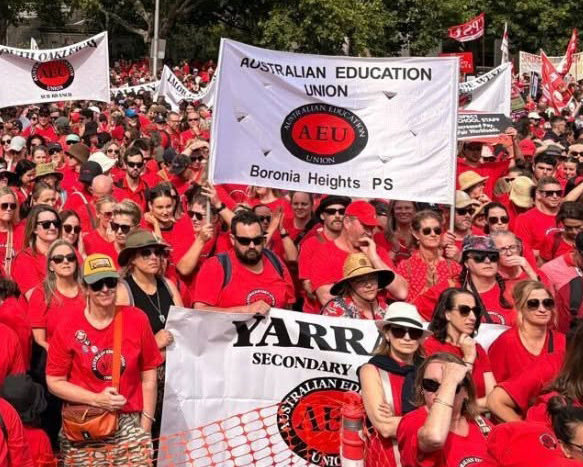
Schools are divided on class and religious lines. The campaign needs politics to overturn this historical injustice writes Martin Greenfield.
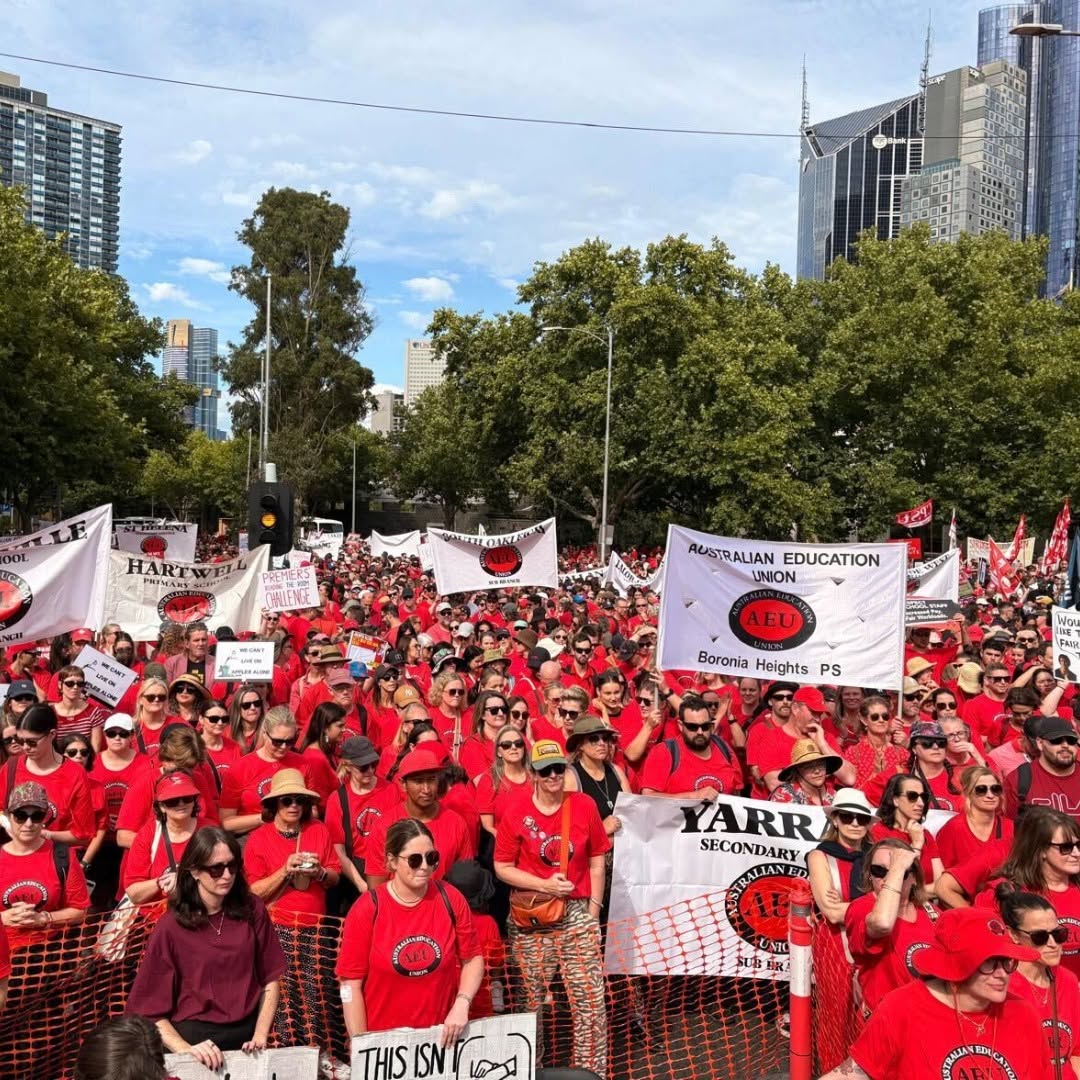
Victorian members of the Australian Education Union (AEU) have delivered a remarkable rebuke to both the Victorian government and their own union leadership, voting by 57.7% to reject the latest enterprise agreement despite a strong recommendation from union officials to accept it.
The result is significant for several reasons.
First, it represents a rare occasion in which the union leadership has actively campaigned for a “yes” vote only to be decisively overruled by the membership. Second, it reflects a deep well of frustration among teachers and education support staff after years of mounting workloads, worsening conditions and the lingering effects of the pandemic on schools and the education workforce.
The rejected agreement contained substantial wage increases. Depending on classification and experience, members would have received pay rises of between 28 and 32% over four years, alongside additional student-free days and other measures. Union leaders described it as a significant achievement and one of the strongest salary outcomes secured in recent decades.
Yet it was rejected.
The vote demonstrates that the discontent among educators runs deeper than a simple question of pay. Many members cited the absence of meaningful improvements on workload, class sizes and face-to-face teaching demands. Education support staff were also dissatisfied that they were not offered the same percentage increases as classroom teachers.
The government and union leadership now face serious questions. This is the first time in decades that Victorian educators have rejected an endorsed agreement, and nobody can be certain what happens next. The government may return with concessions. Equally, it may decide to take a harder line, calculating that it cannot be seen to continually increase offers in the lead-up to the Victorian state election.
Labor Tribune supports those members seeking an improved settlement. Teachers deserve above-inflation wage increases. The disastrous outcome of previous agreements, which saw educators effectively go backwards in real terms, should not be repeated.
Limitations of the ‘no’ campaign
However, support for a stronger outcome should not blind the labour movement to the limitations of the politics that have dominated much of the “No” campaign.
A section of the activist left within the AEU has treated the difference between a 30% settlement and a 35% settlement as though it represents a fundamental principle. It does not.
The distinction between one percentage figure and another is ultimately a tactical question, dependent upon the balance of forces, the preparedness of members to sustain industrial action, and the likely response of government. Workers should always seek the best possible outcome, but trade union strategy cannot be reduced to the proposition that more strikes automatically produce more gains.
Nor should socialists imagine that industrial militancy alone provides a political solution.
Some socialist currents within the union elevate strike action into an end in itself. They proceed from the belief that strikes, by their nature, spontaneously develop socialist consciousness. History provides little evidence for such a proposition.
Strikes are important. Industrial action can build confidence, solidarity and organisation. But trade union consciousness remains limited by its very nature. Workers can become highly militant in defence of wages and conditions while remaining politically tied to the existing social and constitutional order.
Two socialist-led opposition groups
There are two competing left activist groups in the AEU (Victoria). ‘Fight the Crisis’ was set up about a year before the enterprise bargaining campaign, by teaches in or close to the Cliffite group, Solidarity. The other, ‘Socialists in Schools’ was set up by Socialist Alternative and its electoral proxy, Victorian Socialists. Both socialist groups emerged from splits in the International Socialist Organisation in the 1990s and early 2000s.
Of course, it is nonsensical that both these groups remain separate entities – and it is equally, if not more nonsensical that both groups maintain separate oppositional front groups in the AEU (Victoria).
Fight the Crisis was established first, and has the broader activist network across Victoria. So much of the blame for disunity lies with Socialist Alternative.
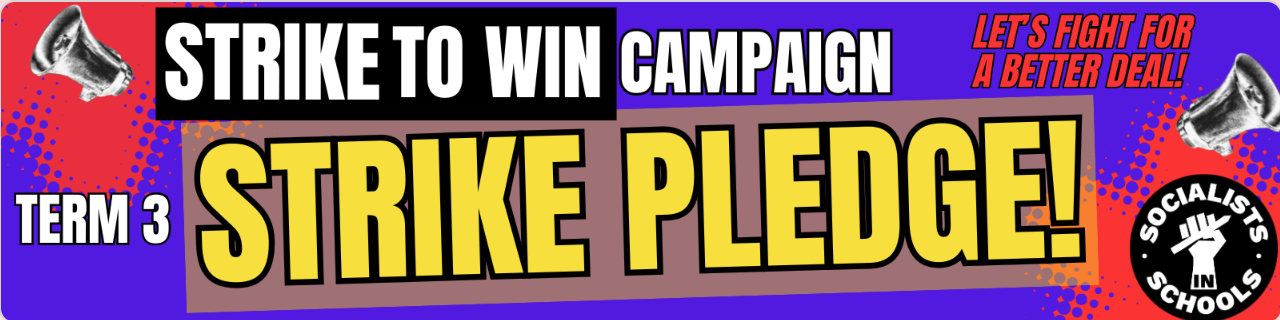
Despite this disunity, credit must be given to Fight the Crisis and Socialists in Schools for running a ‘No’ campaign that picked up on the intransigence of the membership (but, to be fair, these comrades will almost always oppose any settlement of an industrial campaign, no matter the material conditions).
However, we ask, a ‘No’ campaign to what end?
With the wage offer rejected, both groups are just calling for more strikes – and potential wildcat actions at schools. They are not trying to transform the struggles from wages and conditions into politics.
Socialists In Schools next steps are just for more and bigger strikes to gain more pay. It’s “three-point plan” is: 1) Restart strikes; 2) Continue the debate (ie: AEU should distribute our material); 3) Fix the crisis through workload relief; wage rises ahead of inflation; full funding for each school.
Fight the Crisis draft motion for branches is much the same.
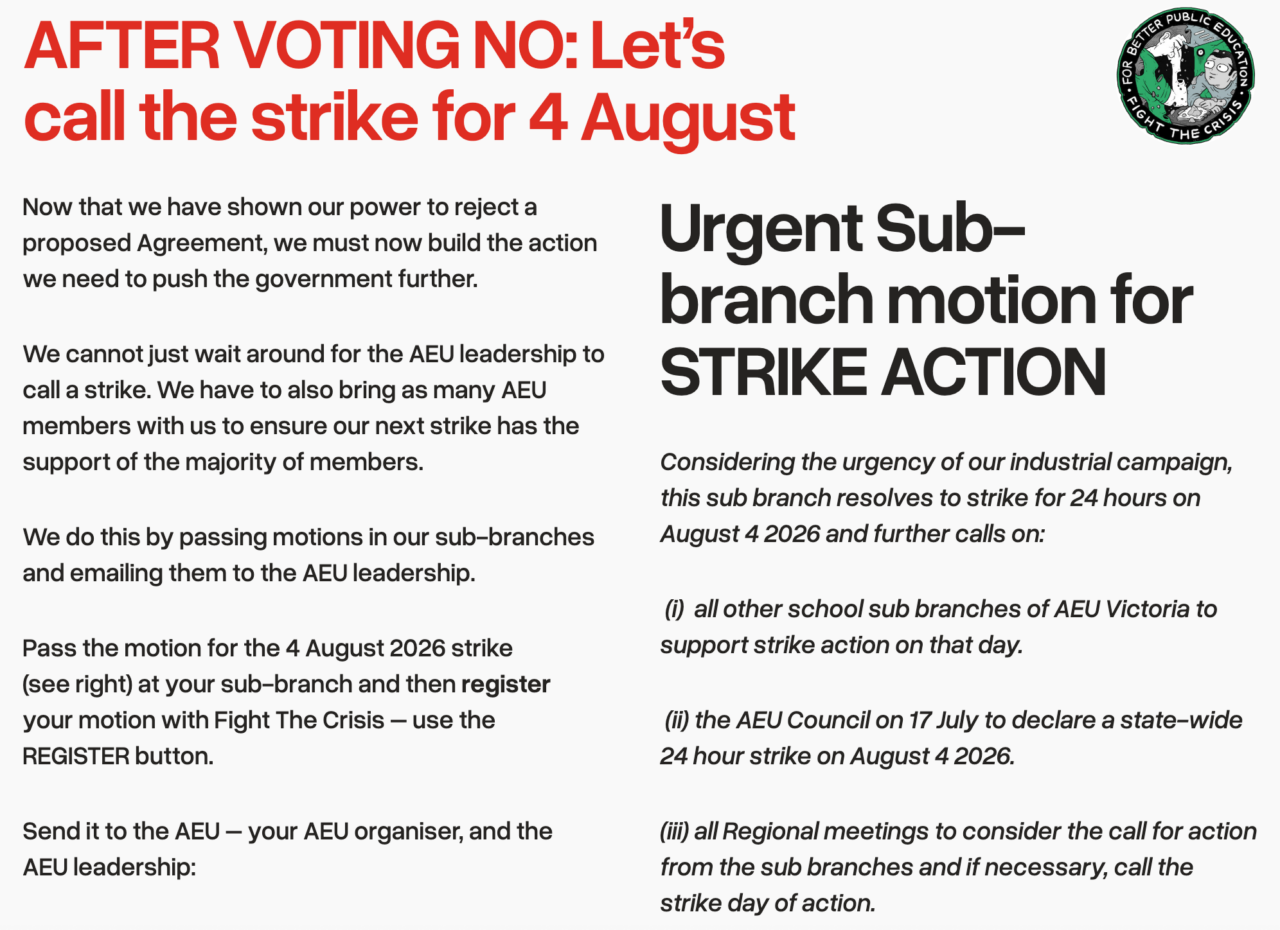
All fine and dandy, but this is not a Marxist approach to trade union work. It is a trade union approach to trade union work.
We don’t simply call for these campaigns to merge. A merged bigger group pursuing the same dead-end economistic strategy of bigger strikes for more money, won’t take the working-class movement a step closer to building the type of political party we need. It might win these competing groups a few recruits, which is of course a main aim of their ‘strategy’.
It’s the politics, stupid
The central crisis confronting public education in Australia cannot be reduced to pay levels, class sizes or workload, important as all these questions are.
The deeper problem is the systematic erosion of universal, free and secular public education.
For decades governments of both major parties have overseen a school system increasingly divided along class and religious lines. Public schools are expected to educate the overwhelming majority of working-class and disadvantaged students while private schools continue to receive enormous taxpayer subsidies. The result is growing segregation, growing inequality and growing pressure on the public system.
This is the fundamental issue that lies beneath many of the daily pressures that teachers experience.
A public-school teacher may win a smaller class or a slightly larger salary increase. But if the broader trend towards educational inequality continues unchecked, the underlying crisis remains.
Yet this political struggle barely features in contemporary industrial campaigns.
That is a mistake.
Teachers’ unions should be fighting not only for wages and conditions but for the restoration of genuinely universal public education. They should be leading campaigns against the public subsidisation of privilege. They should be demanding the full funding of public schools, oppose any public funding for private schools and oppose the growing class segregation that characterises Australian education.
The rejection of the agreement has opened a new phase in the dispute. It has also exposed the weakness of relying exclusively on economistic politics.
The labour movement requires something more ambitious than endless arguments about percentages and industrial tactics. It requires a political vision capable of connecting the immediate concerns of teachers with the broader struggle for radical political change.
Teachers must also join with other unions, ideally through the ACTU, but through unofficial committees if needed, to combat the straitjacket of the Fair Work Act that provides among the most restrictive labour laws in the OECD.
At present, the Fair Work Act prevents industrial campaigns outside enterprise bargaining periods and deems political campaigns outside “allowable matters”. Unionists must fight these restrictions through a combination of politics and militant industrial campaigning – to have the laws repealed and/or to break the laws, backed by mass solidarity, so that they become ineffective.
Trade unions can and must fight for better wages. But they should also become schools of political education, organisation and working-class leadership for a different type of society, for socialism.
The challenge now is not simply to secure a few additional percentage points in the next agreement.
It is to transform the dispute into a broader political campaign for public education itself.
That is a struggle worth waging.