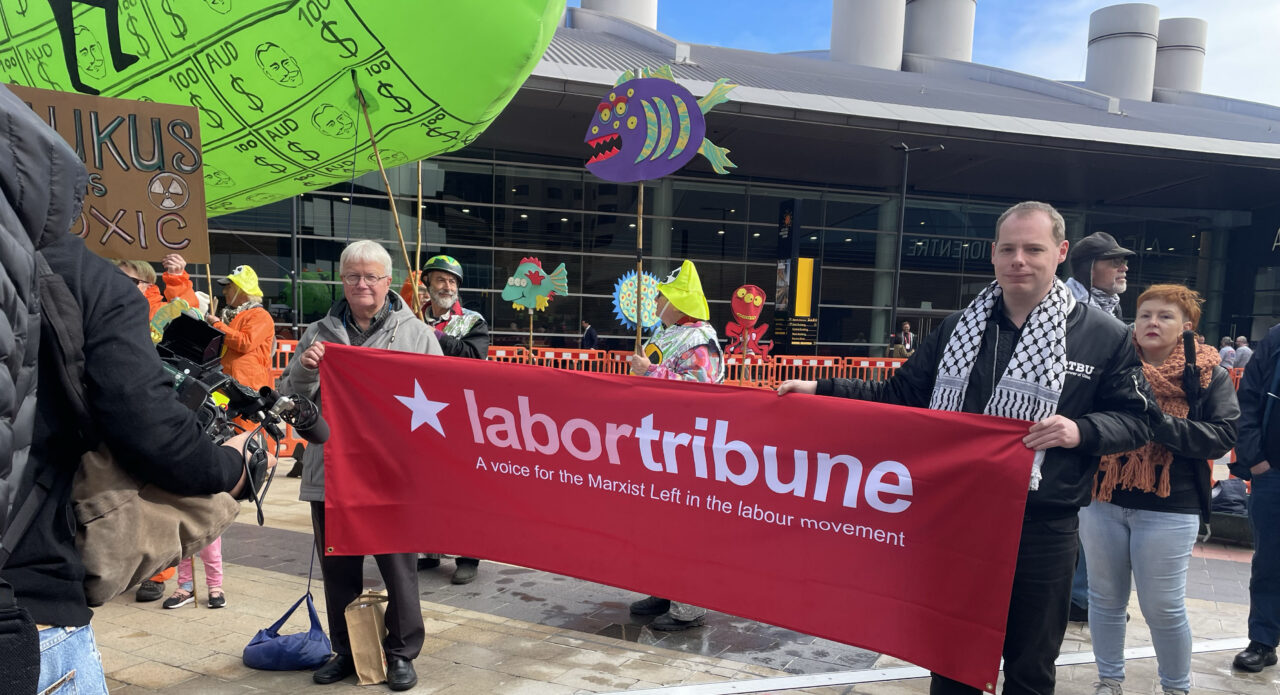
Labor Tribune has obtained a detailed list of conference delegates. Its contents help explain the nature of Labor’s internal life, writes Martin Greenfield.
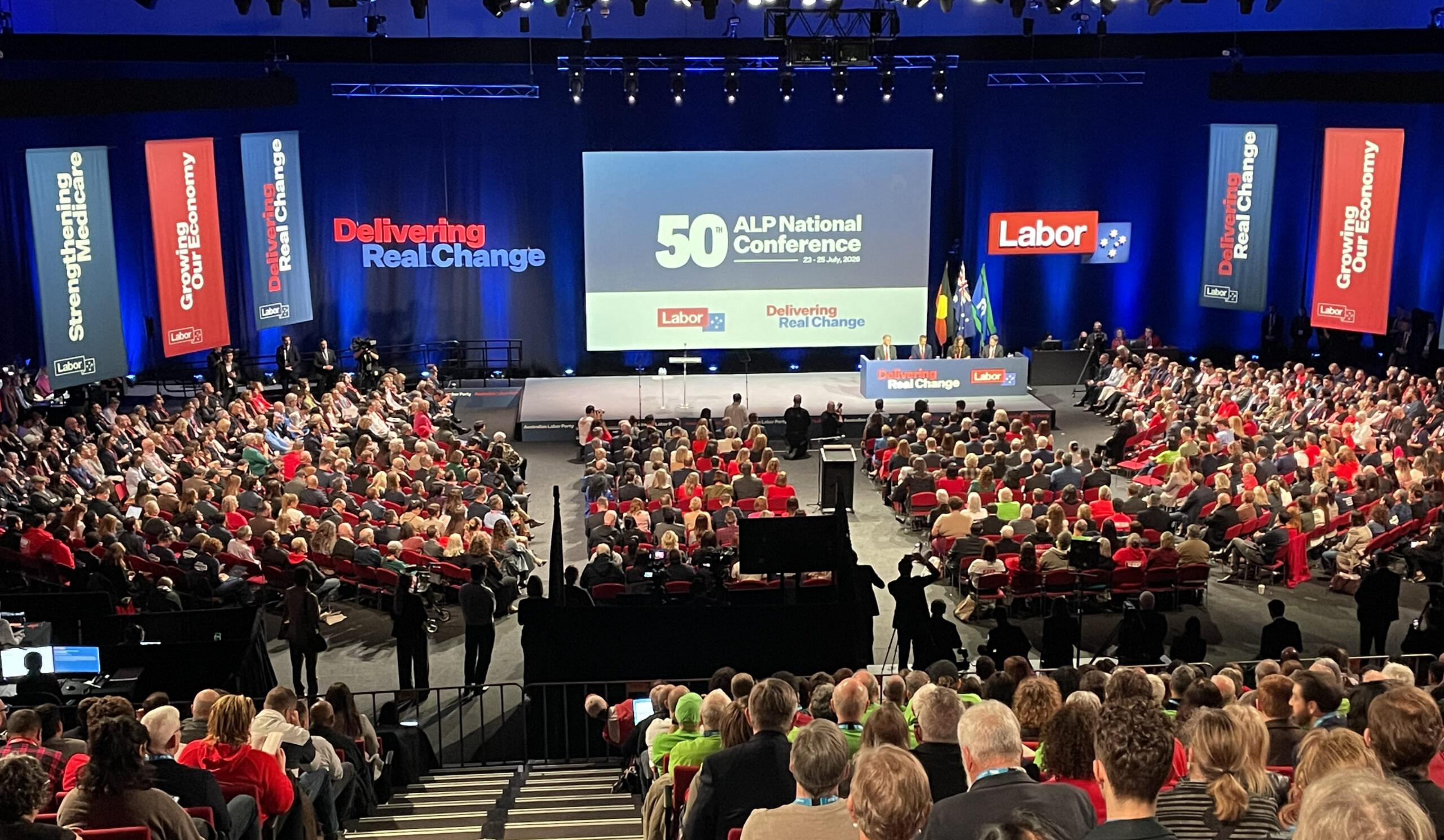
The Australian Labor Party presents its National Conference as the supreme democratic gathering of the labour movement. Every three years hundreds of delegates assemble, the National Platform is endorsed, speeches are applauded and the media is told this is where Labor’s direction is decided.
The reality is rather different.
Labor Tribune has obtained a breakdown of all 396 delegates to the Australian Labor Party’s National Conference, analysing delegates by faction and occupation. It reveals that alongside the half of delegates appointed through affiliated trade unions, more than 30% of the entire conference consists of MPs. The remaining 20% includes MP’s staffers, councillors, former councillors, former MPs and hardly any delegates from the shop floor or workplaces outside the political apparatus.
The figures blow a hole in the notion that National Conference is a democratic deliberative body of the rank and file. It is a jamboree for Labor’s political apparatchiks and their loyal appointees rather than a parliament of the working-class movement.
A closer examination of this year’s conference delegation tells the story. While unions exert influence here, they play it safe. At this conference in particular, unions pulled their punches on broader political matters to promote their sectional interests. The evaporation of support for Ed Husic’s motion on Palestine is a case in point.
The conference consists of almost 400 delegates, split evenly between representatives from the party membership and delegates appointed by affiliated trade unions. The federal parliamentary leadership has four delegates, the Federal Parliamentary Labor Party has six delegates (three each from the Right and the Left) and Australian Young Labor has three delegates (two from the Right, one from the Left).
At a glance this appears all-encompassing. In reality, neither half of the conference is genuinely representative of the rank and file.
Union delegations are not elected by union members, but appointed by the leaderships of affiliated unions, with union secretaries exercising decisive influence over who attends. The cliché of a few union secretaries meeting in Chinese restaurants to decide the outcome of political fights in the ALP is not entirely without basis.
The other half representing branch members is formally elected, but the delegates are overwhelmingly drawn from parliament, political staffers and the party apparatus itself. The conference database shows that 30.3% of all delegates are MPs (120 MPs out of 396 delegates).
State delegations reflect the machine, not members
The state breakdowns illustrate this pattern in greater detail.
There were 104 delegates from NSW. Sixty-five belonged to the Right faction, 38 to the Left and one was unaligned. Among them were 25 MPs, 24 union secretaries, 25 union officials, four staffers, four party officials and six current or former councillors. That makes up 88 delegates out of 104. Outside the political and union apparatus there was just one teacher, one nurse and one early childhood worker.
Tasmania was even more striking. Of its 23 delegates (16 from the Left, seven from the Right), almost half were MPs. There were also two former federal MPs, three union officials, four staffers, one union secretary and one party official. Out of the entire delegation, only one delegate had a job outside the political or union machine.
Victoria follows a similar pattern. Of its 89 delegates (a slim majority from the Left) there were 28 MPs and three staffers, plus 11 union secretaries, 24 union officials and three councillors. Among the relatively small number of delegates outside those categories were a teacher, an historian, a lawyer, a musician, an early childhood worker and a former union secretary.
The pattern is similar across all states. Different states use different methods to select their party delegates, but the political outcome is remarkably similar. The mechanisms vary; the concentration of power does not.
Power flows from top to bottom in modern Labor
The effect is to effectively abolish the ability for delegates to consider motions on their political merits rather than through the prism of factional agreements.
This explains why National Conference has increasingly become a carefully managed endorsement of decisions made elsewhere, rather than a forum where delegates freely deliberate and determine policy.
Husic’s attempt to force a debate on Palestine demonstrated the point. Instead of delegates being able to consider the issue, the factional machine closed ranks, and the proposal was not even allowed to reach conference floor. Similarly, despite an anti-AUKUS motion having a mover and seconder, both the Left and Right factions ensured it would be blocked at the Agenda Committee and was it not debated.
The political culture of the ALP and its National Conference means that for the overwhelming majority of delegates, their very careers depend upon demonstrating loyalty to parliamentary factional leaders or union secretaries.
Power inside the Labor Party does not flow upwards from members through conference to parliament. It flows downwards.
Conference functions as an endorsement mechanism for decisions already settled by parliamentary leaders and factional bosses.
This is not simply a question of constitutional arrangements. It reflects the social composition of the party itself.
Social roots of opportunism
Writing in 1916, Russian Marxist Grigory Zinoviev sought to understand just how the German Social Democratic Party had abandoned the anti-war resolutions of the Socialist International and lined up behind German imperialism in 1914 at the outbreak of World War I.
His explanation, published as ‘The social roots of opportunism’ in three parts, focused on the emergence of a layer of party and trade union functionaries whose material interests had become increasingly bound up with the institutions of the capitalist state. The growth of this labour bureaucracy provided the social foundation for opportunism and the collapse of German social democracy to support German militarism.
Zinoviev went through branch after branch of the German social democracy to find a striking reliance on the state for many of its party officials.
Australia’s labour movement has developed under very different historical circumstances, but the underlying process has striking parallels.
Here the labour movement has been hollowed out by decades of declining union density, corporatisation and parliamentary careerism. As workplace organisation has weakened, party officials, ministerial staff, parliamentary advisers and full-time union officials have come to dominate the internal life of the ALP.
Their livelihoods depend upon preserving the existing structures of the party and state. The ‘branchies’ as the political apparatchiks call ALP members, are expected to hand out at election time and treat MPs like celebrities.
Under such conditions, conference outcomes should surprise no one.
Labor Tribune does not believe the answer lies simply in fighting amendment by amendment inside an increasingly stage-managed conference process.
The deeper task is political. The ALP must be transformed into a genuinely democratic united front of the working class, where communists, socialists and all working-class militants can organise openly. This will not be possible only from within the ALP, but will also require a re-established militant working class movement for socialism.
For ALP conference, trade union delegations should be elected by union members themselves, not appointed by union secretaries.
Conference must become the supreme democratic authority of the party rather than a choreographed rally for the parliamentary leadership.
Factional deals must give way to open political debate.
MPs must be accountable to the membership that elects them, subject to recall and expected to live on the average skilled wage of the workers they claim to represent.
Fundamentally, a cultural revolution is required against careerism and parliamentary cretinism. An inversion of power is needed.
None of this means the Labor Party has ceased to be a strange type of workers’ party, what Marxists have described as a “bourgeois workers’ party” – a pro-capitalist party based on the organised workers’ movement. Currently, the ‘bourgeois’ pole is completely dominant over consistent working class politics.
Laborism thus remains the dominant political ideology of the Australian workers’ movement, expressing both the aspirations and the limitations of trade union consciousness under capitalism. Given the low ebb of the workers’ movement, the outcome of this year’s National Conference can be understood.
Once the objective potential of the workers’ movement to challenge capitalism is again active, this will have an impact within the ALP – as well as no doubt leading to socialist organisation outside the ALP.
But until the re-establishment of a militant workers’ movement that can challenge the political basis of the modern ALP, the National Conference will remain what it has become: not a democratic parliament of the Australian working class, but a carefully managed gathering of the political machine.