
VicSocialists are standing to deliver a ‘better, fairer Victoria’. But without challenging the federal constitutional order, this is fantasy politics, argues Marcus Strom.
A positive aspect of ostensibly revolutionary socialist organisations entering the electoral domain is that they are forced to put out to the general public what their actual politics are, rather than being able to rely on radical sloganeering on university campuses and street demonstrations.
In that sense, it is worthwhile examining the ‘Socialist Manifesto’ of the Victorian Socialists as they contest the Victorian state election, which will take place on 28 November this year.
What is most astonishing about the document is that all the proposals – many of which are completely worthwhile – are envisaged to be introduced within the existing monarchical constitutional framework of the Commonwealth of Australia. On page 23 the comrades outline their “vision for a better, fairer Victoria”. In their online extended version, we see calls for “a fair go for rural and regional Victoria”.
What then follows is a list of reforms that are presented as achievable within the fair state of Victoria alone. This is fanciful stuff and shows a complete disconnection between the stated aims of the Victorian Socialists in its constitution (“to contribute to abolishing capitalism in Australia”) and the platform taken to a mass political audience.
The problem becomes clearer when we look at the manifesto’s more ambitious proposals. Bringing energy into public ownership, establishing a public construction industry, taking vacant properties into public ownership and moving towards a four-day week are not simply matters of passing legislation in Victoria. They necessarily raise the question of the power of the capitalist class to resist such measures.
What happens when the banks refuse to cooperate, developers challenge compulsory acquisition through federal courts, corporations threaten investment or capital flight, or the federal government intervenes?
The manifesto has no coherent answer to these questions.
Fundamentally, this is because the practise of most self-described Marxist organisations in Australia has abandoned the core political framework of the revolutionary-democratic minimum program connected to our maximum program of generalised global socialism. The minimum parts of this program are not only our immediate political, social and economic goals, but are the conditions under which a workers’ party would form government.
Such a minimum forms a clear platform for the establishment of socialism, the rule of the working class and opens the road to the generalised and global socialisation of production, distribution and exchange.
Instead, we get a platform based on ‘the vibe’ of what might work on the doorstep.
Of course, in politics, our election manifesto needs to be crafted to suit the political environment, but this must be informed by our programmatic principles, not based on sniffing the breeze. Unfortunately, some of the Victorian Socialists platform seems to be pulled out of thin air, rather than connected to a general strategic plan for the working class to win political power.
The manifesto calls for a Universal Living Guarantee (usually known as universal basic income); it also calls for the establishment of a State Bank of Victoria. How would the capital be raised by a Victorian Socialists government? How would its interest rates be set given these are dictated by the Reserve Bank of Australia? Fanciful stuff.
Astoundingly there is not even mention of the goods and services tax (GST) and the crippling inefficiencies of a federal system of government; something even the bourgeois class recognises from time to time.
A socialist platform, based on a minimum program, must highlight the massive democratic deficit at the heart of the monarchical constitution. The Victorian Socialists do not even call for the abolition of the Victorian upper house (achieved by the ALP in Queensland in 1922) which was in the platform of the ALP until 1979. There is no call for electoral reform, not even proportional representation. There is no mention of how policing should be radically changed from a system enforced on the community by the state, to one democratically run by the community.
Critically, a coherent socialist program would need to call for the abolition of the monarchy and its colonial-era states – including Victoria – and for a democratic republic. That is completely absent from this document.
For those who ask ‘why would you stand in an election and call for the abolition of the state of Victoria?’ I point you to a letter from Friedrich Engels to a socialist in the United States in 1893 about standing in elections for the US presidency and US senate. Engels writes: “I do not see what violation of the social-democratic principle is necessarily involved in putting up candidates for any elective political office or in voting for these candidates, even if we are aiming at the abolition of this office itself.”
Engels also highlights that elections are tactical considerations for socialists and must be considered in terms of our “immediate goal” which is for “the conquest of political power for and by the working class”. Elections must seek to educate the working class about this principle and organise our confidence to achieve it.
With these democratic demands absent from the Victorian Socialists election manifesto the whole document is left hanging as a bunch of nice ideas.
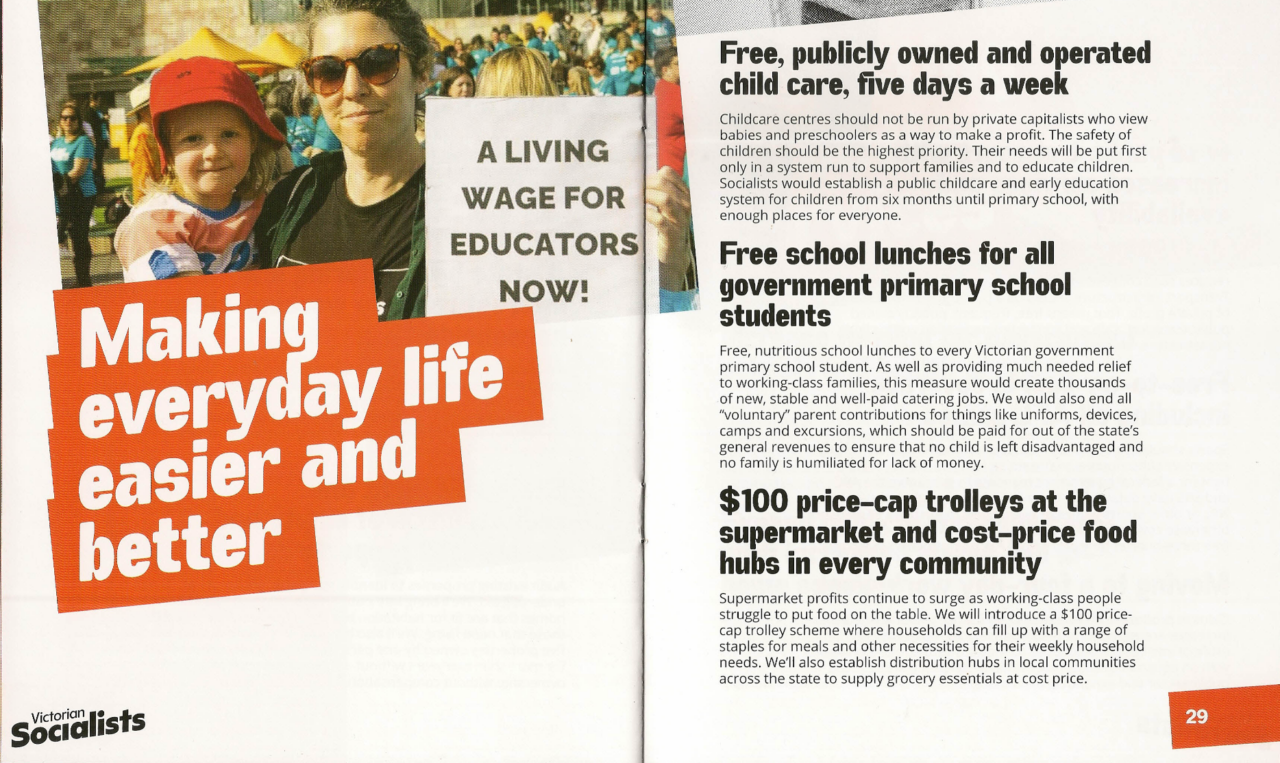
This means that the list of decent campaign proposals – 150,000 new homes, 30% low-cost housing in developments, funding for schools, free public transport, free childcare, energy production in public hands – are disconnected with the very question of how the working class can win power, not “in Victoria”, but nationally as part of a resurgent global socialist movement.
Perhaps the most amusing part of the document is in the “How would we pay for it?” section, suggesting that all their policies are achievable and affordable within the state of Victoria. In that short section, the comrades propose a $5,000 levy on private jets landing at Essendon airport. I kid you not. This is on top of raising state-based taxes: a luxury property tax, a wealth tax on rich Victorians, doubling the payroll tax and “properly enforcing taxes for land banking”. That should do the trick.
The manifesto does raise the need for any socialist MP to act as an organiser for movements outside parliament. Quite right.
But in the section “A people-powered campaign” lies a seed of trouble for the Victorian Socialists should they win a seat in parliament. It says that a socialist MP “would use their public profile and the resources that come with their office to provide support to striking workers and others fighting for progressive change” (emphasis added). Reliance on such resources can skew organisational power.

We have seen across the world and indeed with the Greens in Australia that once leftwing and Green groups win seats in parliament, they often follow the path well-trodden by labourism. The source of power in an organisation flips to the elected officials and their political staffers. It is good that the comrades will insist any MP only takes a workers’ wage, but we have seen in the Democratic Socialists of America (DSA), in People Before Profit (Ireland) and in non-working-class organisations like the Greens that the elected MPs become the ‘star factor’.
Zohran Mamdani has made it perfectly clear that while he is a member of the DSA, he is not held accountable to its program or its discipline.
In the section for “Building a movement for real change”, we hear that “even if we don’t succeed in getting any socialists elected to parliament, the exercise is worthwhile” (true enough) but then we hear that parliament doesn’t really matter anyway.
Quoting American socialist historian Howard Zinn, we hear that “what matters most is not who is sitting in the White House, but ‘who is sitting in’ and who is marching outside the White House and pushing for change”.
Leaving aside why they used this particular quote, what it underlines is the politics of ‘streets and strikes’ being more important than contesting elections.
This section does highlight that socialist parliamentarians must “do everything they can to build the socialist movement outside the parliament to back up their efforts within it”, but without a coherent political program that centres the needs for the extra-constitutional democratic power of the working class, we are just left with ‘the vibe’.
When the Victorian Socialists were established in 2018, it was a coalition between Socialist Alternative, Socialist Alliance and Stephen Jolly (now the mayor of Yarra City Council), largely as a vehicle to get Jolly elected to parliament.
With Jolly largely disgraced in the socialist movement and Socialist Alliance leaving Victorian Socialists in 2020, unprepared to be in a minority, Socialist Alternative was left holding the baby. (As an aside, it is disingenuous for Victorian Socialists to claim it “is the only anti-capitalist party running in this election” given Socialist Alliance is also standing candidates, albeit without being a registered party.)
Nonetheless, Victorian Socialists’ growth to become a national movement claiming more than 6,000 members on paper has been impressive. Its election results have tended to punch above the typical far-left experience of 1% or 2% of the vote. But it has also created tensions within Socialist Alternative that are yet to fully play out.
At the founding conference this year of the Australian Socialist Party, Socialist Alternative split on the question of whether the party should have a democratically agreed program. In Ireland, we have seen that the Socialist Workers Network has recently split over internal tensions about the programmatic and political direction of the People Before Profit party.
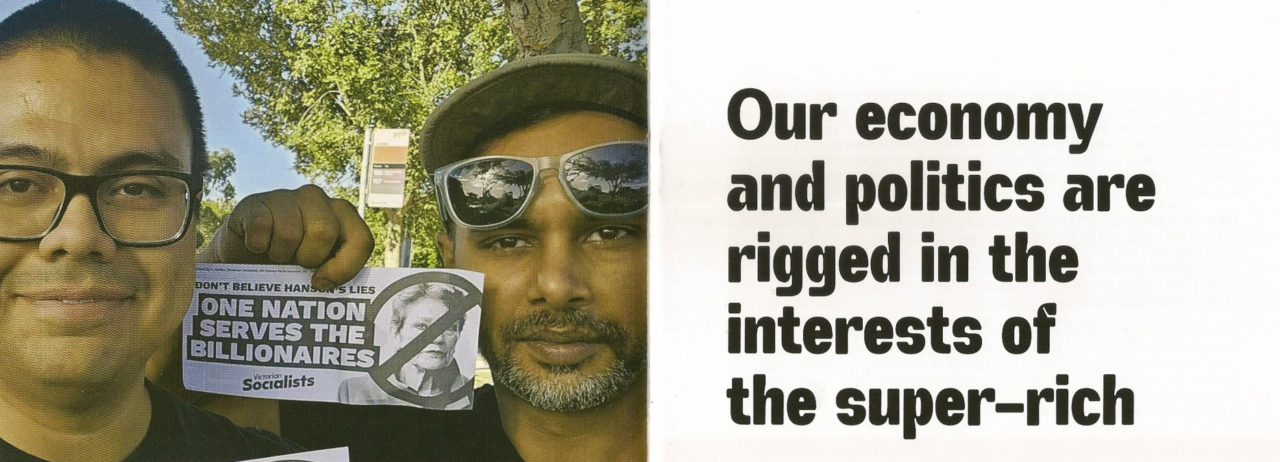
Should the Victorian Socialists get someone elected to parliament, this would be useful in the sense of testing out these assumptions. But standing as people with a shopping list of nice ideas who “hate Hanson”, is not a pathway to working class power.
NB: The election platform of Socialist Alliance can be read here. Unlike the Victorian Socialists manifesto, it calls on a Labor government to act. It also says that Socialist Alliance “campaigns for”, not what it would do in government. This framing is a more typical socialist campaign approach. Nonetheless, Socialist Alliance platform does not raise anything political that directly challenges the constitutional order that underpins Australian capitalism.