

SA Socialists member Tabitha Lean speaks out after being expelled from the Socialist Community Action caucus within that party.
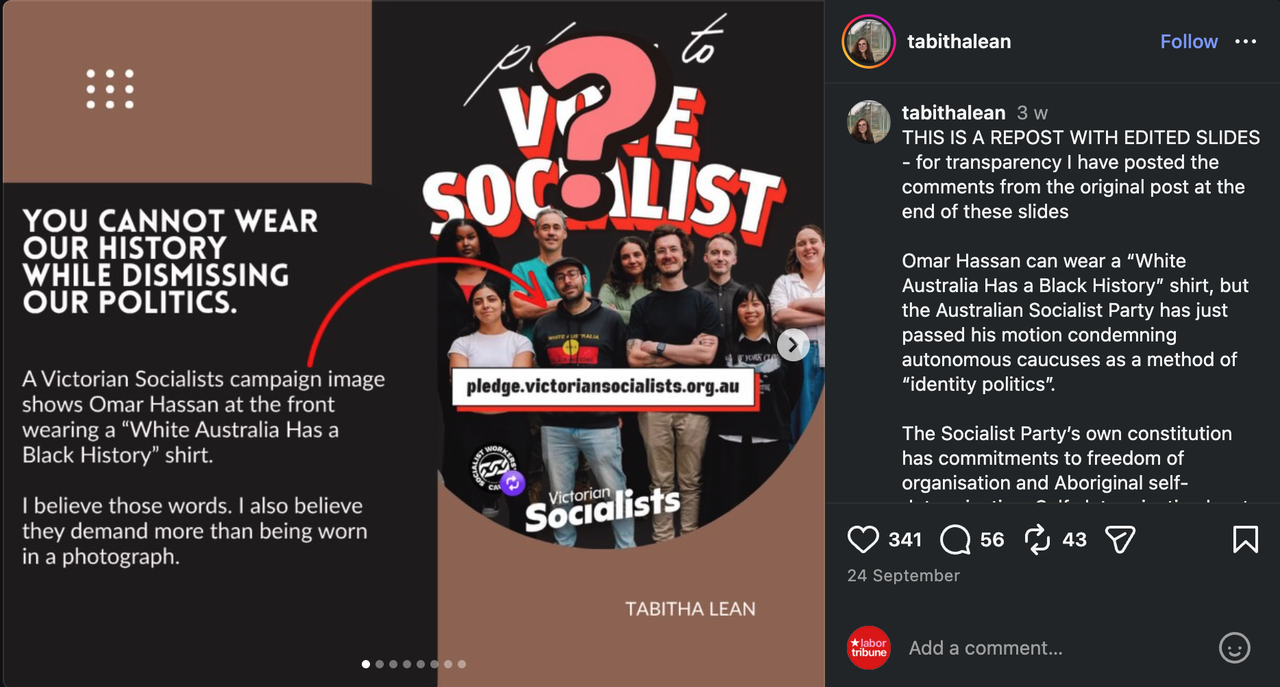
Marcus Strom recently argued in Labor Tribune that the Socialists’ election promises sit uneasily beside their stated ambition to transform the political order. He asked what happens when a party’s public commitments meet the institutions it says it wants to change. I have seen another contradiction from inside the party: a socialist movement that names colonisation, then resists Aboriginal self-determination and disciplines an Aboriginal woman for saying so.
I joined the Socialists despite warnings that the party was dominated by Socialist Alternative and that its internal culture could be cult-like. I did not dismiss those warnings, but I had no faith in Labor, and I had watched the Greens move closer to the political centre. I was looking for a party that could use elections to fight for immediate change while building a movement capable of confronting capitalism and colonialism together. I wanted to see whether its radicalism survived contact with a demand that would change who held power inside it.
At the Australian Socialist Party’s national conference, I was a delegate when Omar Hassan moved a motion called “Taking oppression seriously – Socialists and the fight for liberation”. Its opening clauses declared opposition to bigotry. Clause four then described “identity politics” as “a form of capitalist ideology” and listed autonomous caucuses among the organising methods the party opposed, alongside “oppression olympics” and “circular infighting”.
That is a political choice. Omar’s motion did not simply criticise corporations that celebrate diversity while exploiting workers. It put autonomous organising by oppressed peoples on a list of practices socialists should reject. On colonised land, that includes a direct challenge to how Aboriginal people have organised for our own liberation.
I proposed an amendment. It retained a critique of liberal identity politics when individual identity or representation substitutes for collective struggle, but it distinguished that from autonomous organising by oppressed peoples, including Aboriginal and Torres Strait Islander peoples exercising our inherent right to self-determination. I called for members to participate in struggles against oppression while respecting the leadership, autonomy and self-determination of the communities most directly affected.
I also proposed a new clause recognising that Australia is a settler-colonial state founded on Aboriginal and Torres Strait Islander dispossession, that our sovereignty was never ceded, and that socialism here must support decolonisation. These were not decorative additions. They went to the question Omar’s motion avoided: who gets to decide how Aboriginal people organise?
My amendment did not weaken class politics. Capitalism in Australia was built through the invasion and dispossession of Aboriginal lands. Its property relations, industries and accumulated wealth depend on that theft. A socialist movement that treats colonialism as an optional addition to class struggle has misunderstood the class struggle taking place here.
This was not an isolated dispute. At the NSW Socialists’ founding conference, Aboriginal members proposed a self-determining First Nations working group with authority over Aboriginal affairs within the party. Labor Tribune reported that Socialist Alternative members responded with a replacement motion rejecting “identity politics”, moved without the original movers’ consent. At the later national conference, Omar’s motion explicitly opposed autonomous caucuses. The conferences and motions were different. The answer to Aboriginal people seeking authority was disturbingly familiar.
“Identity politics” has become a way to avoid saying what is actually being rejected. Aboriginal sovereignty is not an individual asking to win an argument because of her identity. It is a collective political claim by peoples whose lands were invaded and whose authority the Australian state continues to deny. Autonomous Aboriginal organising is how we have resisted that denial. To put it in the same sentence as petty infighting is politically dishonest.
The contradiction reaches into the party’s constitution. It can describe Australia as a colony without recognising Aboriginal nations as nations with political authority of our own. That leaves Australia as the unquestioned political subject and casts Aboriginal people as one oppressed group within it. However, our sovereignty preceded this state. We do not derive our right to organise from a socialist party, and that right does not disappear because a conference majority finds our autonomy inconvenient.
After the national conference, I spoke publicly about Omar’s motion. I had argued against its relevant clause and tried to amend it as a delegate. Socialist Community Action (SCA), my caucus in South Australia, then treated my public criticism as grounds to expel me. (See the motion expelling the author at the end of the article.)
SCA said I had breached its democratic centralist norms. Its own case acknowledged that those norms had not been established in writing or communicated to members. I had relied on the state and federal party constitutions as I understood them, including their commitments to freedom of speech and democratic participation. No one had identified an agreed rule requiring me to defend Omar’s motion publicly, or to surrender my voice on Aboriginal sovereignty after the conference vote.
The quasi-disciplinary process compounded that injustice. A fair process requires clear allegations, adequate notice, a genuine opportunity to respond, an impartial decision and reasons that address the response. My experience of SCA’s process did not meet those requirements. I was called to answer for breaching a norm I had not been told existed, in a process that treated my public political disagreement as misconduct. The caucus could not point to a clear rule I had knowingly broken, yet it reached for the most severe outcome available to it.
SCA should be named because its conduct matters in its own right. Omar moved the national conference motion. SCA expelled me for publicly criticising it. The party’s professed commitment to democratic debate means little if a caucus can impose an unwritten obligation of silence and remove a member who refuses it.
This is what demands for “unity” can mean in practice. A majority decides the position on Aboriginal self-determination. An Aboriginal delegate objects through the conference process, loses the argument, and is then told that continuing to speak is disloyal. The majority claims the power to settle the issue and the power to end the dissent. That is not solidarity. It is the protection of authority from Aboriginal challenge.
I keep thinking about Omar wearing a shirt that says, “White Australia has a Black history” in the socialist’s campaign photo. White Australia does indeed have a Black history, but wearing those words costs little. Respecting the political consequences of that history would mean accepting that Aboriginal people can organise autonomously, assert sovereignty and contest the authority of a party that says it stands with us. Black history cannot be reduced to a slogan while the people carrying its continuing consequences are told how to organise and when to be quiet.
The Socialists know how to name colonisation. Naming it has not stopped them from reproducing a familiar colonial relationship: non-Aboriginal people set the political terms, Aboriginal people are invited to participate, and our autonomy becomes a problem when it challenges their control. SCA then took that relationship a step further by punishing my refusal to be silent.
I did not join the Socialists to be included in a movement that would decide the limits of my people’s self-determination for us. I joined because I thought a revolutionary movement on this land might be prepared to give something up: the assumed right to lead every struggle, define every political question and demand obedience when challenged.
A socialist party cannot abolish the colonial order while insisting on that authority inside its own walls. If its members can wear Black history, they can face what Black sovereignty demands of them now.
Motion to expel Tabitha Lean from the Socialist Community Action caucus of the SA Socialists
In regards to the recent events surrounding Comrade Tabitha Lean’s instagram post criticising Omar Hassan, there has been considerable and, from my perspective, avoidable fallout from the handling of this incident stemming primarily due to a lack of codified norms within SCA.
It is my view that the posting of this critique online violated the democratic centralist norms that are central to Marxist organisations. These are the norms of upholding the party line externally while criticising and struggling for change within. These norms provide socialists the means to undertake action with a strong and united front, whilst ensuring the political line is still able to develop.
The subsequent exacerbation of the issue by posting the complaint letter further violated these norms. As a founding member of SCA, I acknowledge a failure of the caucus to establish these norms in writing which has opened the door for ambiguity and fallout surrounding this incident. For these reasons, I view her continued membership of SCA as counter-productive and untenable and move to vote for expulsion.
As a concluding point, I am of the view that part of the breakdown of this situation comes from a deficient culture of internal debate, critique and conflict and that we should strive to develop a culture of forthright, comradely debate where passionate disagreement is encouraged.
I move that Tabitha Lean shall be expelled from the Socialist Community Action Caucus effective immediately. This process includes removal from all communication channels shared by the membership.
Moved: B.
Seconded: M.