
The ferocity of the election battle in the United Workers Union – a fight for control of the union – should come as no surprise when you understand the powerful role it plays in the labour bureaucracy. Bob Sparks investigates.
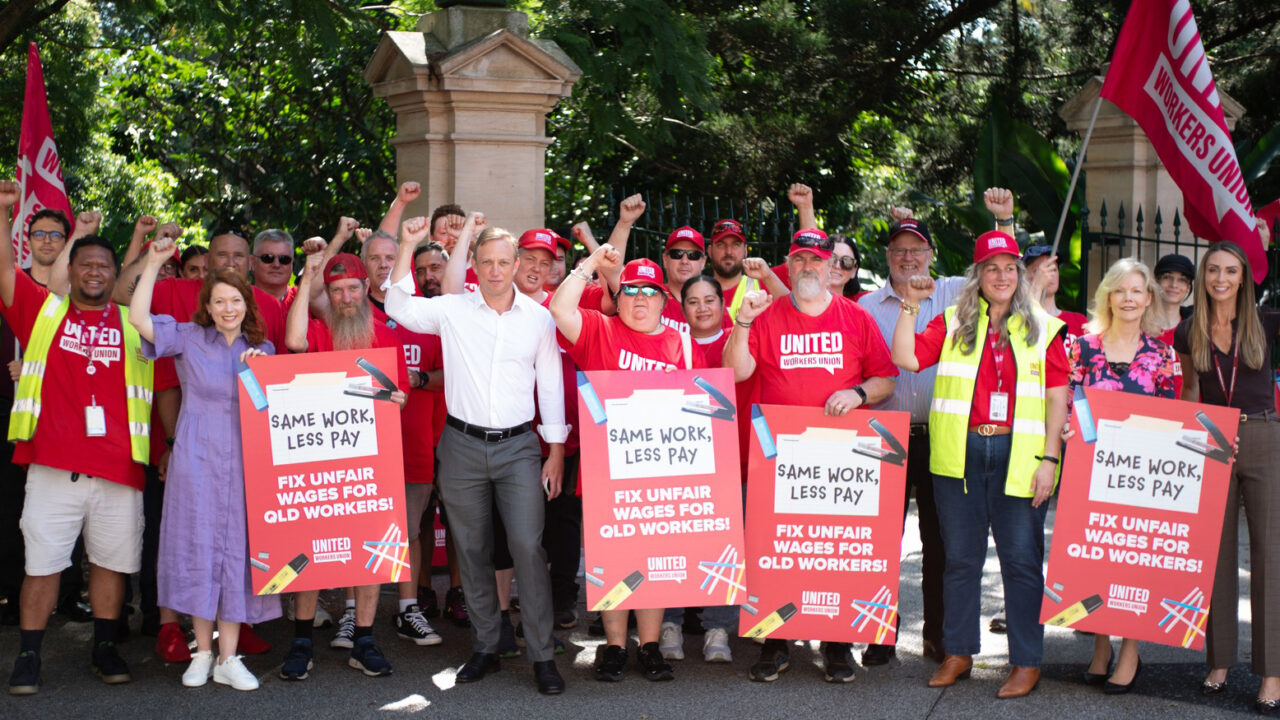
The United Workers Union (UWU) wields enormous power within the Australian Labor Party. The nominally left-wing union regularly gets its own leaders elected to state and federal parliaments, and has even on occasion been able to make or break the odd Labor state premier. This institutional power is part and parcel of the current factional battle for control of the UWU.
The earlier article “United Workers Union: winner takes all” looked at both the formation of the UWU in 2019 and the fact that UWU national secretary and former National Union of Workers (NUW) leader Tim Kennedy and UWU national president and former United Voice (UV) leader Jo Schofield are now on opposite sides of a factional divide.
This article will delve into the UWU’s institutional power within the ALP, the power that the union’s contending factions are now fighting for.
The UWU makes no bones about the political influence it wields. In a 2024 article on the UWU website, the union outlined the various groups of state and federal Labor politicians aligned to the UWU, including the “fourteen United Workers Union Members of Parliament elected” in the first Albanese Labor government.
As will become evident below, the UWU has acquired this institutional power primarily through its United Voice predecessor, the product of the 1992 amalgamation of the Federated Miscellaneous Workers’ Union (FMWU) and the Liquor, Hospitality and Miscellaneous Union (LHMU), the so-called “Missos” and “Pissos”. The United Voice union gathered its greatest strength in the states of Western Australia, Queensland and South Australia, and this has now flowed into the UWU.
WA Labor’s ‘most dominant sub-faction’
The United Workers Union is the single most powerful union in the Western Australian Labor Party. The union dominates the state’s left faction, known as the Broad Left, and has around two dozen state MPs directly aligned to it.
WA Labor’s Administrative Committee provides an insight into the power that the UWU wields in the West. Several members of the 16-strong committee are directly linked to the UWU. These include current Premier Roger Cook, who hails from United Voice and the “Missos”; Carolyn Smith, long-term state United Voice and UWU leader and left power broker; Dominic Rose, a UWU political coordinator; Federal WA Senator Sue Lines, a former National Assistant Secretary of United Voice; WA Labor State Secretary Mark Reed, who spent six years working at United Voice; and Naomi McLean, a former electorate officer for Amber-Jade Sanderson who was once a United Voice assistant state secretary.
After WA Labor’s historic victory in 2021, the Broad Left’s 40 state MPs included a total of 26 aligned to the United Workers Union. This made the UWU forces “the most dominant sub-faction of the most dominant faction of Labor’s 74-person caucus”.
However, dominance does not make for total control. This can be seen in the fight to replace WA premier Mark McGowan in June 2023. Factionally, Amber-Jade Sanderson was set to take the top job. She had the support of UWU leader and left faction heavyweight Carolyn Smith and a “clear majority” of her UWU-aligned colleagues. However, Roger Cook managed to cobble together an alliance of a minority of UWU-aligned colleagues, the Broad Left’s 17 MPs aligned with the ‘metal workers’ (Australian Manufacturing Workers’ Union) and 26 MPs from the right to become WA premier.
Senator Fatima Payman is another product of Carolyn Smith’s power within WA Labor. Previously working as a UWU organiser, Payman was elevated to the generally unwinnable third spot on WA Labor’s Senate ticket at the behest of Smith. Two years after her 2022 election, Payman was suspended from the Labor caucus for voting in favour of a Greens resolution to recognise the state of Palestine. She has since quit the Labor Party and gone on to launch her own political party, Australia’s Voice.
Despite these setbacks, UWU power broker Carolyn Smith still wields enormous clout. Having been the WA Labor state president from 2017 to 2021, she now sits on the Labor Party’s national executive.
‘The man who runs Queensland’
For decades the dominant force within Queensland Labor was the right-wing Labor Forum faction led by long-time Australian Workers’ Union (AWU) leader Bill Ludwig. Today, that role belongs to the United Workers Union and the faction it leads simply called “The Left”.
UWU leader Gary Bullock has replaced Ludwig as Queensland Labor’s kingmaker. The former Queensland state secretary of United Voice and current UWU national political director stepped into the void left by Ludwig’s retirement in 2013 to break down the Right’s stranglehold over the state.
Bullock’s rise can in part be explained by the differing fortunes of United Voice and the AWU over the last decade. United Voice in Queensland began as the union’s fourth-largest branch and finished as its biggest with a total of 28,000 members. Amalgamation with the NUW boosted Queensland UWU numbers to around 37,000 members. On the flip side, the Queensland AWU was savaged by conservative premier Campbell Newman, who outlawed compulsory payroll deductions for union memberships and outsourced lower-paid public sector jobs covered by the AWU. The union’s inflated national membership figures, which between 2012 and 2017 fell from a supposed 140,000 members to just under 70,000, didn’t help matters.
Gary Bullock is now touted as “The Man who runs Queensland” and “the left’s most formidable factional power player”.
Bullock was instrumental in ensuring that Steven Miles, himself a former United Voice campaign director, became the Sunshine State’s 40th premier after Annastacia Palaszczuk resigned in December 2023. The UWU powerbroker has also strengthened the institutional left’s hold on power by convincing some from the two right-wing factions to switch to the left.
At the end of 2023, the Queensland Labor government’s 52 MPs were made up of 25 from the left, including 12 directly aligned to the UWU, 18 aligned with the AWU Right and nine in the smaller right-wing “Old Guard” faction. Despite Labor’s state election loss in 2024 and two recent defections from the Labor Forum to The Left, the factional proportions are pretty similar today. Of Labor’s current 35-member opposition caucus, around half are from the left, around a dozen from the Labor Forum right and just six from the “Old Guard”.
Bullock’s role as Queensland Labor’s powerbroker was cemented at the 2023 ALP national conference in 2023 when the UWU leader was elected to the party’s powerful national executive.
South Australia’s PLUS faction
The UWU in South Australia has nothing like the power of its WA and QLD counterparts, but it does control the Labor left faction in that state.
SA Labor has for decades been dominated by the right-wing Labor Unity faction led by the “shoppies” union, the Shop, Distributive and Allied Employees’ Association (SDA). Playing second fiddle to Labor Unity is the left-wing Progressive Left Unions and Sub-branches (PLUS) faction, which for years has been dominated by United Voice and the UWU.
Former United Voice official David Gray served as the PLUS faction’s convenor for 10 years. His tenure saw something of a coup when he helped elevate the SA left’s Jay Weatherill into the premier’s job in 2011. When Gray stepped down as PLUS convenor in 2019, he was replaced by Karen Grogan. Grogan spent several years as chief of staff to federal MP and former United Voice state secretary Mark Butler before taking up her own role within United Voice. In 2021 she was nominated to fill a casual senate vacancy to become a Labor Senator for South Australia. In that same year she was elected to the Labor Party’s national executive and reelected in 2023.
For various historic and political reasons, the UWU does not wield the same clout in other states as it does in Western Australia, Queensland and South Australia. But the union is far from powerless in these other states. A good example is Labor Senator for Victoria Jess Walsh. Walsh was the United Voice state secretary for 12 years before being elected to the Senate in 2019. In 2025 she became the Albanese Labor government’s Minister for Early Childhood and Minister for Youth.
National influence
The UWU’s institutional power does not stop at the state level. It makes its way to the very top of both the Labor Party and the Labor government.
The Labor Party National Executive is the party’s chief administrative authority. It is currently made up of 27 members, with an approximate 50:50 split between union representatives and politicians. Of the 13 current union representatives, six are from the left. These include two UWU officials, Carolyn Smith from Western Australia and Gary Bullock from Queensland. Senator for South Australia and PLUS faction convenor Karen Grogan is also directly aligned with the UWU.
The UWU’s influence extends right up to the federal cabinet of the Albanese government. With the Labor left improving its position within the caucus after the 2025 elections, there are now 12 cabinet members from the left and 11 from the right. Three of the left’s 12 members have direct links to the UWU: Foreign Affairs Minister Penny Wong, a former legal officer for United Voice in South Australia; Health Minister Mark Butler, a former SA United Voice state secretary; and Environment Minister Murray Watt.
The power that the United Workers Union wields within the Australian Labor Party cannot be underestimated. The union has the power to elect its own state and federal MPs, play the role of state power broker and win positions on the ALP National Executive and in federal Cabinet. This is this glittering prize that helps to explain the ferocity of the current factional battle for control of the UWU.