
Two competing factions of the United Workers Union have launched campaigns to control the union. While its leaders talk up the need to rebuild union power, the union’s current election system only stifles it. Bob Sparks investigates.
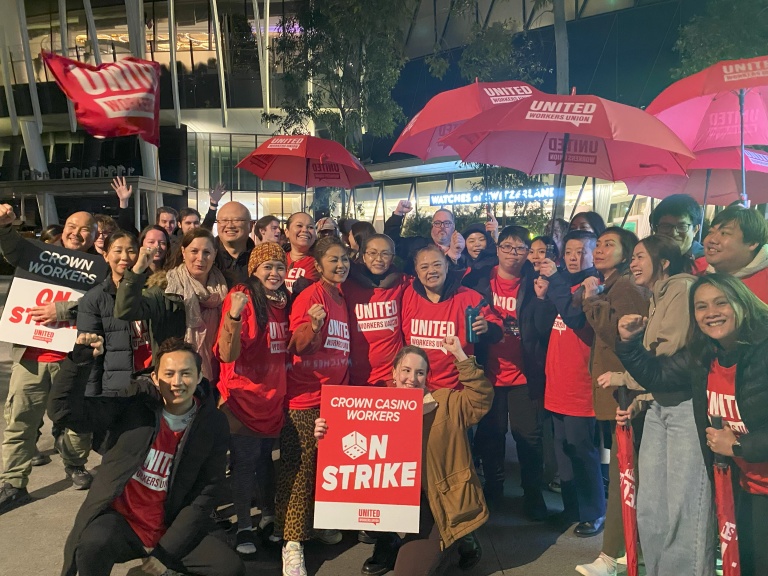
The United Workers Union (UWU), one of the biggest general workers’ unions in Australia, will soon hold its national elections. And for the first time since its formation in 2019, these elections will see two separate tickets led by two incumbent national leaders challenge one another. Each leader comes from one of the two unions that merged to form the UWU – the National Union of Workers (NUW) traditionally aligned with the Labor Right and the United Voice (UV) union aligned with the ‘Albanese Left’.
On one side is UWU national secretary and former NUW national secretary Tim Kennedy. Having suffered a vote of no confidence after a UWU internal investigation alleged his ongoing involvement with controversial fundraising company IR21 Ltd., Kennedy has launched the Members First ticket to regain control of the union. On the other is UWU national president and former United Voice national secretary Jo Schofield who is heading up a competing ticket.
A future article will delve into the politics of this contest further. For the moment, it is worth noting that many on the socialist left inside and outside the Labor Party are taking the ‘radical’ and ‘rank-and-file’ Members First ticket at face value. But a closer look suggests that this contest is not a rank-and-file challenge to entrenched incumbents. It is a fight between union apparatchiks who have fallen out with one another.
The ‘first past the post’ basis of UWU elections means that this is a winner takes all battle for control of the union. If the ‘Albanese Left’ loses its control of the UWU, it will weaken the Prime Minister’s hold over the ALP conference. For both sides in this contest, the stakes are high.
Union marriage of two equals?
The National Union of Workers and United Voice were two very different unions. The bedrock of the old NUW was in warehouses, distribution, logistics and food manufacturing, while United Voice organised cleaners, security guards, casino and hospitality workers, early childhood educators and aged care workers. The NUW was based in more male-dominated industries while United Voice covered more female workers. Both organised in relatively low-income sectors of the economy.
The 2019 merger of these two unions to form the UWU was accompanied by more than a little fanfare. Industrial reporters wrote that the new union had undergone “a radical overhaul” and had “ditched more than a 100 years of union practice in Australia” by “abolishing the structures of state and federal branches”. UWU National Secretary Tim Kennedy told assembled delegates that the new union would “rebuild worker power” and put workers “back in the centre of the political contest”. Unfortunately, the reality is far removed from this rhetoric.
The rules of the United Workers Union in fact do little to “rebuild worker power”. This is particularly the case with the way the union carries out its national elections. UWU rules enshrine a complicated electoral college system of indirect voting. The more than 140,000 union members don’t directly vote for their national leadership, instead that task is handed over to about 500 union delegates that rank-and-file UWU members elect only once every four years.
The complicated UWU election process consists of three separate stages. The first stage is the election by all financial UWU members of between 450 and 500 delegates to the National Convention. The second and third stages see National Convention delegates first elect 50 councillors to the union’s Member Council and then elect the National Secretary, National President and other National Officers from among their ranks. What this means is that over 140,000 UWU members do not get a direct say in either who their national leaders are or who sits on the Member Council. Only 450 to 500 delegates get that right.
Union electorates: atomising the membership
This year UWU members will vote for a total of 483 National Convention delegates in an election conducted by the Australian Electoral Commission (AEC). While not yet finalised by the AEC, these elections will take place around late April or early May and run for 28 days.
Unlike most national unions, UWU members are not grouped together in industry groups or state branches but in so-called Union Electorates. These are based on the electoral divisions of the federal House of Representatives. Each Union Electorate is made up of between two and a dozen federal electorates and has a minimum of 2500 UWU members. And just like bourgeois parliamentary democracy, UWU members are allocated to Union Electorates on the basis of where they live, not where they work.
UWU members are currently divided into 26 separate Union Electorates. Members in each electorate will elect between 11 and 27 National Convention Delegates, with a total of 483 delegates being elected to this year’s National Convention. Delegates are elected on a ‘first past the post’ system and gender equity provisions ensure that at least 50 percent of the National Convention Delegates are women.
It’s worth looking at an example to see how these Union Electorates work in practice. The Union Electorate of Sydney South West includes the Smithfield-Wetherill Park Industrial Estate, one of the biggest industrial hubs in the Southern Hemisphere. Sydney South West is made up of four federal electorates (Fowler, Macarthur, McMahon and Werriwa). To its north is the Union Electorate of Sydney North West made up of five federal electorates (Chifley, Greenway, Lindsay, Mitchell and Parramatta). Under this system, a UWU member working in a warehouse in Smithfield-Wetherill Park but living just 10 to 15 kilometres away in Parramatta or Blacktown resides in the Union Electorate of Sydney North West. Yet their workmate living 30 kilometres away in Campbelltown is still in Sydney South West, the same union electorate they work in. Dividing unionists working in the same workplace into different Union Electorates does not “rebuild worker power” but instead dilutes it.
National Convention
The second and third stages of the UWU’s election process take place at the National Convention. This is likely to be held around mid to late July. National Convention Delegates from the union’s 26 Union Electorates will elect 50 councillors to the union’s Member Council and then elect the union’s national leadership – a National Secretary, a National President and other National Officers. So whichever group controls the convention will elect every member of the national leadership. The power-sharing deal from the merger of the two unions will be dust.
Member Councillors are elected in two separate groups. One group is elected by the National Convention as a whole. The other is elected by and from Convention Delegates living in each of the nation’s states and territories. This year’s National Convention will see 20 Member Councillors elected by all National Convention Delegates and 30 Member Councillors elected on a regional basis: ACT, Northern Territory and Tasmania (one councillor each), South Australia (four), NSW and WA (five), Victoria (six) and Queensland (seven). The Member Council is nominally the union’s highest decision making body between conventions. All Member Councillors are elected for a four-year term and at least 50 percent of Member Councillors must be women.
National Convention Delegates then elect the union’s national leadership. This year, the National Convention will elect 12 national officers – the UWU National Secretary, National President, four National Vice-Presidents and six other National Executive Members. Affirmative action ensures that either the National Secretary or the National President positions must be held by a woman and at least 50 percent of all national officers are women.
Locking in incumbents
Delegate Convention systems like the UWU’s complicated electoral college process are a rarity in the Australian union movement. Nearly all major unions in Australia use direct membership elections to choose their national leaders. But the opposite is the case in the United States, where only six of the country’s 20 largest unions have direct leadership elections. The majority use delegate conventions to elect their leaders and more often than not, the results are not good.
One example is the United Auto Workers (UAW) union. For seven decades the union was ruled by the “Administration Caucus” which was first set up after Walter Reuther and his supporters won a clean sweep of leadership positions in 1947. The Administration Caucus ruled the UAW like a one-party state. Factional struggles for control and succession only ever broke out within the top union leadership, all of whom were Administration Caucus members. Once these disputes were settled behind closed doors, the Caucus would close ranks to ensure that its ticket won a comfortable majority at each delegate convention.
The UAW regime increasingly collaborated with employers, signed sweetheart deals and failed to organise the growing sector of non-union auto production. It also opened the door to corruption, a process which culminated in the 2020 scandal that saw top UAW officials embezzle more than $US1.5 million in union money and accept more than $US5 million in kickbacks from auto company contractors and Fiat-Chrysler executives.
Then there’s the International Brotherhood of Teamsters (IBT). The Teamsters under former president Jimmy Hoffa was synonymous with organised crime. Unsurprisingly, it too had a decades-long practice of electing its national officials at national conventions every five years.
The UAW and Teamsters were only obliged to adopt direct membership elections after the two unions settled anti-corruption and anti-fraud lawsuits brought against them by the US Department of Justice under the Racketeer Influenced and Corrupt Organizations Act (RICO).
One member, one vote
Delegate Convention systems do not automatically lead to union corruption. And direct leadership elections do not instantly lead to union militancy or leadership accountability. But all too often the Delegate Convention system entrenches incumbent officials who can deploy the union’s vast resources to maintain their hold on power and fend off any challengers. This gives rise to an almost permanent layer of officials who are insulated from member accountability and control. Weaker unions are the final result.
The 140,000 members of the UWU are currently denied the basic democratic right to directly elect their union’s national leaders. This is made worse by the fact that delegates are not elected proportionally, but on a first-past-the-post ‘winner takes all’ system. This must come to an end. Union militants and socialists in the UWU must fight to scrap the union’s complicated three-tier electoral system and the divisive Union Electorates based on where members live, not work. Rebuilding worker power in the UWU starts with direct membership election of all national leaders.
Statistics taken from Rules of the UWU (2024) and the Fair Work Commission decision of December 22, 2025.