
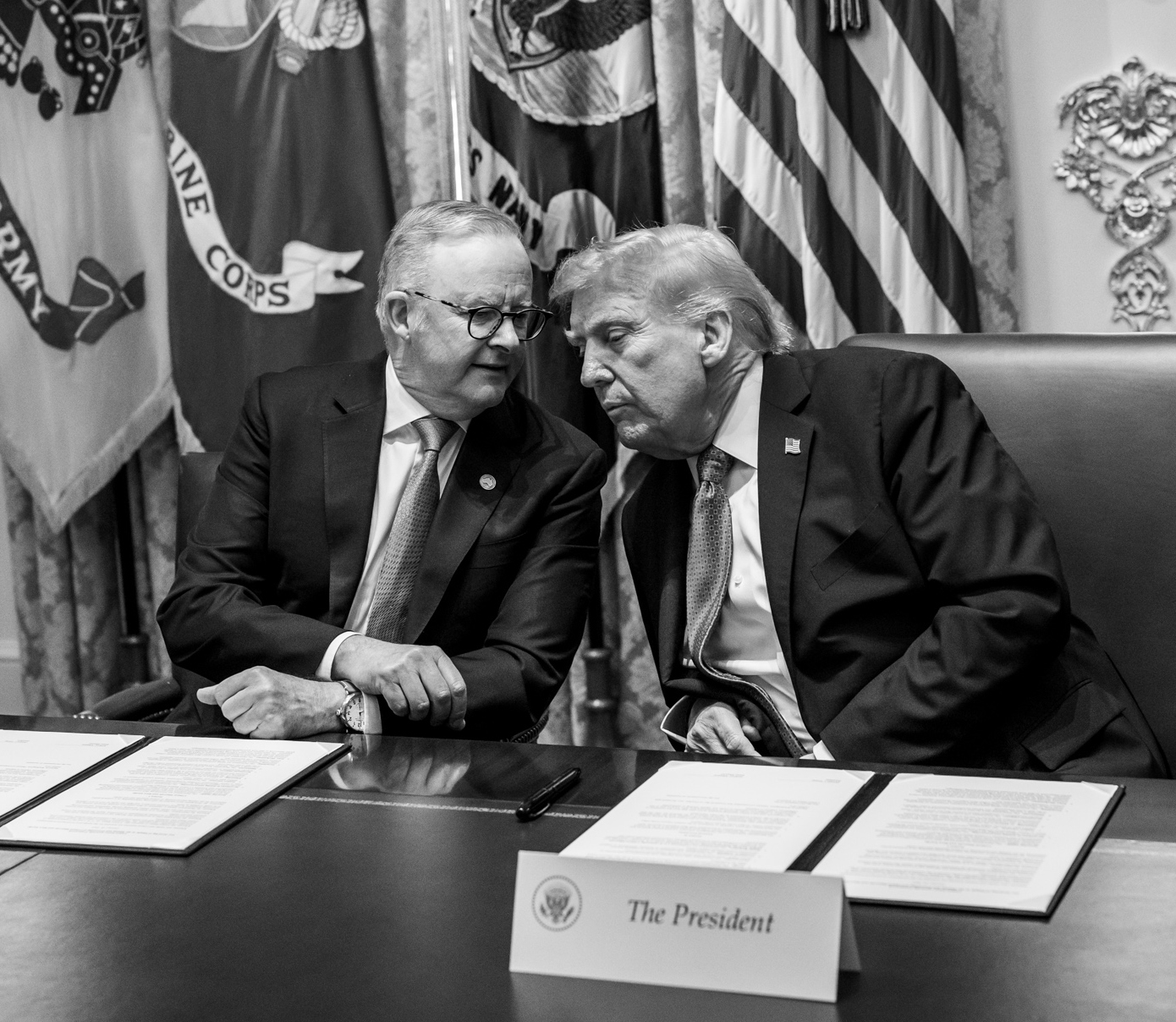
Thinly veiled threats to use nuclear weapons against Iran weren’t enough for Albanese to withdraw support for Trump’s war, writes Hamish McPherson.
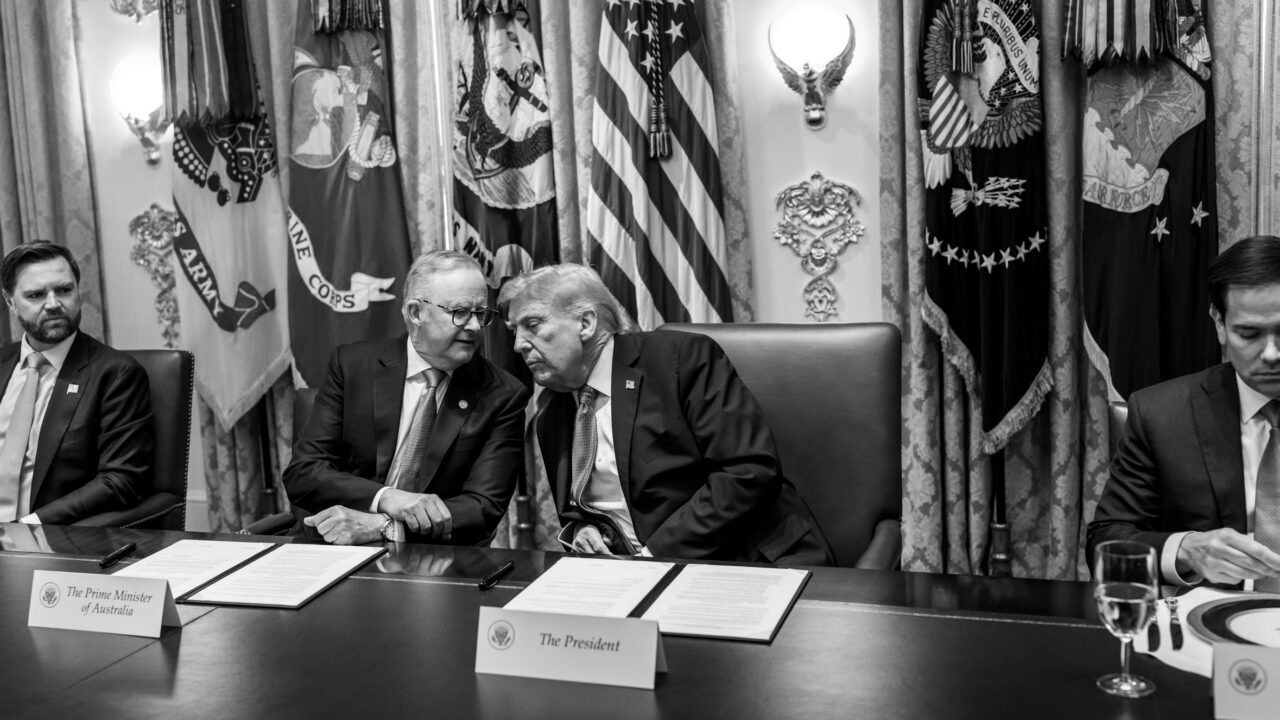
The US and Israel’s wars on Iran and Lebanon are a brutal assertion of power that is exposing the violence and dysfunction at the core of global capitalism.
Faced with Iran’s resistance, an increasingly unhinged US President Donald Trump declared: “We’re going to hit them extremely hard over the next two to three weeks. We’re going to bring them back to the stone ages where they belong.”
It was a shocking but accurate description of the war crimes US forces have been committing for more than five weeks. As we go to press, it is unclear if the fragile ceasefire between the US and Iran will hold. So far, Israel has ignored the ceasefire and continued its war against Lebanon.
The Iranian people have endured relentless US and Israeli bombing of military, industrial and civilian sites. In just the day before the ceasefire was announced they bombed railway lines, bridges, oil production facilities and the Sharif University and the Khorasaniha Synagogue in Tehran.
According to Human Rights Activists Iran by March 23, at least 1,443 civilians had been killed by US-Israeli airstrikes, including 217 children.
The United Nations Office of the High Commissioner for Human Rights stated that:
“US and Israeli strikes have claimed the lives of people across Iran. Housing complexes, medical facilities, schools, shops, courthouses, UNESCO World Heritage sites and energy installations have been impacted by strikes. According to the Iranian Red Crescent, 67,414 civilian sites have been struck, of which 498 are schools and 236 health facilities.”
The US military is well practised in destroying civilian life to achieve military goals. The phrase “We’re going to bomb them back into the Stone Age,” was first used by senior US Air Force officer Curtis LeMay, in his 1965 book, Mission with LeMay, in relation to the carpet bombing of North Vietnam.
LeMay had played a central role in executing the World War II carpet bombing of Japanese cities that killed hundreds of thousands of civilians, a tactic repeated by the US military with devastating effect against North Korea in the early-1950s.
As the US airstrikes failed to break Iran’s national defence, topple the regime or reopen the Strait of Hormuz, Trump made the chilling warning on his Truth Social that without a deal, “a whole civilisation will die tonight, never to be brought back again”.
Vice-President JD Vance followed up by stating that US has “tools in our tool kit we have so far decided not to use”.
While the White House later denied that he was alluding to nuclear weapons, this was clearly an implied threat by Trump and Vance to unleash nuclear annihilation.
When threats, implied or otherwise, are made by the only nation to have used nuclear weapons, against the cities of Hiroshima and Nagasaki, they carry a deadly weight of seriousness.
The best Prime Minister Anthony Albanese could muster is to say he didn’t think it was “appropriate to use language such as that” and that he hoped “any conflict must be within international law”.
But we have seen that the previously negotiated arrangements of globalised capitalism are breaking apart; “ruptured” is what Canadian Prime Minister Mark Carney said. Long gone is the naively optimistic vision of a stable integrated world economy and polity that held sway at the turn of the century.
We are seeing a return to the normal factory settings of capitalism – a system of highly competitive blocs of national capital and states, that constantly vie for influence and dominance. This competition increasingly takes the form of military-state rivalry, with the threat or actuality of war always present.
This is evident in the accelerating rivalry and competition between the major powers – the US, China, Europe and Russia – for raw materials, critical minerals, new technology, markets, territories and zones for the investment and accumulation of capital.
These circumstances require a political response that rejects imperialist militarism and war and applies anti-capitalist measures to bring the economy under greater democratic control to benefit the living conditions and wellbeing of the majority.
Australia’s rotten partnership
The Australian Labor government could have responded to the US war of aggression by condemning the attack and ensuring that no Australian military forces or intelligence infrastructure would be involved in aiding the US war effort. Spain did just this.
This would have been a firmer position from which to take active measures to protect working class living standards from the economic shocks coming our way.
However, the mildly social-democratic government led by Anthony Albanese, Penny Wong and Richard Marles is incapable of doing so. The Labor leadership is simply too thoroughly bound up in the commonsense norms of the Australian ruling class to challenge its central partnership with the US superpower.
All this is evident in two speeches Albanese made at the height of the crisis. His bland televised speech to the nation on 1 April contained little of substance and only one sentence about the war, the dishonest assertion that, “Australia is not an active participant in this war”.
That’s right, we’re just passive bystanders. The junior kid watching on while the playground bully runs amok again.
Forget the Royal Australian Navy sailors training for AUKUS aboard the US nuclear submarine that sunk the Iranian frigate in the Indian Ocean. Ignore the 85 ADF personnel and Wedgetail spy-plane sent to the United Arab Emirates and providing operational data to US Central Air Force Command. Don’t mention the Pine Gap or North West Cape military spying bases that are crucial to all US war operations in Asia.
Albanese repeated the assertion and said a little more about Australia’s stance in his prepared speech the following day at the National Press Club:
“Australia is not an active participant in this war. We did express support for the original objectives: preventing Iran from ever obtaining a nuclear weapon…. Iran’s air force is degraded. Its navy is degraded, its military-industrial base is degraded and so too is its capacity to launch missiles. That is a good thing.”
This uncritically repeats Trump’s own talking points, including the claim that Iran was intending to build nuclear weapons. Here is what Trump himself said on 1 April, in the same televised speech threatening to bomb Iran into the stone ages:
“We are systematically dismantling the regime’s ability to threaten America or project power outside of their borders. That means eliminating Iran’s navy, which is now absolutely destroyed, hurting their air force and their missile program at levels never seen before, and annihilating their defence industrial base. We’ve done all of it. We’ve beaten and completely decimated Iran.”
Albanese followed Trump’s script and declared it all to be a good thing. It’s just that his speechwriter probably thought that ‘degraded’ sounded nicer and less Trumpian than ‘eliminating/ destroyed/ hurting/ annihilating and decimated’.
Having signalled support for the US war effort, Albanese then made clear that he has no idea what we have gotten involved with:
“And now those objectives have been realised, it is not clear what more needs to be achieved – or what the endpoint looks like.”
The trouble is, when you sign up to support an imperialist war of aggression, you share political responsibility for the consequences.
And those consequences, chiefly the spiralling economic crisis, has Albanese stumbling in the dark looking for the exit door, unable to find “what the endpoint looks like”.
It is important to note that the Albanese government has not gone ‘Trumpian’. Its strategy is tied to the long-term US alliance. As Penny Wong told the Senate last October: “The US relationship matters more than some domestic politics about environmental reform.”
The government’s strategy is to keep the US alliance alive, despite Trump, and will therefore go along with him, hoping to appease him, but not far enough that it causes domestic political problems for them.
The Albanese Government is now attempting to distance itself from the war and making plaintive calls for diplomacy and ‘de-escalation’. Maybe they should have thought of that before giving Trump the thumbs up?
The war has created an economic crisis that threatens to drive up inflation, plunge the economy into recession and hammer working class living standards.
Most of Albanese’s speech was devoted to outlining, in pithy one-line statements, how the government plans to respond to the crisis created by the war.
Referring to the mantra of “progressive patriotism”, Albanese explained that the plan is to reinvest in onshore manufacturing, supply-chain capacity, technology, education, regional diplomacy and all the infrastructure of a proudly independent middle power.
According to Albanese:
“No government can promise to eliminate the pressures this global crisis will impose. But we can be a buffer against the worst of it. A shock absorber, in a time of global shocks. And we will do everything we can to protect the Australian people from what the world throws at us.”
At one level this makes sense from a nationalistic point of view. Except that the Australian government isn’t a bystander to the unfolding war crisis, just helping us to dodge whatever debris “the world throws at us”.
Since 2022, the Australian government and military establishment have made a calculated decision to align ever more closely as a junior partner of US imperialism. They have embraced AUKUS, investment in offensive weaponry like cruise missiles and the general interoperability of our military forces.
This is not a case, as many on the left assert, of Australia simply being misled by and subservient to the US. The Australian capitalist ruling class, including the state, government and military, have long determined that the best way to advance Australia’s national interest is through a firm alliance with the US. They are genuinely committed to a partnership to maintain the US as the dominant power in Eurasia and to counter or at least limit the rise of China.
This partnership is viewed by Australia’s ruling class as a key means to maintain stability in Asia, to make the region safe for capital investment, trade and accumulation, and to maintain its own spheres of influence in the southwest Pacific.
Australia is not just a junior supporter of US imperialism, but an imperialist power in its own right with its own self-appointed sphere of influence, albeit under the global hegemony of US might.
The decision to support Trump’s war on Iran is but the latest expression of a considered strategy by the Australian ruling class to assert its own national interest.
In the Q & A session following Albanese’s Press Club speech a journalist posed a sharp question about the government’s involvement in AUKUS.
JOURNALIST: “Prime Minister, Donald Trump in recent days and weeks has abused his oldest allies. He started a war without consulting those allies, and he’s used military assets that have Australians serving on them, including nuclear submarines. What work needs to be done to rescue the social licence for the $350 billion AUKUS pact?”
In response Albanese didn’t answer the question but did make clear that the commitment to AUKUS and the US alliance remains fully intact, regardless of the disasters being unleashed by the Trump administration:
PRIME MINISTER: “The US alliance is our most important. That remains the case. And we’ve relied upon it. 1951 was when it was formalised, but the truth is, it was really formalised in World War II by John Curtin when he said, “Australia looks to America.” And ever since then, they’re our most important military partner. The AUKUS relationship makes sense for us.”
Albanese is right that the Australian state has relied on the US – but to what end and in whose interests? The military alliance may have provided the architecture to support profitable trade and investment by Australian capital in the Asia-Pacific. It may have enabled the Australian military to access military hardware and technology to improve its arsenal.
But at what cost? Since WWII Australia has committed forces to a series of US-led wars of aggression to maintain its status as a junior partner. The horrors of war in Korea, Vietnam, Afghanistan and Iraq are the true measure of our commitment to the military alliance.
To date, the Australian governing and military elite have embraced AUKUS. According to Albanese by doing so “we have cemented our relationships with our traditional partners, the United States and the United Kingdom”.
The Australian ruling class wants to gain access to the apex technology of nuclear-powered submarines and cruise missiles – to join the elite group of nations who possess such weaponry and can project lethal power beyond their shores.
In military terms AUKUS is not defensive, it is offensive weaponry – designed to project military power into North Asia to contain China and maintain the US and Australia as dominant powers.
We have to stop Australia becoming like the Israel of the Pacific – armed to the teeth to do the bidding of Washington to maintain US hegemony in East Asia.
The Iran war disaster shows the danger of maintaining AUKUS and Australia’s uncritical partnership with a unilateral US superpower. Given what is occurring in the Middle East, how would the US respond to a crisis over the status of Taiwan?
Our central task, as activists and socialists in the labour movement is to build deeper opposition to Australia’s dangerous military partnership with US imperialism, including AUKUS.
Against the drive to increased militarism and war, we need a positive program, for an independent working-class foreign and defence policy that refuses involvement in imperialist wars and makes common cause with the people of the Arab world, Asia and the Pacific.
Read more: After the ‘rupture’ in international affairs described by Canadian PM Mark Carney’s truth bombs at Davos, Hamish McPherson calls for a working-class foreign policy.