
In a mostly stage-managed conference, ALP delegates still managed to debate the Iran war and voted to oppose the Albanese government’s support for Trump’s war, reports Hamish McPherson.
The rise of One Nation and a challenging upcoming state election in November were the issues that loomed large as Labor members and delegates met for the Victorian State Conference on 23-24 May.
Labor has held power in Victoria since 2014 and extended its majority at the last election. However Premier Jacinta Allan has struggled to connect or shake off a sense of government tiredness and drift.
The government has not been under pressure from a divided Liberal opposition, whose leader Jess Wilson recently made the surprisingly honest pledge to a business gathering to cut government spending by $40 billion if elected. This has enabled Labor to again revive the spectre of the Jeff Kennett era as a warning about the perils of voting Tory.
However, One Nation is an unknown quantity in Victoria, where historically it has performed badly. There are real concerns it could sweep up the widespread alienation and anti-Labor feeling in parts of outer suburban and regional Victoria that have previously backed either the Nationals or Labor.
The Allan government’s recent term has been dominated by big spending on major public transport and roads projects, new schools and hospitals, implementing a state-based Treaty with Aboriginal peoples and a marked shift to the right on issues of youth criminal justice.
While the government has invested heavily in new infrastructure, there is continued chronic underinvestment in social services and a failure to halt the corrosive effects of outsourcing and market competition. This is particularly evident in education, where despite building many new schools in growth corridors, Victoria has delayed fully funding public education to the Schooling Resource Standard until 2032, thereby saving $2.4 billion.
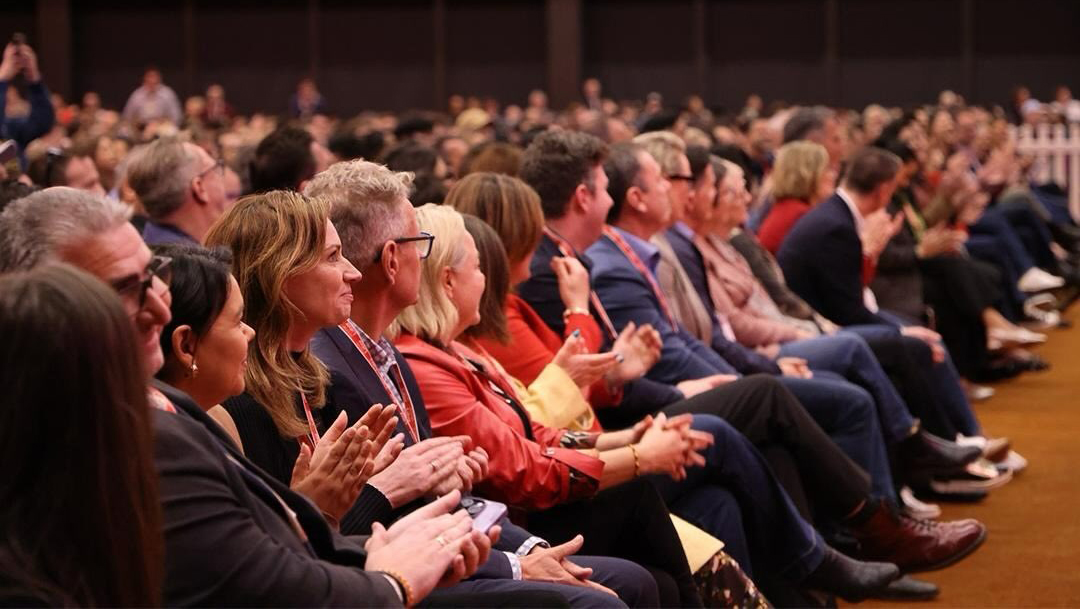
These tensions were evident at the State Conference, the main purpose of which was to decide the party’s policy platform to take to the November election. Labor’s union base used the first day to move a series of amendments to the platform in an attempt to gain basic commitments to public provision and funding of social services, to secure employment in government procurement, to industrial rights, to regulate the use of artificial intelligence and reduce the prevalence of workplace surveillance and outsourcing of jobs in the finance and local government sectors.
These prosaic proceedings were enlivened by Anthony Albanese’s speech on Saturday, when he spoke with confidence and some humour in support of the federal government’s changes to the taxation of capital gains, family trusts and negative gearing. Delegates warmed to the theme that this is about rebalancing the system in favour of working people and the aspiration of home ownership for all. Albanese played to the base when he taunted the Liberals as being out of touch defenders of unfair tax settings.
Premier Jacinta Allan made a shorter speech mainly focusing on Labor’s record on delivering expanded free TAFE and a public scheme of 2,000 apprenticeships with the newly reformed State Electricity Commission. Her rhetoric was limited to a general commitment that Labor is acting to “make life easier, safer and more affordable”. Inspiring stuff.
The challenge of confronting One Nation was taken up in a series of resolutions and speeches. Delegates pointed out that Treaty will be on the ballot paper in November, with the Liberals committed to undo it. Others emphasised that it was time to reassert the labour movement’s values of class unity to achieve progress and the need for Labor to show up and deliver for working people facing material pressures and social alienation.
It is yet to be seen if any of the government’s modest reforms will have enough impact to hold back disillusioned voters from casting a protest vote for One Nation. The union movement is well placed to target One Nation – a party funded by corporate elites – and to highlight their record of voting against all pro-worker industrial laws.
The conference generally lacked political debate, with most amendments or resolutions apart from some rules changes agreed between the dominant Socialist Left (SL) faction and minority right factions beforehand – literally a case of ‘going through the motions’.
The main exception to this was the questions of Palestine and the Iran war, which generated real political debate. Both issues have been the focus of sustained political organising by left activists within the party.
Palestine
Labor Friends of Palestine held a successful fringe event moderated by Danae Bosler, Assistant Secretary at Victorian Trades Hall Council with speakers Ged Kearney MP for Cooper; Sarah Schwartz from the Jewish Council of Australia; Madelaine Chiam, a professor in public international law from La Trobe University; and Jehad Alsabe, a Palestinian from Gaza living in Melbourne, who gave personal insights into the ongoing crisis in Gaza. The event was also attended by Aston MP Mary Doyle and generated constructive discussion about what further actions are required by Australia to halt Israel’s ongoing genocide and occupation.
Labor Friends of Palestine-aligned union secretaries and delegates successfully moved a series of amendments to the platform on Saturday on matters such as defending democratic rights (of public sector workers and in universities) and government procurement and military manufacturing not providing assistance to Israel’s occupation.
The main debate around Israel-Palestine that occurred on Sunday was proceeded by a series of motions condemning antisemitism and calling for ‘respectful’ discussion of the conflict generally moved by right-aligned delegates.
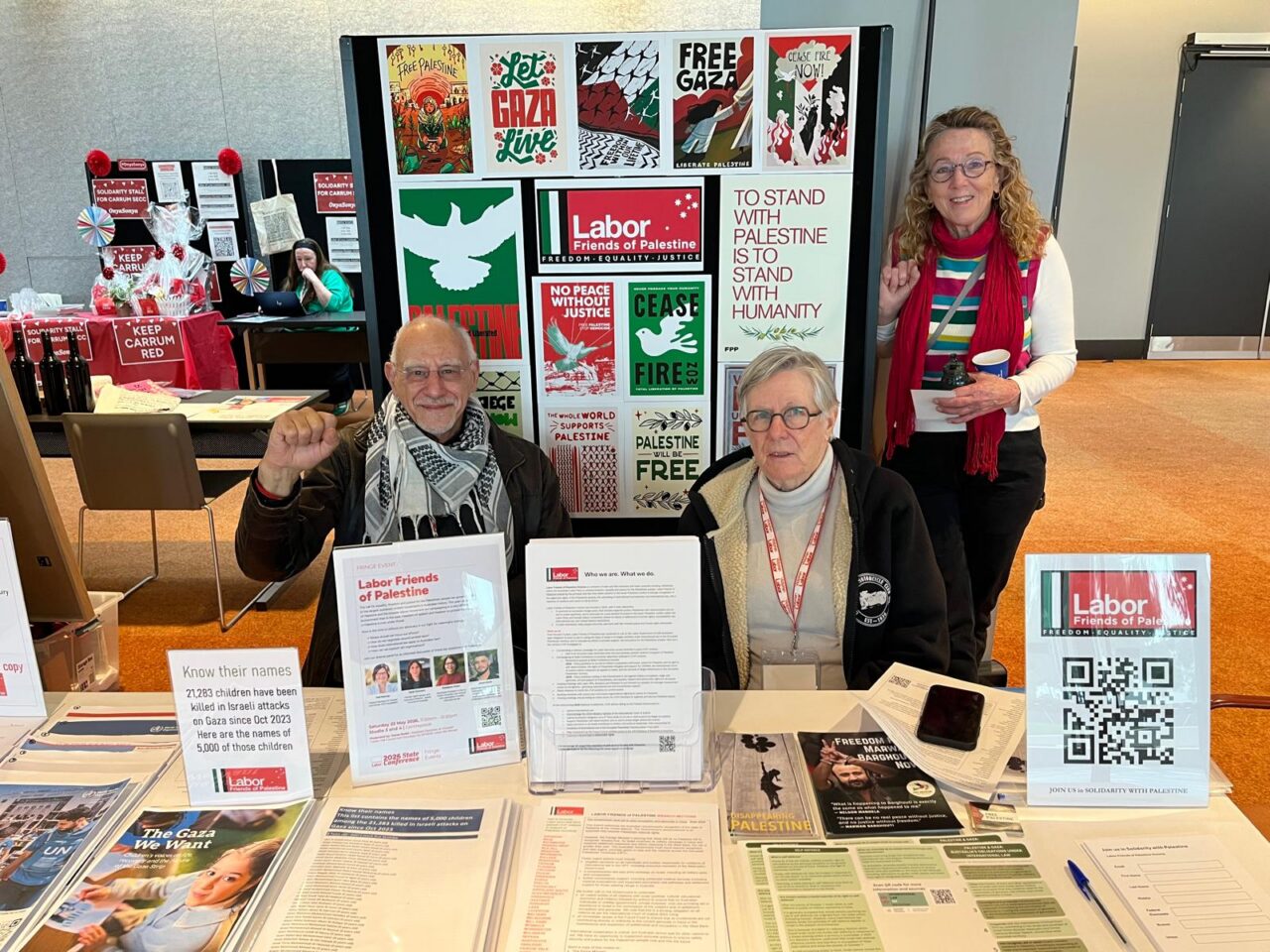
Labor Friends of Palestine and the AMWU moved resolutions condemning the occupation, apartheid policies and arbitrary detention of Palestinians and calling for further sanctions on Israel. An AMWU resolution calling for Labor to campaign for the release of political leader Marwan Barghouti was carried. These motions were opposed by speakers and sections of the right and have caused a predictable rightwing media backlash in the days since conference.
Iran war
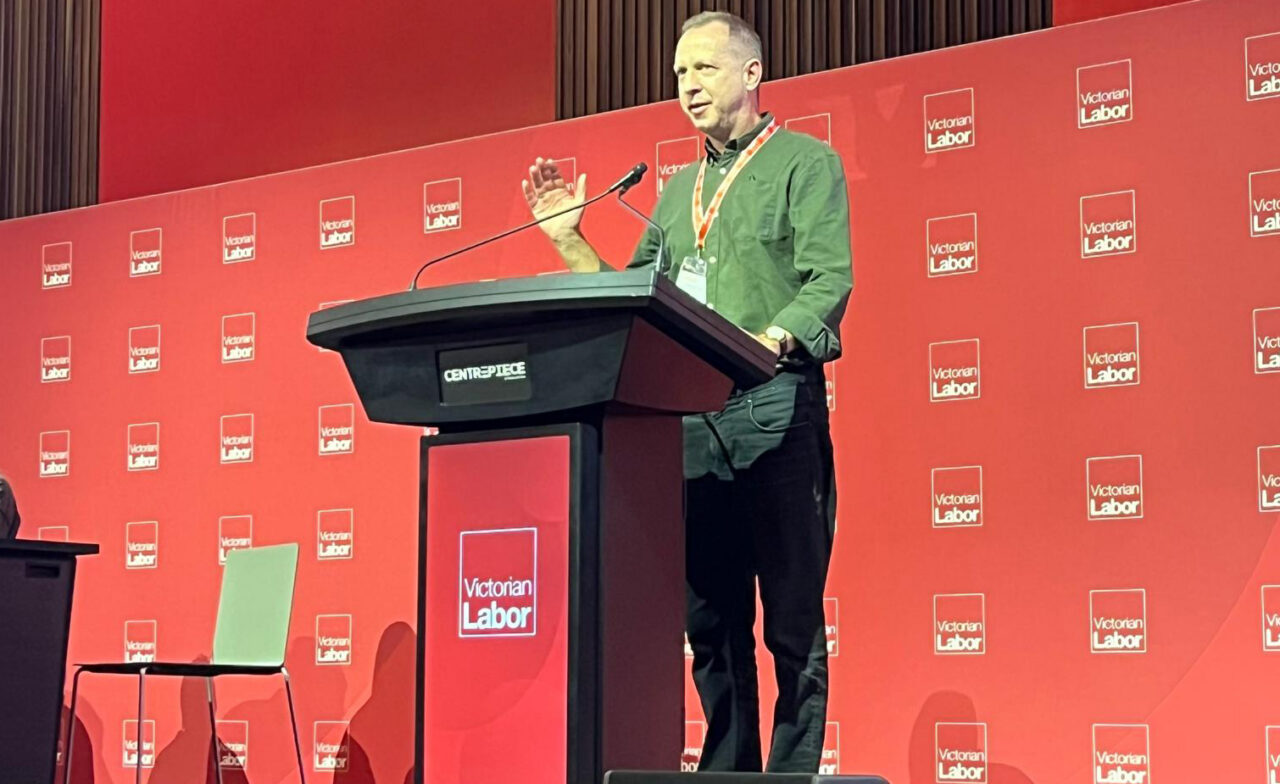
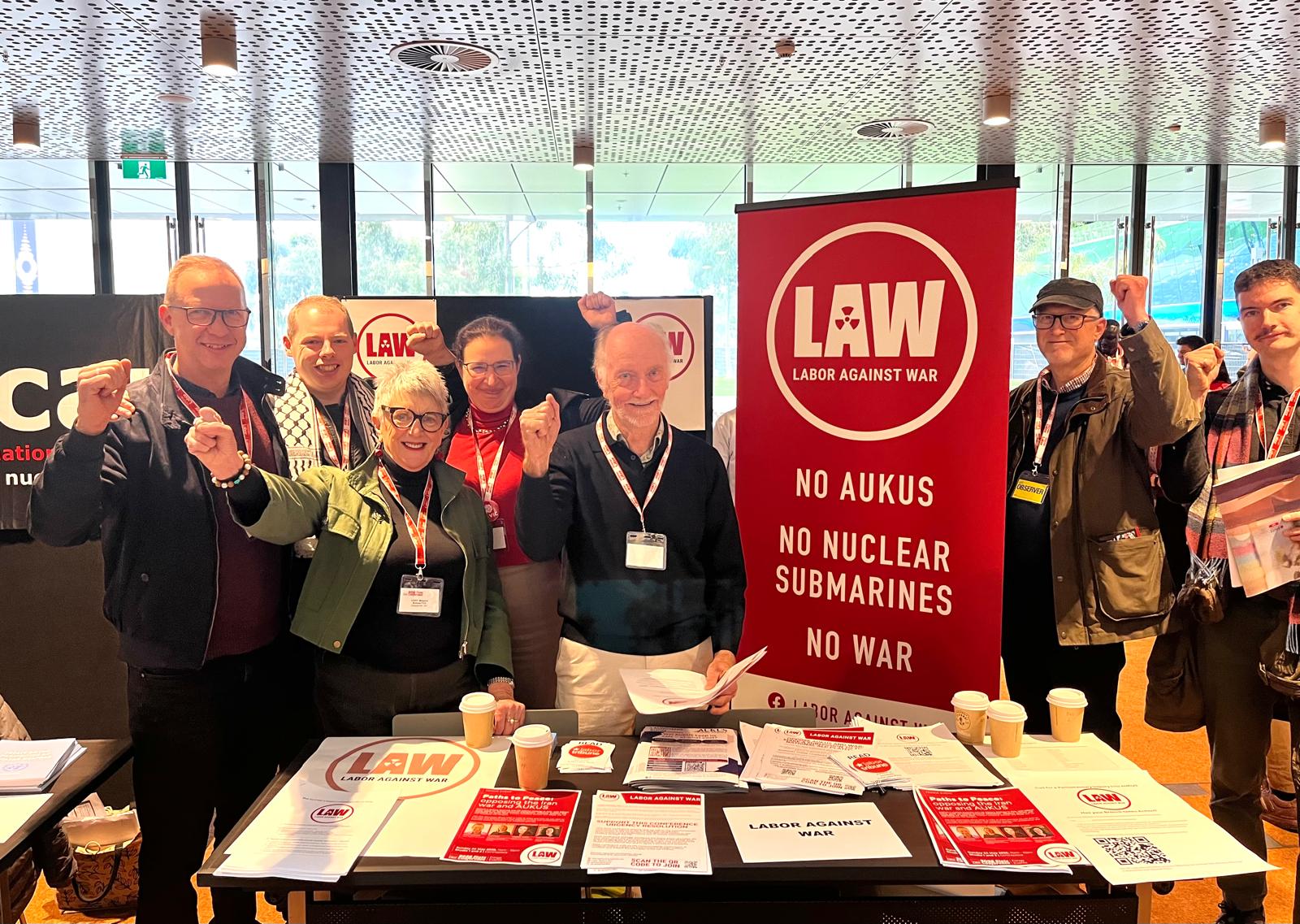
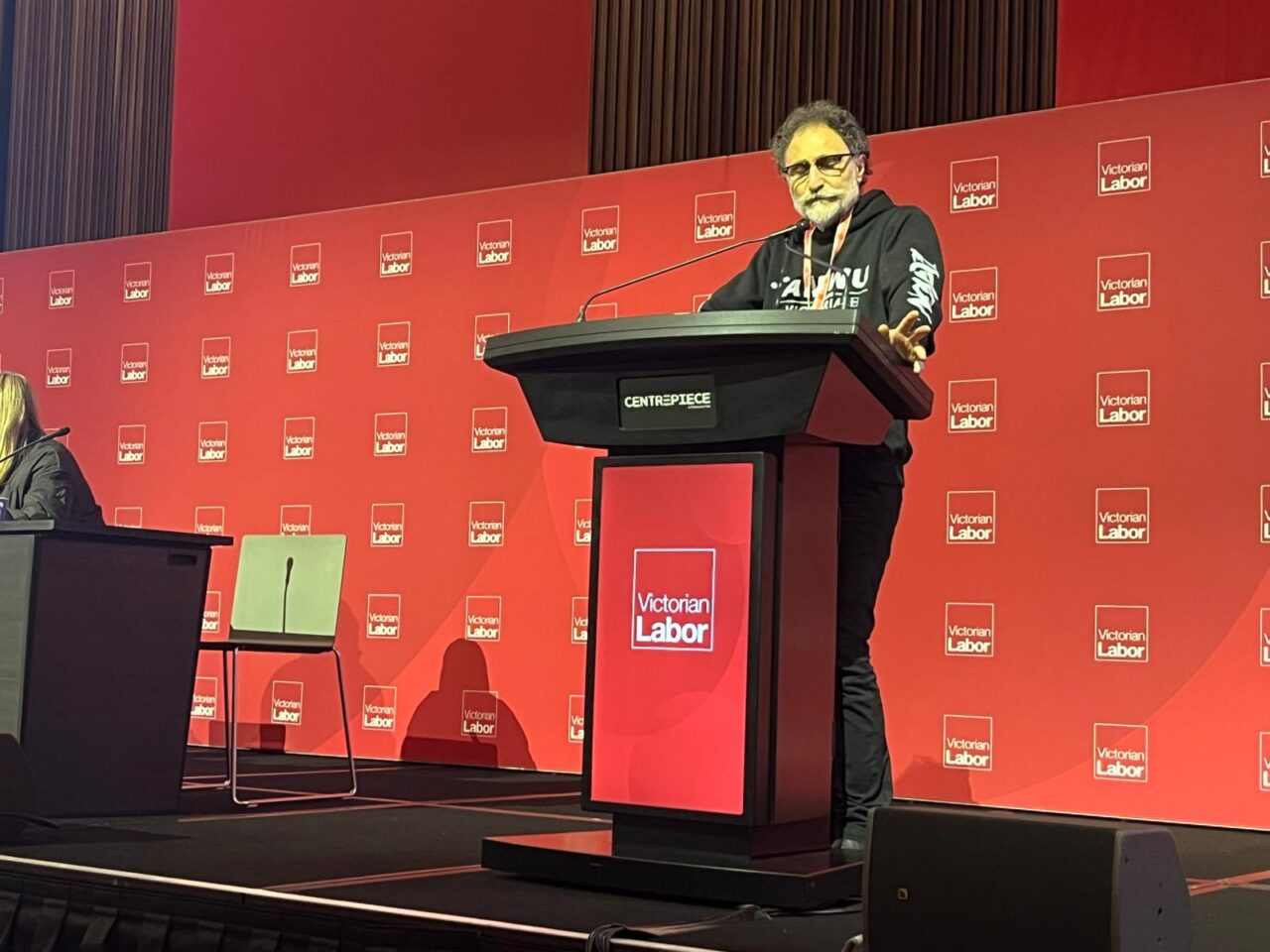
The US-Israeli war on Iran was the subject of major political debate. As convener of Labor Against War (LAW) in Victoria, I moved an urgency resolution opposing the war and the support given by the Australian government. This was seconded by Eric Seychell, a LAW member and SL aligned delegate from Wills electorate.
The resolution referred to commitments in the ALP National Constitution, pointed out that the US and Israel going to war was not authorised by the United Nations and called on the Commonwealth government to withhold military support or involvement in foreign military conflicts that breach the principles of the UN Charter. This framing of the issue was based on the reasons that Labor had opposed the Iraq war in 2003.
In the lead up to conference LAW members successfully raised this or similar motions in local branches, consulted with left unions and sought support in the policy caucus meetings of the Socialist Left faction. In the final weeks I was also approached by staff in Foreign Minister Penny Wong’s office who asked to discuss the motion. This led to some back-and-forth negotiation and slight moderation of the motion, while retaining key elements.
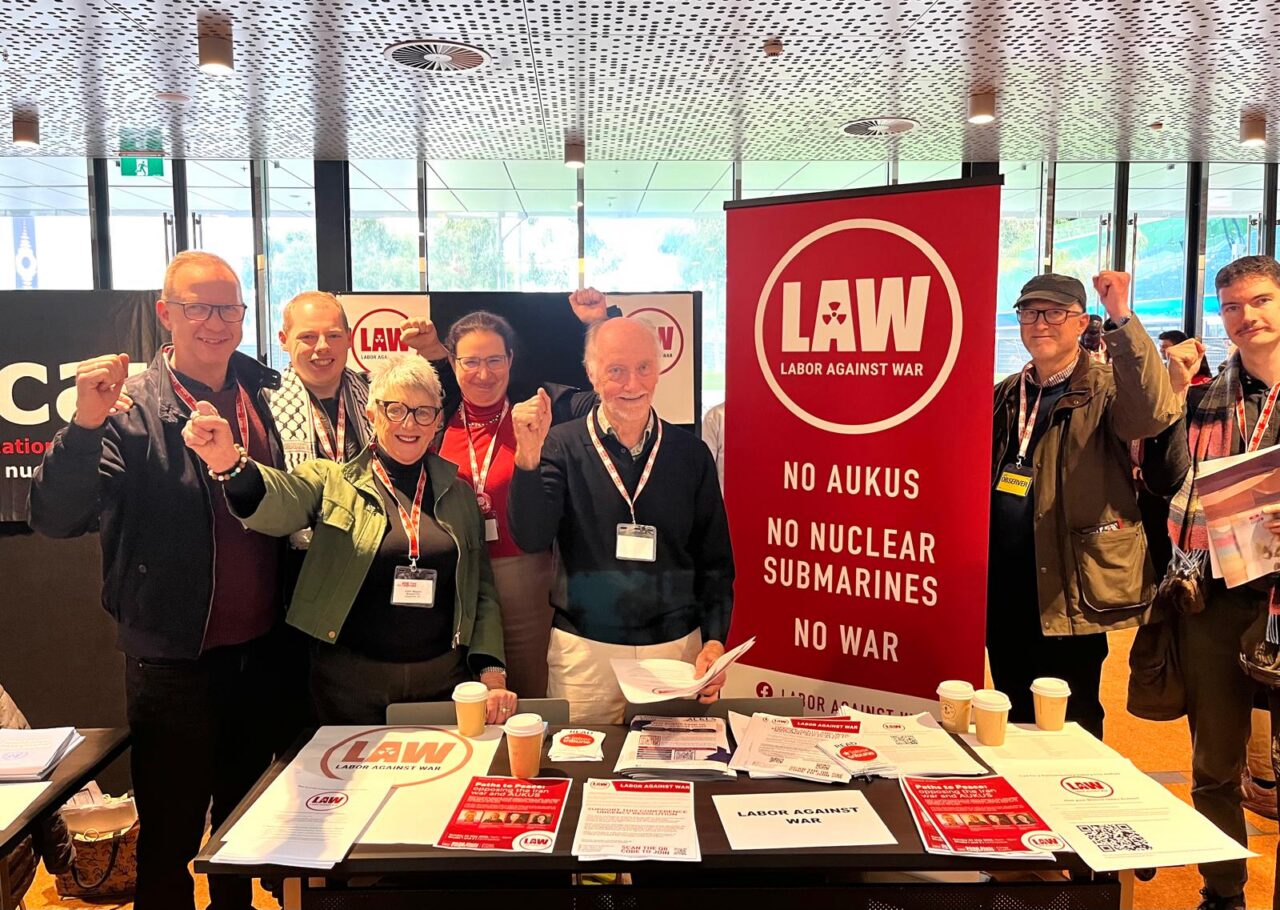
Active members of Labor Against War made a collective effort to have a strong and visible presence at conference, with a prominent stall, signage and 400 leaflets with our resolution and arguments distributed to delegates.
Our fringe event “Paths to Peace: opposing the Iran war and AUKUS” was well attended and audience members raised important questions about building the campaign in the labour movement and internationally. The event was chaired and addressed by LAW members Lea Campbell and Jack Howard alongside Janet Craven from International Campaign Against Nuclear Weapons (ICAN) and Stephanie Thuesen from the Health and Community Services Union (HACSU).
During conference sustained pressure was applied by Nos Hosseini to include a lengthy amendment condemning the crimes of the Iranian regime. Hosseini is a right faction delegate from the seat of Wills of an Iranian background with connections to MP Peter Khalil. Hosseini had spent the days before conference backgrounding the Murdoch press about the issue.
Members of Labor Against War and the SL caucus discussed the amendment and we decided that it would be a mistake to include, given that the repressive character of the Iranian government is a reason given by Trump for launching the war and by Albanese in lending political support. It was noted that recent State Conferences had carried motions condemning the Iranian government.
Further approaches were made about including the amendment via the emissaries of MP Gabriel Ng and SL co-convener Julijana Todorovic.
We decided to include the statement that “State Conference supports the struggle of the Iranian people for democratic change and human rights” to make clear our position on the issue, but this was not sufficient for Hosseini. Comrades in LAW and the SL remained firm and we gained further support from delegates on this basis.
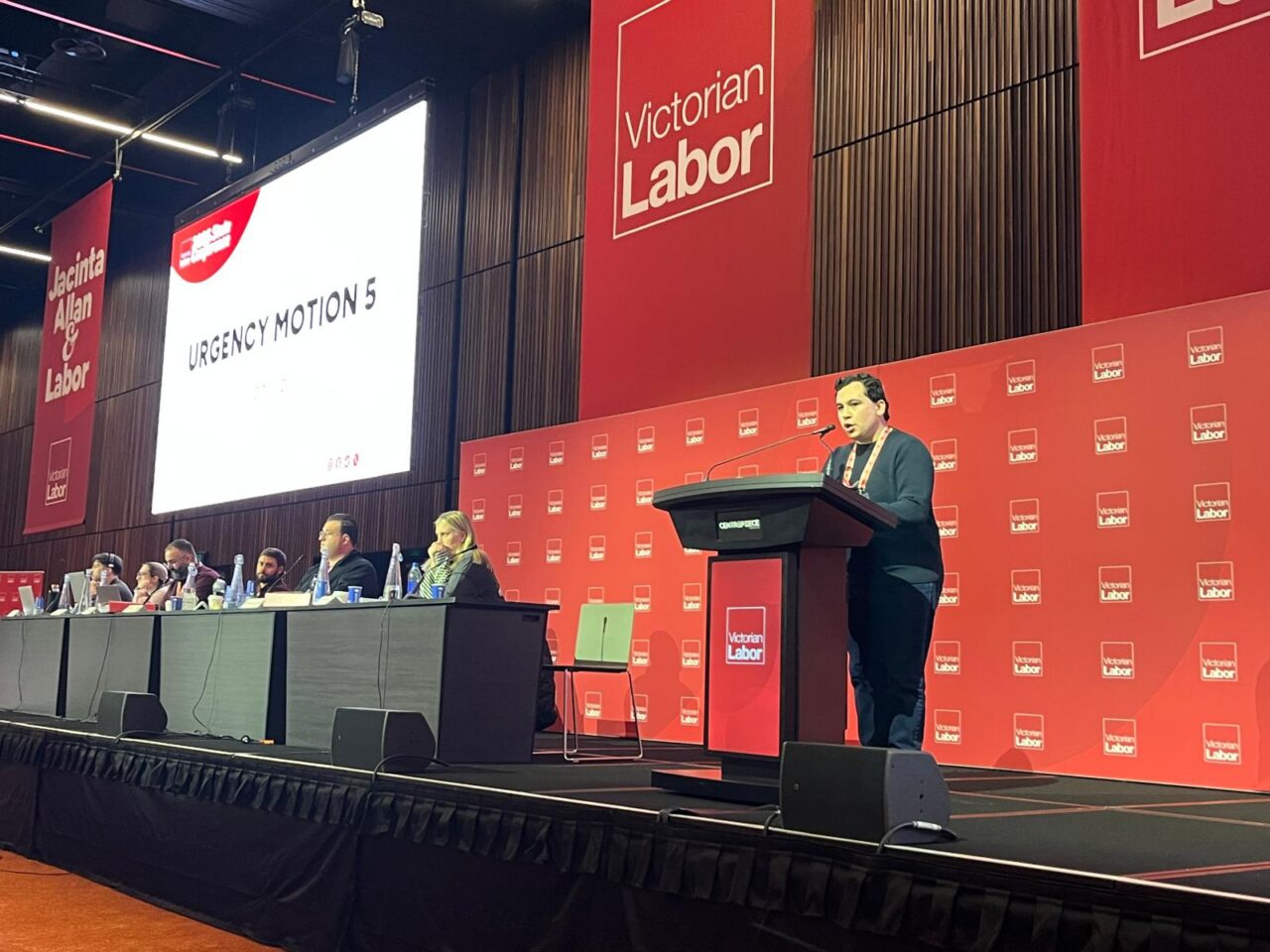
The resolution was moved Sunday afternoon and in doing so I made clear that the war is an illegal war of aggression against a sovereign nation, that we completely opposed the support given by the Albanese government, support that could partly be explained by the deepening US military alliance based on AUKUS and that opposing war is a central question for working people, who always pay the price of wars launched by presidents, prime ministers and generals.
Eric Seychell made a clear and compelling speech opposing the war as an illegal act in breach of the UN Charter and Labor Party policy and principles.
Hosseini then moved her amendment, repeatedly denouncing us for “ignoring” the crimes of the Iranian government. My rejection of her amendment was met by loud booing and cries of “Shame!” from right-aligned delegates, who seemed to have easily forgotten their earlier sermonising about “respectful debate”.
At this point comrade Saina Salemi, gave a brilliant speech rejecting the hostile amendment. In powerful words she said:
My name is Saina, proud unionist, proud Labor Party member and Iranian woman. I am rising to speak against the amendment but not because of its content.
This motion has no intention of denying what we know to be true which is that the IRGC, a terrorist organisation, commits atrocities against the innocent people of Iran and that the execution of innocent political prisoners needs to end, and I don’t disagree with you Nos, this haunts me like it does every Iranian.
Let me be clear, the West are not our saviours. They weren’t our saviours when they invaded Iran in WWII, split our resources for themselves and created a man-made famine. They weren’t our saviours when they overthrew our democratically elected prime minister for wanting to nationalise our oil, and they weren’t our saviours when they supplied and allowed Saddam Hussein to use mustard gas against our people.
History shows that Iranian people will not be liberated by Donald Trump and Benjamin Netanyahu’s illegal war, and by threats to end our entire civilisation.
My people’s liberation will come from their own hands, and I’d like to remind everyone that the revolutionary protests of December 2025 were spurred on by the bravery of the bazzaris, the working class who shut down their shops and went on strike in a country where unionism and industrial action are illegal and punishable by death.
We need to recognise that it is the workers, the people that will continue to fight against this regime and bring democracy to state of Iran and it is an insult to them to assume that it will be the West who saves us.
Therefore, I stand here to say that this amendment must stand as its own motion, as to not allow itself to justify an illegal war.
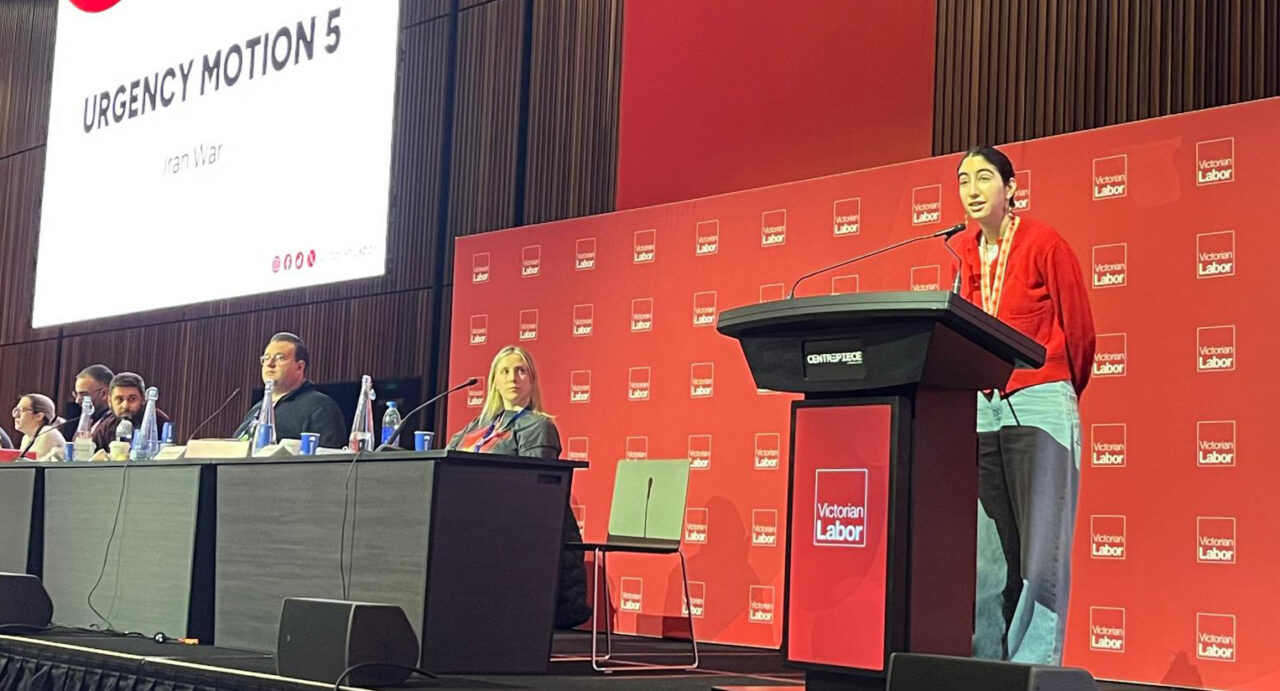
The Iran war motion was then carried by a clear majority of conference, including delegates of the left, independents and key left aligned trade unions. This decision will give Victorian delegates to the upcoming National Conference a clear mandate to raise the issue and demand a break from the dangerous drive to militarism and war that is represented by AUKUS.
Conference also passed the report of the Commonwealth and Federal Relations policy committee, which reiterated Victoria Labor’s call for an independent inquiry into AUKUS and for the federal government to suspend support for the program.