
Chris Minns and the Zionist movement in Australia tried to silence protests against genocide and the visit of Israel’s President Isaac Herzog. They failed. But there are important lessons to learn about building a democratic mass movement after the police riot at Sydney’s Town Hall. Marcus Strom and Clarrie Lewis report
A civil war is threatening to break out in the NSW branch of the Australian Labor Party following the Chris Minns inspired police riot against Palestine demonstrators at Sydney’s Town Hall last Monday.
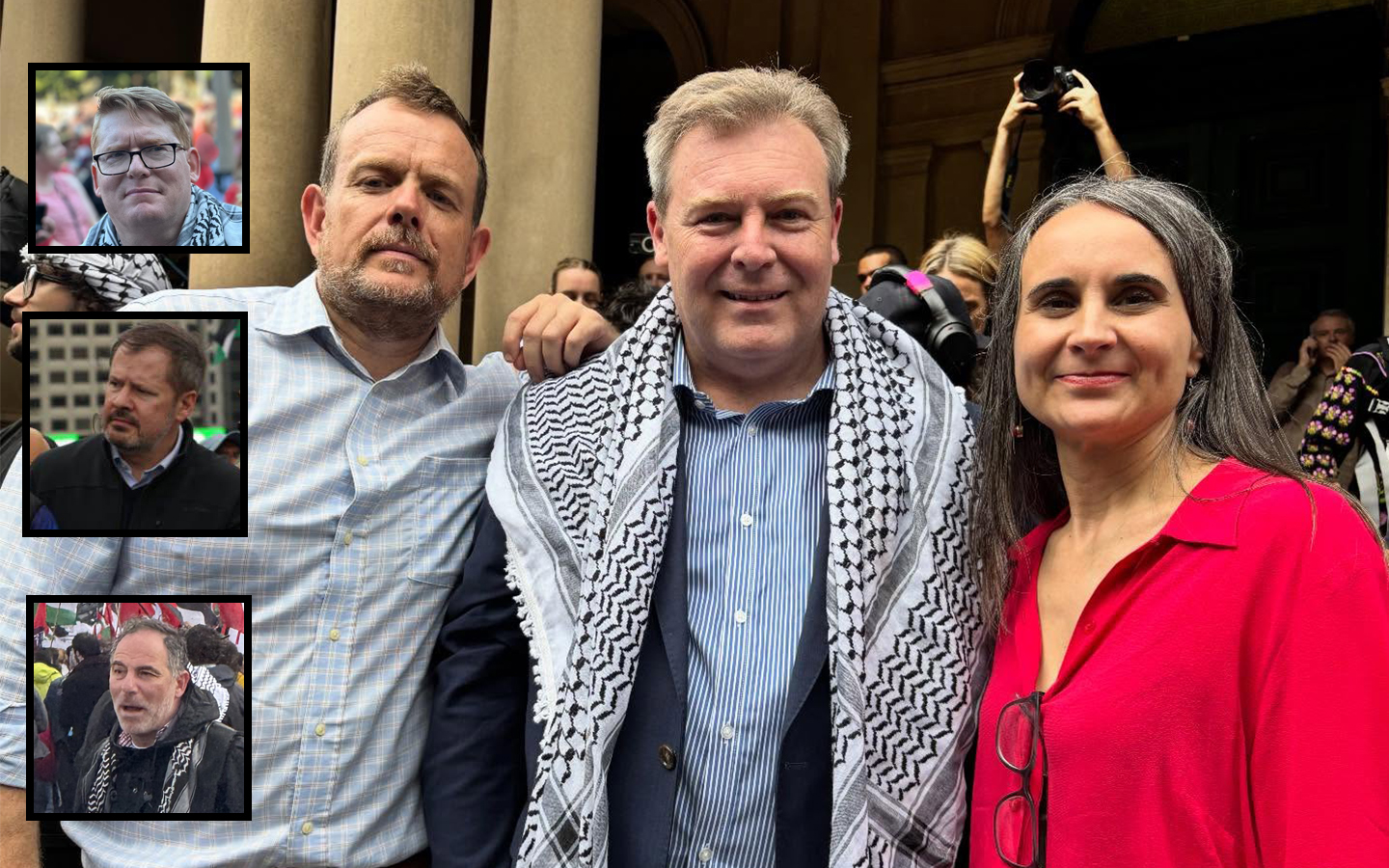
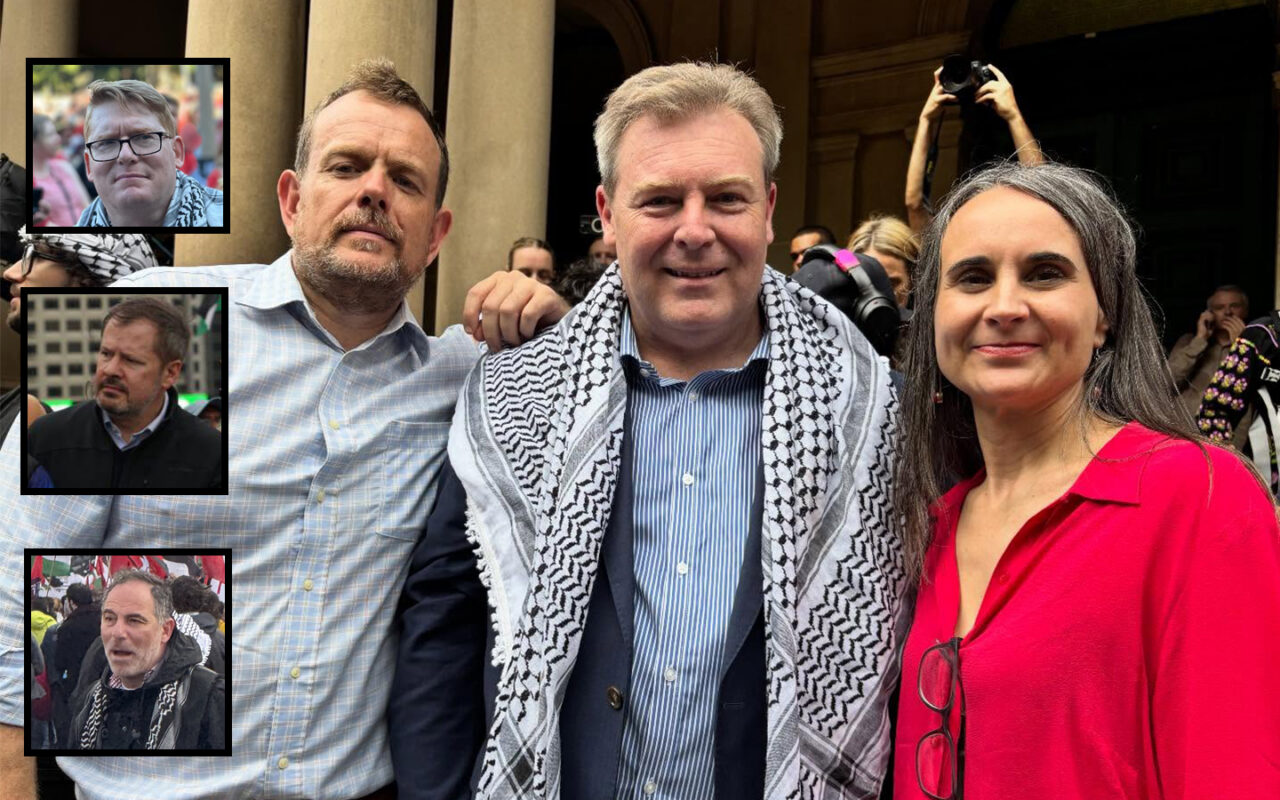
Four NSW Labor MPs attended the demonstration called to protest the visit to Australia by Israel’s President Isaac Herzog, identified by a UN Commission of Inquiry as someone who has made ‘direct and public incitement to commit genocide’.
Following the march, at which NSW Police violently assaulted demonstrators, including physically attacking Muslim men at prayer even after they had been given permission to do so, the NSW member for Bankstown Jihad Dib and federal Labor MP Ed Husic have also spoken out.
The four MPs who attended the rally – Anthony D’Adam, Sarah Kaine, Cameron Murphy, Stephen Lawrence – have called for an independent inquiry into the police violence. On cue, the Liberal opposition leader and the Murdoch press have called for the MPs to ‘be sacked’ – from what, it is not clear.
Premier Minns is trying to stand firm, shamefully refusing to apologise to the men at prayer who were assaulted by police, and refusing to allow an independent inquiry, backing the existing police watchdog, the Law Enforcement Conduct Commission.
Stephen Lawrence was forthright as to where the blame lies for the police violence: “The difficult truth is that the political and legal elites actually caused the Town Hall riot. A dysfunctional political culture in NSW created possibly the most draconian anti-protest laws in the Western world,” a view backed up by Professor Ben Saul, Chair of International Law at the University of Sydney.
ALP members must support these rebel MPs and force a repeal of these anti-democratic protest laws. The South Coast Labour Council posted a call by the President of the NSW Council for Civil Liberties, Timothy Roberts:
“We call on the Labor caucus to either bring this Premier to heel or turf him out.”
It is important to remember these laws have been brought in to suppress a mass democratic movement in solidarity with Palestinians facing genocide at the hands of the Israeli state. What is clear after last Monday’s demonstration is that they have failed to suppress our movement.
Zionists, cynically using the horrific antisemitic violence at Bondi unleashed by two ISIS aligned terrorists, have tried to capitalise on this to silence dissent. They too have failed.
Chutzpah of the Albanese ‘left’ faction
In the aftermath of the police violence, the Anthony Albanese-aligned NSW Left faction issued a letter to ALP members calling for branch motions that would commit the NSW ALP to repeal anti-protest laws brought in by the Liberal-National Coalition (with ALP support) and further expanded by the Minns government.
This is an amazing display of chutzpah, given that the four horsemen of the Albanese Left in NSW – John Graham, Penny Sharpe, Jo Haylen and Rose Jackson – have sandbagged the Minns leadership and backed these laws.
Police Minister Yasmin Catley, also a member of the Albanese NSW Left faction, condemned Anthony D’Adam in parliament last week accusing him of “breaking the law” and “encouraging people to break the law”. She ended her tirade saying, “back the cops”.
It seems unlikely that Albanese is completely unaware of this call by his own faction to repeal the anti-protest laws. There is no love lost between Minns and Albanese, and this seems like a shadow war between the two. It may break into open battle at the NSW ALP conference in July.
How the NSW Left will square this circle remains to be seen, but ALP activists must make it increasingly difficult for the NSW Government to carry on like this. An open rebellion is required.
Resisting the anti-protest laws
The Palestine Action Group, which called the demonstration, wanted to assemble at Town Hall and march to Parliament. You’d think a reasonable request. This was refused under extraordinary new police powers after the Minns government on Saturday 7 February declared the visit of Herzog a “major event”, which gives police power to close off areas and order people to leave.
A last-minute court challenge from PAG failed with less than an hour before the scheduled start. It was impossible to move the demonstration.
It was quite right for the demonstration to go ahead, to challenge the anti-democratic laws and, in that sense, the event was a success. The 15,000 or so assembled showed we will not be silenced.
But herein lies the question for the mass movement: how to organise demonstrations when protests are being criminalised and quashed. So far, the left hasn’t looked up to the job and the internal divisions hidden inside the Palestine solidarity movement remain a hindrance to building a truly successful mass movement.
It is clear that the police violence wasn’t an “overreaction”, it was the point. The NSW Police acted as armed managers of public space for the benefit of the establishment and the state. The brutality unleashed on protesters was a message from Premier Minns: you can protest, but only on our terms, in our lanes, at our convenience.
Poor discipline, undemocratic PAG
The high political stakes of this demonstration demanded discipline, democratic transparency and collective planning; instead, the rally drifted.
Speeches dragged on for roughly two hours, with no clear, communicated plan about whether there would be a march, let alone where it would go. In a crowd that large, confusion is not a minor inconvenience; it creates gaps the police can exploit to declare “non-compliance” and escalate. Without clear stewarding, mass communication, and agreed timelines, the crowd is left to guess and police step in to “restore order” by imposing violence.
This isn’t about blaming attendees who showed up in good faith; it’s about recognising that the state studies our weaknesses and uses them.
Some elements attempted to posture about “fighting the cops” and “bringing on the revolution” as if a crowd of largely small‑l liberal protesters is a pre-assembled insurrection. This is the dead-end politics of spontaneity fetishism: anti-strategic, anti-dialectical, and indifferent to the actual consciousness of the crowd.
It mistakes adrenaline for organisation, noise for power and isolated confrontations for mass politics. It also provides the police exactly what they want: a pretext, a headline, a justification to punish thousands. Mass politics is building durable working-class power, protecting the movement’s broader layers, and choosing tactics that expand, rather than shrink, our base.
The Palestine Action Group should move to democratic mass organising, not opaque, top-down improvisation. Holding open mass meetings ahead of major actions so people can debate, decide, and then act collectively on a clear plan.
Stewards need to be democratically accountable and trained to defend the demonstration. With transparency and accountability, demonstrators can feel confident complying with the direction of stewards.
Instead, we have seen groups like Solidarity seeking an opportunity to pose to the left of PAG and even Socialist Alternative. This is not serious politics about building a mass movement, it is left opportunism designed to recruit and then keep new recruits on the hamster wheel of ‘busy activism’.
For a democratic mass movement
Instead of leaving demonstrators in the dark, if possible a democratically organised protest would publish and distribute the rally’s run sheet: start time, end time, speaker limits, whether there is a march, the route, and the rationale.
Stewards teams must be built and trained with clear roles such as crowd communication, de-escalation, safety, and liaison that are accountable to the rally’s democratic decisions, not to police.
On the day, distribute thousands of flyers that clearly outline the plan, legal and other support information, and the political goals while pushing the same information hard across social media in the lead-up. This was not done.
Critically, we must start the work of building serious working-class defence of our demonstrations – against provocateurs and police violence.
But this needs a democratic movement. At present the Palestine Action Group organises an opaque and byzantine process that is not accountable to the many thousands who regularly protest.
An opportunity was missed after the Sydney Harbour Bridge demonstration to establish a democratic mass organisation with affiliates, delegates, open meetings and a plan of action.
Palestine is bringing new layers into political action and consciousness for the first time. These new layers can be educated and trained: then our movement can ensure it is big enough – and politically organised – to to ensure we can’t be ignored. We can widen action beyond weekly demonstrations into workplaces and communities, and to create real costs for the politicians and institutions that sustain Israel’s impunity.
The strategic task is to organise that sentiment into sustained power: workplace action, campus escalation, boycott and divestment campaigns, community defence, and disciplined mass mobilisation. A Marxist framework doesn’t mean lecturing people; it means showing patiently and concretely how genocide abroad and repression at home are connected by the same system: imperialism, profit and the state machinery that protects both.
The lessons from Town Hall is not that people “shouldn’t protest”. It’s the opposite: when our numbers grow, the state will meet us with force, and it will use confusion, poor planning, and adventurism as the excuse. The answer is not retreat. The answer is organisation: democratic, disciplined, mass and politically sharp enough to expose the violence of the state while building the power required to stop it.
Social cohesion?
In this context, calls for social cohesion are nothing less that a call for our movement to demobilise.
Since the Bondi massacre Minns, Albanese and the rest of the political establishment have repeated this call. At the Sydney Town Hall rally, Green Senator Mareen Faruqi said that it is “us” on the pro-Palestine side that are for social cohesion and the political establishment through its anti-democratic laws are against it.
This is a mistake.
As Bernard Keane writing for Crikey pointed out, calls for ‘social cohesion’ are nothing but the powerful calling for obedience. He posted on social media: “Social cohesion was always a lie, a fiction pedalled by the powerful to silence the less powerful. Minns’ goons beating up protestors against genocide has ripped the mask off it.”
Calls for social cohesion in a class society are calls for obedience to oppression and the unchallenged rule of capitalism. We reject such calls.
We instead support the construction of a disciplined democratic mass movement against not only the anti-protest laws, not only in solidarity with Palestine but as a springboard for a mass movement and a political party that is capable of fighting for working class power. That will take patient and painstaking work to build up actual strength so that our class can emerge as a successful ruling class once we have enough strength to overthrow capitalism in Australia and globally.