

Notes of a candidate: Marcus Strom stood to represent Sydney ALP at National Conference on a staunchly anti-AUKUS and pro-Palestine platform, winning nearly 30% of the vote. After a complaint from a supporter of his opponent, Linda Scott, the returning officer suspended him from campaigning.

For the final two days of a long, three-week campaign, I was suspended from actively campaigning to be the Sydney federal electorate council (FEC) delegate to the ALP’s National Conference in July. My crime? I appeared on a podcast.
I will spare the blushes of the complainant who lodged the protest, no doubt carrying out the instructions of the ‘NSW Left’ faction, which ran the successful candidate, Linda Scott. (I received 29% of the vote standing as a socialist staunchly opposed to AUKUS, supporting Palestine and calling for mass investment in public housing.)
Of course, the 53-hour suspension at the end of a three-week campaign made little to no difference to the outcome. I suspect I might have done a little better if I’d had access to the membership email list that Linda Scott used with some profligacy, sending out at least six emails to all members. I was given no email addresses, just mobile phone numbers and home addresses of members. The rules banned mass SMS messaging, but using a magically acquired email list was fine, it seems.
I did ask the FEC secretary for equal access to the email list of members. I received instead the email addresses for the 14 ALP branches in the electorate. At least one of them was defunct.
Serious Danger: a ‘criminal’ podcast
My crime was appearing on the Serious Danger podcast of Tom Ballard and Emerald Moon – pitched as an ‘unofficial Green Party podcast’. I was invited on as National Convenor of Labor Against War to explain why anti-imperialists, peace activists and socialists campaign against AUKUS and militarism within the ALP. When asked about my candidature to be Sydney delegate to ALP National Conference, I quickly said I couldn’t talk about it. The rules, you see.
Half of delegates to conference are chosen by affiliated unions. (I’m not aware of a single union that holds membership ballots to choose delegates, with union secretaries and executives wielding their influence by appointment of delegates.)
For the other half, each state branch has its own rules as to how delegates are elected to conference. But the mathematics is that each state gets six delegates plus delegates equal to the number of federal electorates in that state.
NSW has among the most undemocratic voting system. Each electorate selects a single delegate, helping to ensure the factional machines keep control. There were only 11 contested ballots in NSW out of 46 federal electorates (plus the NSW Admin Committee no doubt choosing the other six delegates). Many of the candidates are either MPs themselves or part of the already existing factional machinery. Very few rank-and-file members get through this system, with most delegates being reliable factotums of this or that faction or subfaction.
Of the 11 contested ballots in NSW, two could broadly be argued as an ‘insurgent’ left candidate against the institutional left. There were three seats where ‘soft left’ candidates ran against a Centre Unity (ALP right) candidate; one where an independent ran against the institutional (Albanese) left; and the remain five contests were between the ‘official’ NSW Left and Centre Unity.
In Victoria, things are a little more open, with the 44 state delegates elected at large across Victoria. Voting closed last week in Victoria, so we will find out soon how insurgent candidates like Hamish McPherson fared soon.
More strangely, the NSW ALP guidelines for the election of National Conference delegates prohibits “campaigning in the media (including interviews, articles, press conferences and statements, whether unsolicited or not)”.
The complaint against me was that I had breached this guideline by appearing on Serious Danger. The complainant requested the Returning Officer investigate and “take action as the rules provide”.
There is provision for disqualification for breaching the guidelines, as was pointed out to me by the Returning Officer. He was, however, reasonable noting that I had stated in the podcast that I can’t comment on the election in public and that the breach was at the “lower end of seriousness”. Nonetheless, a breach was found to have occurred, and the penalty was a suspension of the campaign by me and any supporters.
My reply to the Returning Officer ensured I would abide by the decision and ensure no other breaches occurred. Given my “contrition”, the penalty was reduced by about 24 hours.
In that reply, I stated:
I appeared on that podcast in my role as National Convenor of Labor Against War, not as a candidate. When the host raised the fact that I was a candidate, I explicitly said that I could not talk about this.
It would be unreasonable to ask candidates to cease their work in the broader labour movement throughout the length of the campaign. For instance, I note that Linda Scott continued her role as CareSuper chair and this was reported in the media favourably in the context of Mark Carney’s views on cooperation of middle powers – this being a central plank of Linda Scott’s campaign for her candidacy.
Given this was also likely a ‘breach’ of the guideline that I had transgressed, I was invited to make a complaint. I declined.
I also pointed out that the transcript of the interview provided by the complainant had removed references where I said I couldn’t discuss an internal party election.
Further, I requested that all ALP members in Sydney receive a copy of the complaint, the ruling of the Returning Office and a full transcript of the interview. This did not occur.
Widespread opposition to war
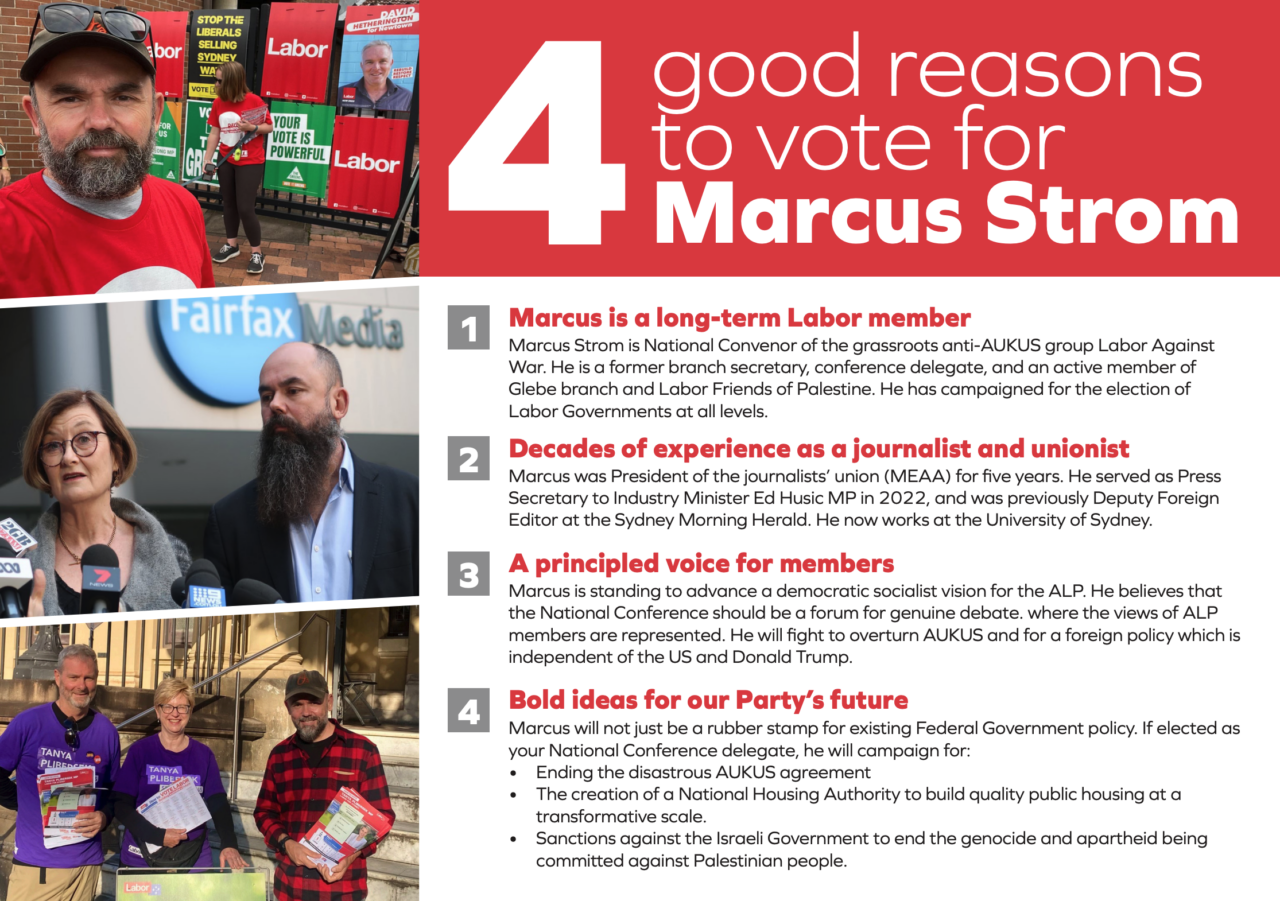
While of course I wanted to win, a result of 29% (151 votes out of 520 returned ballots) was in line with my expectations. Many members, while expressing sympathy for my position, remain factionally loyal, loyal to the local MP or loyal to the ‘machine’. This is particularly the case in a seat like Sydney.
My candidature came out of the Inner West Reform Group that is seeking to democratise the ALP and fight for more progressive politics than that on offer by the Albanese ‘left’. It is not a consistently socialist grouping but is a group that fights to change the undemocratic culture of the party.
I submitted myself to a pre-selection process and was chosen in a contested ballot to be the Sydney FEC candidate. Thanks to the dozens of members who assisted in this campaign and thank you to Labor Friends of Palestine, Labor Against War, Bob Carr, Sydney Young Labor, Margaret Reynolds and Doug Cameron who all endorsed me.
I very much presented as an insurgent socialist candidate who wanted to disrupt ‘business as usual’ at ALP conference. While not possible to quantify, my feeling is that closer to half of active branch members supported my campaign and I performed less well with passive paper members.
Many members did say to me that while they agree with removing AUKUS from the platform, they had a long association with Linda Scott, who is well known in the area having been a City of Sydney councillor for 12 years, including a brief stint as Deputy Lord Mayor.
The campaign overall was a great exercise of engaging with the hundreds of ALP members in the Sydney electorate. I phoned almost every single member and letterboxed just about everyone’s letterbox. It was clear that an overwhelming majority opposed the Albanese government’s support for Trump-Israel’s war on Iran, and most also oppose AUKUS.
This much was clear in the shifting language of my opponent, Linda Scott.
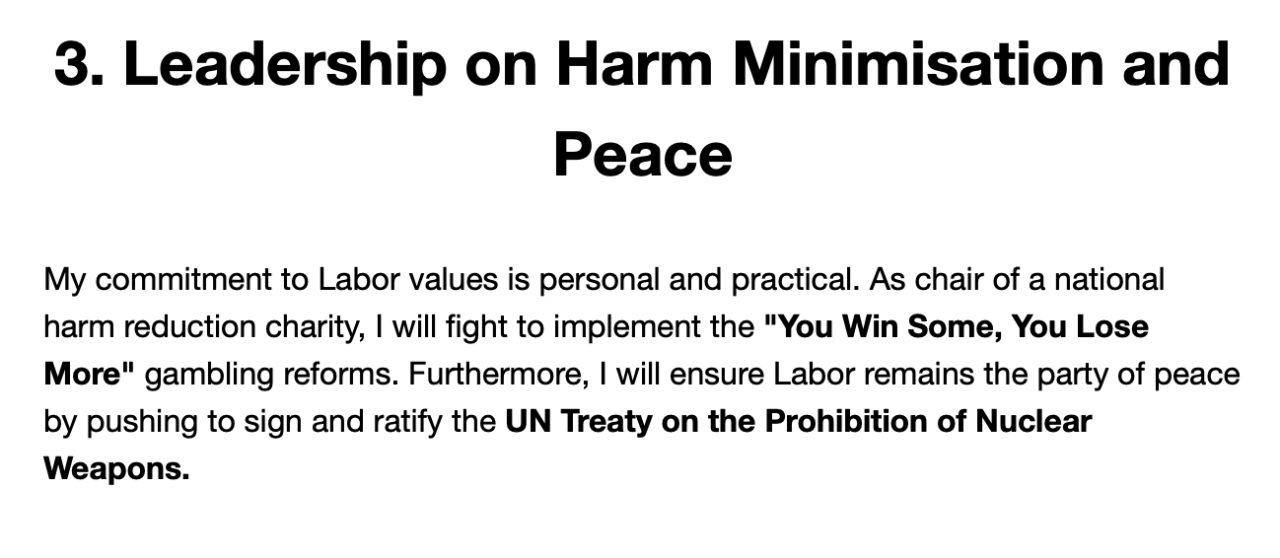
Her first emails did not mention AUKUS at all but included banal generalities about ‘peace’ and urging the government to sign the Treaty for the Prohibition of Nuclear Weapons. It is already ALP policy to sign this treaty and in debates at branches, I made the point that AUKUS was the main obstacle preventing the ALP in government carrying out party policy to sign the treaty.
With the US and Israel unleashing a war on Iran – backed by the NSW Left’s very own Anthony Albanese – campaigning to oppose AUKUS got an open hearing.
This was reflected in the final emails from Linda Scott just before ballots closing, where she shifted her language and claimed that she had made a real difference by “removing references to AUKUS” in the draft ALP National Platform through her role on the National Policy Forum.
This is technically true. But hides quite the deception. In the current ALP National Platform “AUKUS” is mentioned four times, once in the body of the platform in relation to defence policy, and three further times in reference to ‘job opportunities’.
In the initial draft of the 2026 National Platform, AUKUS was mentioned five times: once in relation to strategic alliances, once in relation to defence policy, and three times referring to jobs. It has been agreed that the first reference to AUKUS be removed.
However, the platform still commits the government to support AUKUS.
The National Policy Forum does not distribute minutes – indeed, it doesn’t even publish who is on the forum – so we don’t know who pushed for that change. But I have been told that Linda Scott did argue for its removal from Chapter 7, Clause 15. (It remains in Chapter 7, Clause 33.)
The next draft that will be released to the membership for review will have four references to AUKUS – exactly the same number of times it is mentioned in the current platform.
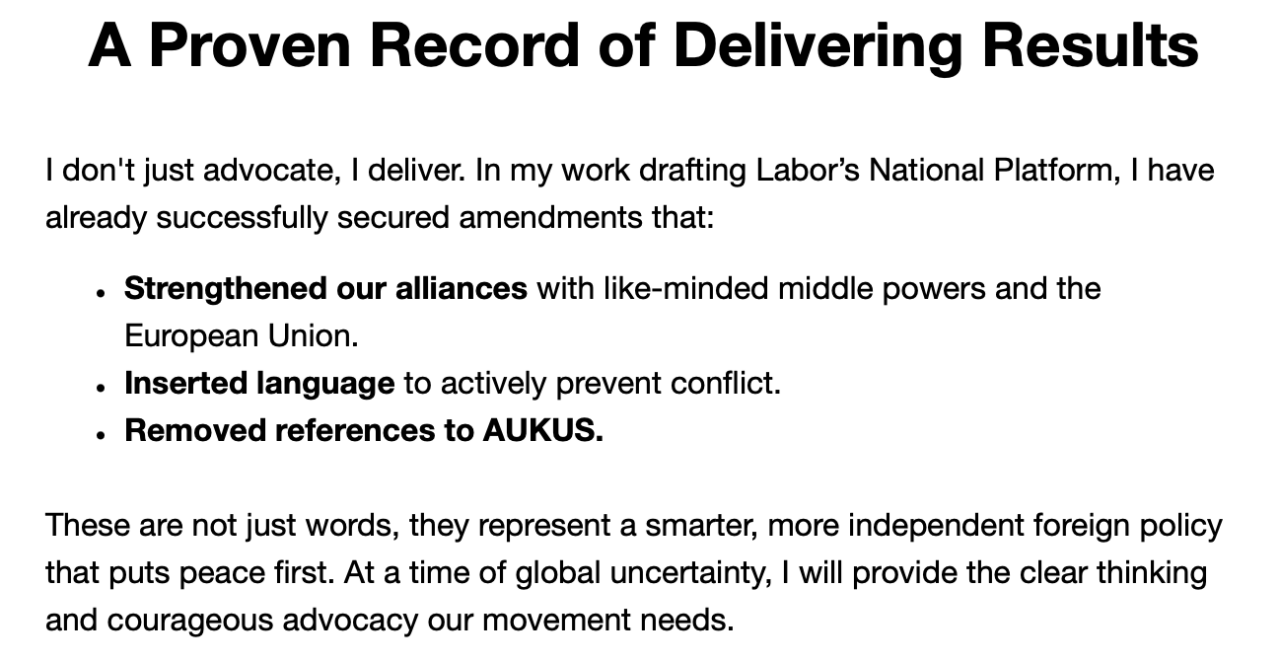
It takes some chutzpah to claim that standing still on AUKUS is a victory and an example of “delivering results”.
But this is the nature of the ‘Brahmin Left’ – a term coined by French economist Thomas Piketty – to explain the ‘progressive’ managerial class stranglehold on social-democratic parties, further emptying them of working-class content. It is this chokehold on such parties that is central to a decline in support for them and the beginnings of a drift to the populist right (or occasionally the populist left).
The petty attempt to have me disqualified as a candidate is just part of the DNA of the apparatchiks that run the ALP as an outlying defensive structure for the capitalist class.
Most of them are ‘declassed’ elites who are such a turn off to working class people drifting from the mainstream parties. They get jobs for each other, they sit on boards appointed by their mates. They use ministerial cars to take their friends for piss-ups in the Hunter Valley.
Alas, the Marxist left does not have its act together to be able to offer a coherent, militant working-class and anti-establishment alternative to this putrid culture.
But it does show that fighting for such an alternative will require not only work to regroup the Marxist left outside the ALP, but to coordinate and build our work inside the ALP.
While such work may seem pointless to the left outside the ALP, it is worth noting that the membership of the ALP in the one single federal seat I ran this campaign is larger than the largest of the socialist sects, Socialist Alternative, which claims 750 members. Food for thought.