Socialist Alternative delegates to the Socialist Party conference split on the question of whether the new party should have a democratic roadmap to power. Simon Kenning, a member of the Australian Socialist Party, reports.
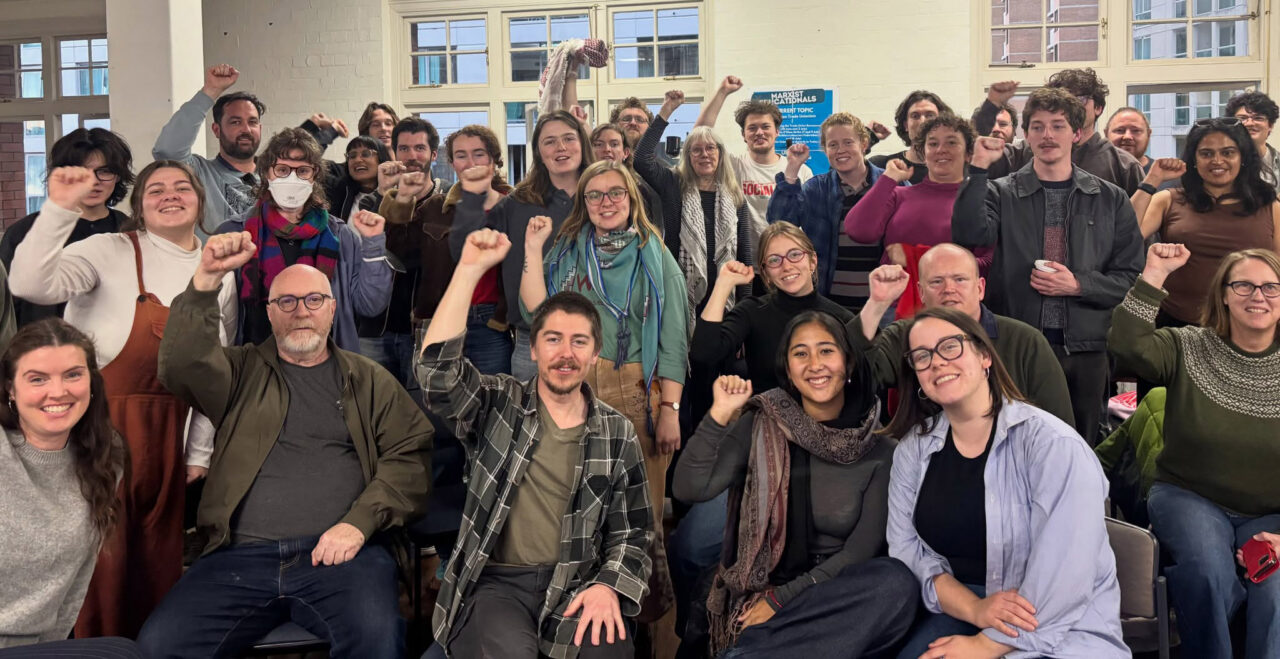
The founding conference of the Australian Socialist Party ended without the party adopting a political program, after a majority of delegates voted down a motion tasking the incoming national executive to drafting one. The failure marks the most significant setback of the conference and exposes a fracture within the Socialist Alternative (SAlt) group, the Cliffite organisation that has dominated the party’s structures since its formation, over the very question of what kind of party is being built.
For a party that presents itself as the vehicle for uniting Australia’s fragmented socialist left, the refusal to commit to writing a program is no small matter. A program is not a media strategy, a slogan generator or even a set of demands or policies for an election campaign. It is the codified expression of a party’s analysis of the society it operates in, the tasks that follow from that analysis, and the basis on which it seeks power.
Without a coherent and consistent program, the Socialist Party has no roadmap for building working-class power, and no guide against which policy, campaigns and electoral interventions can be tested and cohered. Every decision becomes ad hoc, made in reference to nothing more durable than the instincts of whoever holds influence in the room at the time.
Further, without a program, neither the membership, nor the broader working class movement can hold the leadership to democratic account.
That this should be the outcome of a founding conference, a critical moment when a new party has both the mandate and the responsibility to set its own course, is a damning indictment of the political culture on display.
A vote unlike the others
Conference watchers following proceedings noted something unusual in the pattern of voting. Across the bulk of motions put to delegates, votes broke down in a strikingly consistent ratio, with roughly 137 delegates voting one way and 29 the other. That pattern is itself instructive: it suggests a conference in which the outcome of most questions was settled in advance by bloc discipline, with a large, tightly whipped majority around Socialist Alternative moving in lockstep against a much smaller layer of other delegates from largely state-based caucuses, which are largely cohered around the fact they are not Socialist Alternative members or adjacent to Socialist Alternative.
That pattern held until the motion on writing a program. There, the vote was lost, 63 in favour to 85 against, with a further 12 abstaining. The arithmetic makes clear that this was not a case of the independent minority being outvoted by a disciplined majority. It was a case of that majority itself splitting down the middle.
For members of Socialist Alternative, an organisation that believes it operates on the principles of democratic centralism (but in the tradition of Cliffism and most of the Trotskyist and Stalinoid left, operates according to bureaucratic centralism, where public debate is almost universally gagged), this is a remarkable development.
Centralism exists precisely to prevent a membership from fracturing on a vote during a democratically agreed united action. That it did not hold here suggests something more than a difference of opinion on tactics. It suggests the beginning of a genuine fault line.
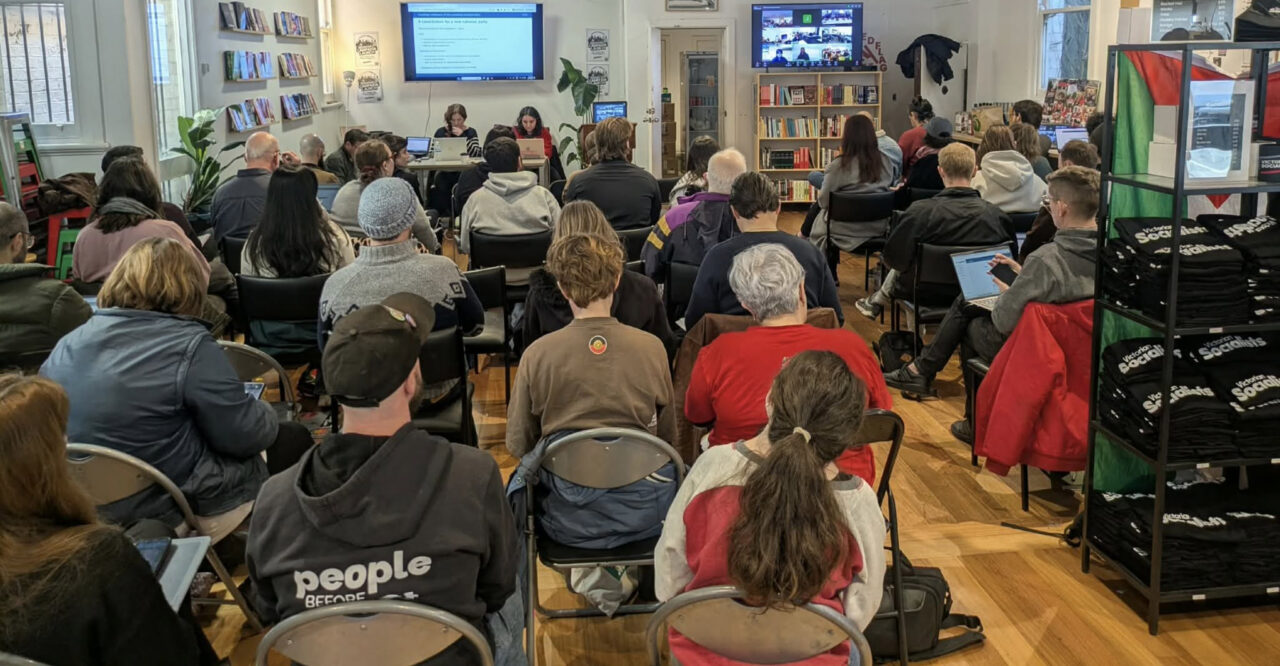
It has to be said the format of the conference was not conducive to detailed, democratic and thorough political debate and outcome. The 160 delegates met in state and territory conclaves connected by zoom. Such a format gives all initiative to the conference organisation majority and none to the delegates themselves.
The debate
The motion itself was modest in its ambition; it did not attempt to pre-empt the content of a program. It recognised that the party’s current statement of aims, while adequate as a general description of capitalism in Australia and a broad brush vision of socialism, does not constitute a programmatic basis on which the party and the working class is prepared to take and hold power.
The motion proposed that the national executive draft such a program, to be debated and received at the next national conference. Once adopted, the program should become the basis for the party’s unity in action on the basis of acceptance not agreement, informing agitation, electoral campaigns and demands rather than the reverse.
Speaking in favour, one delegate argued plainly that a socialist party ought to have a program, that the country’s political situation demands a platform addressing the whole of it, and that the motion did not presume to write that program from the floor of this conference but simply to commit the party to the task and entrust the leadership with beginning the work to carry it out.
That argument found support from at least one delegate identified with Socialist Alternative, who observed that having recently been involved in drafting material for the party’s own election launch, a genuine program, understood as a general set of core demands expressing the party’s overall vision, would be of real use. It is easy, this delegate noted, to become lost in the minutiae of policy at various levels of government without a document that holds the bigger picture together.
But this view was directly contradicted by other Socialist Alternative-aligned speakers, who argued against the motion on strikingly similar grounds to one another. One suggested that popularising the party’s views has served well enough so far, and that committing to an all-encompassing program at this stage would mean dwelling on specificities at the expense of the bigger picture of organising the working class, better handled by responding to events as they arise.
Another warned against placing too much on a new national executive so early in the party’s life, cautioned that a program risks locking the party into positions that might prove unpopular down the track, and suggested that much of the existing socialist left is already too preoccupied with programmatic point scoring against rival tendencies for this to be a productive use of energy.
There is an obvious tension worth naming here. While Cliffism in general has eschewed any sort of party program, the organisation has spent decades producing its own internal documents, resolutions and theoretical publications, and is quite prepared to draft material for election activity, but becomes wary of the written word the moment the document in question would bind the organisation as a party rather than a sect.
What the split reveals
None of this should be mistaken for a case of the tail wagging the dog. Socialist Alternative has, since the inception of the Victorian Socialists, treated it as an implantation project: a recruiting ground and a public face, run according to the logic of the front rather than the logic of a genuine party of the working class.
Sectarian practice of this kind is nothing new, and Labor Tribune has documented examples of this before. What is new is the sign that this practice is beginning to generate friction inside Socialist Alternative’s own ranks.
It is not hard to see why. A layer of that membership, having actually thrown itself into the work of building a mass party, engaging with workers who are not interested in sect history and want a coherent account of what the party stands for and where it is going, is starting to feel the contradiction between the front’s institutional interest in remaining unaccountable and flexible, and the party’s basic need for a program around which members can organise.
The other layer, evidently still the larger one on this question, remains committed to the orientation that has defined the group for its entire existence: keep the party doctrinally loose and organisationally soft, so that the Socialist Alternative apparatus, and not any democratically arrived at program, remains the real centre of gravity.
This is, in short, exactly the kind of division that was always latent in an organisation trying to run a mass electoral organisation on loose political footing as a front for a much smaller sect. What is notable is how quickly it has surfaced, and openly on the floor of the very first national conference, and on a question as fundamental as whether the party should even have a program at all.
The danger for those on the more party-oriented side of this divide should not be understated. Without a strong, organised pole of attraction actively fighting for the party to become a real, programmatically grounded organisation of the working class, the impulse to resist sect discipline can just as easily drift rightward into liberalism as it can drift toward genuine partyism.
An ‘anti-sect’ and ‘anti-organisation’ instinct that is not rooted in a positive commitment to building working class power, and to the patient, unglamorous work of developing and organising around a program, has nowhere else to go but into the comfortable vagueness of left liberalism.
No roadmap, no compass
The consequence of this vote is not abstract. A party without a program cannot answer, in any considered way, what it would do in government, the conditions upon which it would form government, in coalition (or not) with what forces, what its attitude is to the state, to the armed forces, the monarchy, to the trade union bureaucracy, to the various arenas of struggle it claims to support.
It can only react, campaign by campaign, press release by press release, with no fixed point to return to. Policy becomes whatever seems tactically convenient at the time, drafted anew each election cycle by whoever happens to be doing the drafting, unaccountable to any prior collective decision. This is a recipe for opportunism.
That is not a criticism of any individual member’s sincerity. It is a structural and political problem, and one that this conference had the opportunity to resolve and chose not to.
Labor Tribune will continue to report on the fallout from this vote, along with other important political matters that arose during the conference and on whether the party-building layer inside Socialist Alternative, having broken ranks once, is prepared to organise itself and fight this question through to the next conference, or whether the moment passes and the old, unaccountable front-party model reasserts itself unchallenged.