
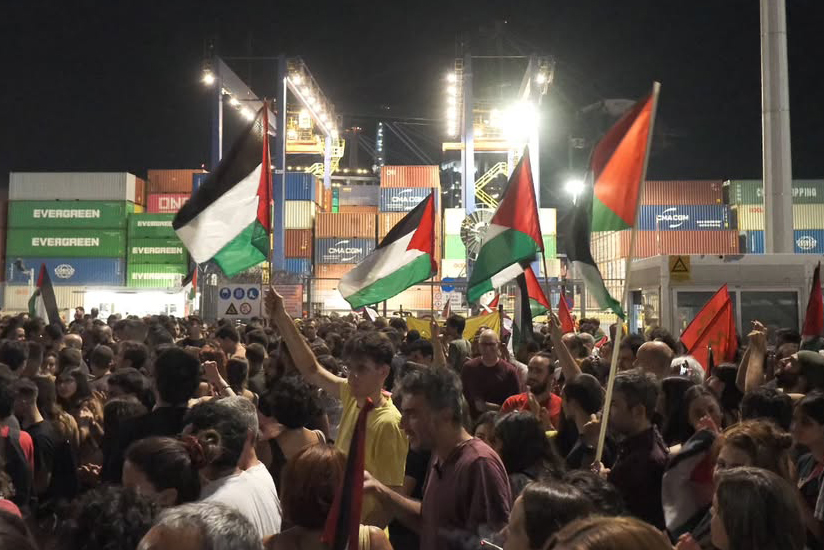
The MUA was largely MIA as ports across the world were shut down in support of Palestine and against imperialist war on 30 October. Bob Sparks takes a look.
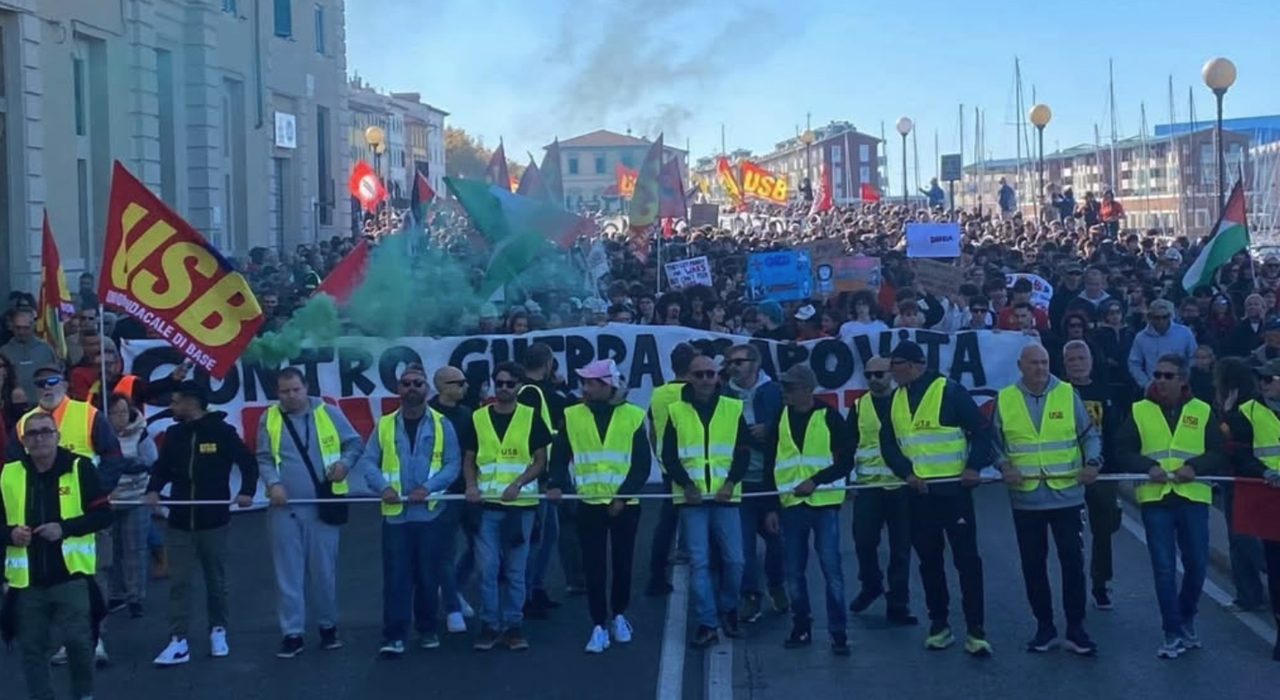
The 30 October dockworkers’ international day of action saw strikes and demonstrations take place in more than 100 ports around the world. Over two dozen unions from more than 20 countries took action on the day. However, the Maritime Union of Australia (MUA), the International Transport Workers’ Federation (ITF) and the International Dockworkers’ Council (IDC) marked the day by issuing resolutions of solidarity, social media clips and little else.
The international day of action was truly historic. Under the slogan “Dockworkers do not work for war”, port workers across the globe took part in an unprecedented day of action in solidarity with Palestine and in opposition to the arms trade and imperialist war.
The Mediterranean was the focus of the day’s action. The highlights included a nationwide general strike of up to two million people in Italy, a localised general strike across the Greek port city of Piraeus and a 24-hour strike of French dockworkers in more than 20 of the nation’s ports.
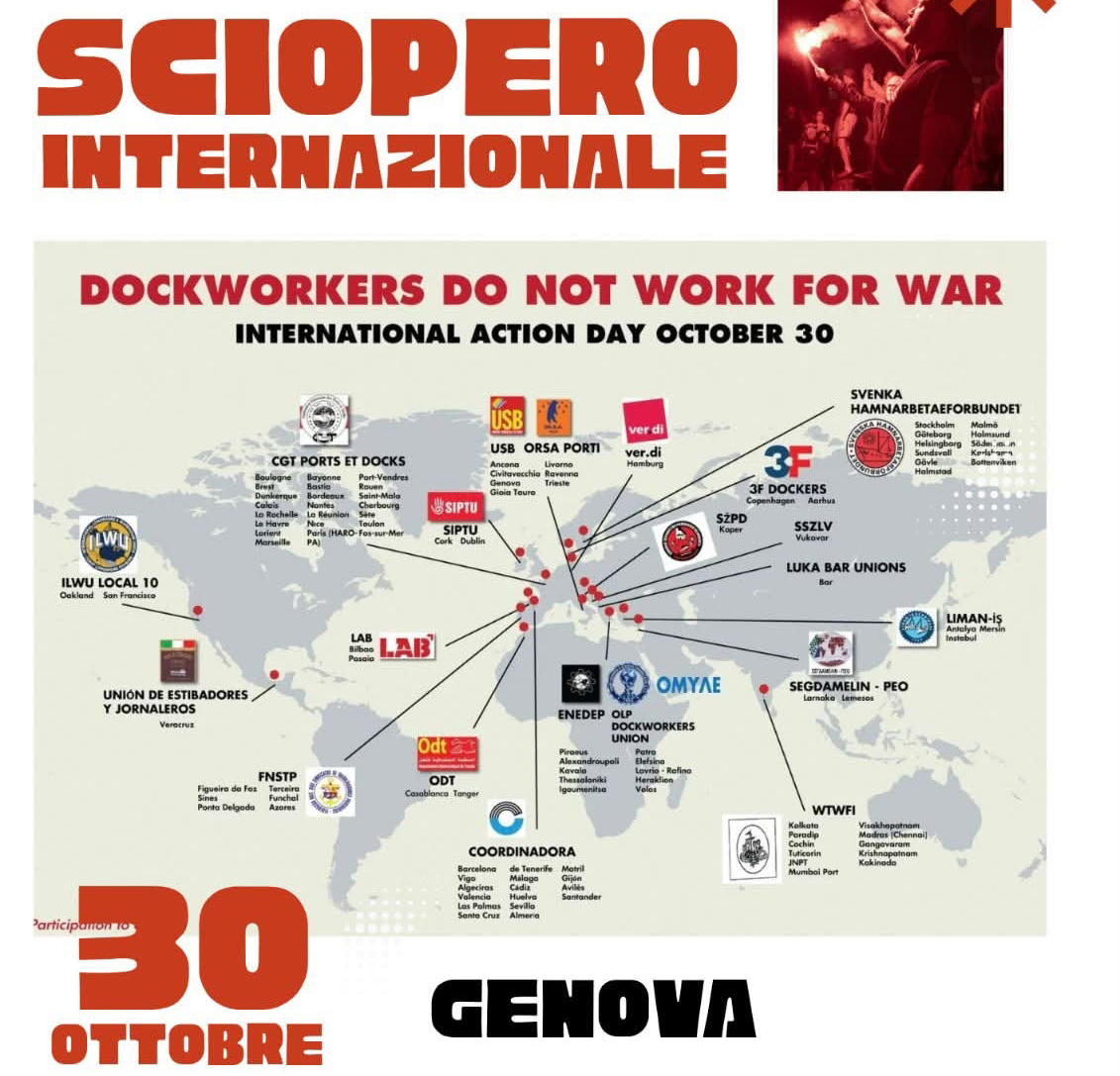
The 30 October dockworkers’ international day of action is the product of almost two years of international coordination that included three International Meetings of Dockworkers’ Unions and an earlier international day of action that took place across the Mediterranean on 6 February 2026.
Two years of international coordination
Stevedoring is by nature a global industry. It has a rich tradition of internationalism. Dockworkers’ unions have taken direct action in solidarity with Palestine in the past. But in the days after October 2023, a growing number of dockers’ unions started acting against arms shipments to Israel. As necessary as these actions were, they lacked any form of international coordination.
The first step towards the historic 30 October international day of action was taken in Athens, Greece on 28 February 2025. Dockworkers’ unions from across the Mediterranean came together for the First International Meeting of Dockworkers’ Unions to discuss how they could disrupt weapons shipments to Israel and stop the war in Gaza.
The Second International Meeting of Dockworkers’ Unions was held on 25-26 September 2025 in the Italian port city of Genoa. This larger meeting brought together dockworkers from Greece, Slovenia, Morocco, Cyrpus, the Basque Country, France, Cyprus and Turkey. The meeting’s declaration entitled “Dockworkers do not work for war” called for a free Palestine and opposition to imperialist wars.
These two international meetings gave rise to the first dockworkers’ international day of action held on 6 February 2026. The day saw dockers’ unions in more than 20 ports across the Mediterranean disrupt war cargo destined for Israel. The standout was Italy, where the action of dockers saw the ZIM Virginia, ZIM Australia, ZIM New Zealand and the MSC Eagle III either stopped from docking or forced to change course for alternative ports.
The Third International Meeting of Dockworkers’ Unions took place in Istanbul on 18-19 May 2026. A joint statement now known as the Istanbul declaration was signed by six unions: France’s National Federation of Ports and Docks (FNPD-CGT); ENEDEP in Greece; the Patriotic Workers’ Committees (LAB) from the Basque Country, the Liman-İş union from Türkiye, the Democratic Labour Organisation (ODT) from Morocco and Italy’s radical Unione Sindacale di Base (USB) federation. OR.S.A. Porti, the dockers’ section of Italy’s autonomous OR.S.A. union federation and the Water Transport Workers Federation of India (WTWFI) subsequently signed on. It was this third international meeting that called for a second dockworkers’ international day of action to take place on 30 October.
The European Dockworkers Council (EDC) also threw its weight behind the 30 October day of action. This year’s EDC General Assembly issued a statement on 14 October that called for a “day of strike action and protest on 30 October in all ports affiliated with EDC, using all appropriate forms of mobilisation”.
Now calling itself Ports in Action, this network launched the 30 October international day of action at a press conference in Rome on October 15. In conjunction with the No Harbour for Genocide collective, it also issued a statement which documented the ongoing international trade that continues to fuel genocide in Gaza and the material and economic power of dockworkers to stop it.
Italy: 24-hour nationwide strike
Anti-war strike action in Italy has been spearheaded by militant collectives of dockworkers such as Genoa’s Autonomous Dockworkers’ Collective (CALP) and smaller union federations such as the Unione Sindacale di Base (USB) with roots in Italy’s radical “autonomist” or “di base” (‘base’: rank-and-file / grassroots) tradition.
Two dockers’ unions jointly called a 24-hour national strike for 30 October; the maritime section of the USB (USB Mare e Porti) and the dockers’ section of the autonomous OR.S.A. union federation (OR.S.A. Porti). The USB Mare e Porti unites dockworkers in the ports of Genoa, Trieste, Livorno, Civitavecchia and Naples, while the OR.S.A Porti has a major presence in the southern port of Gioia Tauro, Italy’s largest transshipment hub, among others. The day saw work grind to a halt from one minute past midnight for a full 24 hours in at least seven of Italy’s major ports and stop for hours at a time in others.
The USB and other autonomist / di base union federations, including various COBAS federations, CUB and the CLAP, went further. These federations called nationwide 24-hour general strikes in solidarity with the striking dockworkers. Combined, these strikes saw militant blockades of Italian ports and massive demonstrations in more than 60 cities across the country, including 100,000 in Rome and 70,000 in Naples. In the port city of Livorno, United Nations Special Rapporteur on the Occupied Palestinian Territories Francesca Albanese met with striking dockworkers at the port blockade and later addressed the city centre rally of 15,000 people.
An estimated one million people either went on strike or joined demonstrations in Italy on 30 October. The communist daily newspaper Il Manifesto suggests that as many as two million people may have taken part.
Autonomous Dockworkers’ Collective of Genoa
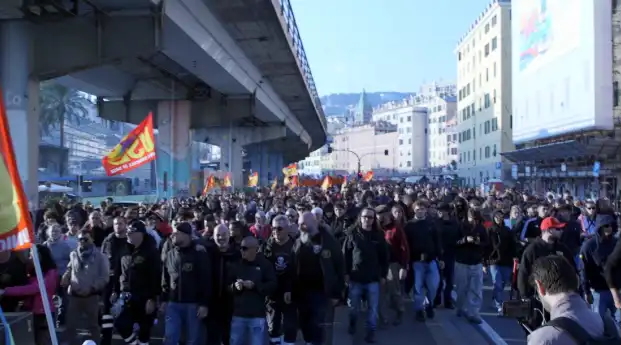
Genoa’s Autonomous Dockworkers’ Collective (CALP) has been at the forefront of Italy’s anti-militarist struggle for years. The self-described “collective of anti-fascist, anti-capitalist and internationalist dockworkers” first came to prominence in May 2019 when its members refused to load two electricity generators onto the Saudi-government owned Bahri Yanbu. The civilian-registered generators were destined for use by the Saudi Civil Guard in their war in Yemen. CALP members have blockaded the same ship a number of times since.
In September 2025, the CALP again made international headlines. Having helped the Global Sumud Flotilla with docking and logistics, the CALP offered a blunt warning to Israel. In the words of CALP spokesperson Riccardo Rudino: “If we lose contact with our comrades, even for just 20 minutes, we’ll block all of Europe. […] If something happens, not a single nail will come out of here. We will launch an international strike, we will block the roads. We will blocchiamo tutto (block everything)!” The brutal IDF attack on the Global Sumud Flotilla weeks later led to a three-month wave of pro-Palestine strikes, protests and student occupations that culminated in a massive general strike on 28-29 November 2025.
Greece: Piraeus port paralysed by strike action
The ENEDEP dockers’ union in the Greek port of Piraeus has been at the heart of the national and international coordination that led to 30 October. On the day, it played a pivotal role in the coordination of the three-hour nationwide dockworkers’ strike which saw it stop work alongside the OLP Dockworkers’ Union in Piraeus and other dockers’ unions in around a dozen Greek ports. Seafarers’ unions also called a separate 24-hour strike for that day which paralysed ferry services in Piraeus and six other Greek ferry terminals.
Action in Piraeus was not confined to dockworkers and seafarers. In fact, Greece’s largest port experienced something approaching an All-Piraeus strike. The Piraeus Labour Centre (EKP) led by ENEDEP president Markos Bekris called its own 24-hour strike across the port city, which was joined by strikes and demonstrations of metalworkers, shipwrights, chemical industry, rail and telecommunications workers, public servants and even self-employed truck and taxi drivers.
The 30 October day of action saw militant strikes, rallies and demonstrations take place in Thessaloniki and over a dozen other cities across Greece.
ENEDEP has taken militant action in solidarity with Palestine. In June 2024, the union forced the MSC Altair container ship that was transporting weapons to Israel out of Piraeus. In October 2024, ENEDEP again mobilised to stop a container carrying 21 tonnes of ammunition from being loaded onto the Marla Bull which was bound for Israel. ENEDEP president Markos Bekris is now being prosecuted for his role in this internationalist anti-war action.
France: 24-hour dockworkers’ strike
The National Federation of Ports and Docks (FNPD-CGT) called a 24-hour nationwide strike which brought 95% of French ports to a standstill. The FNPD-CGT represents about 90% of all French dockworkers and its strike shut down 24 ports across the country, including Le Havre, Marseille and Fos-sur-Mer, Dunkirk, Calais and Rouen.
In June 2025, FNPD-CGT members in the industrial port town of Fos-sur-Mer refused to load military equipment bound for Israel onto the cargo vessel ZIM Contship Era. These dockworkers refused to load 19 pallets of machine-gun ammunition belt links and two containers of cannon parts, which forced the ship to leave port without its deadly cargo. A few days later, dockers in the Italian port of Genoa blocked this same ship from docking there.
Spain and the Basque Country: two-hour strikes
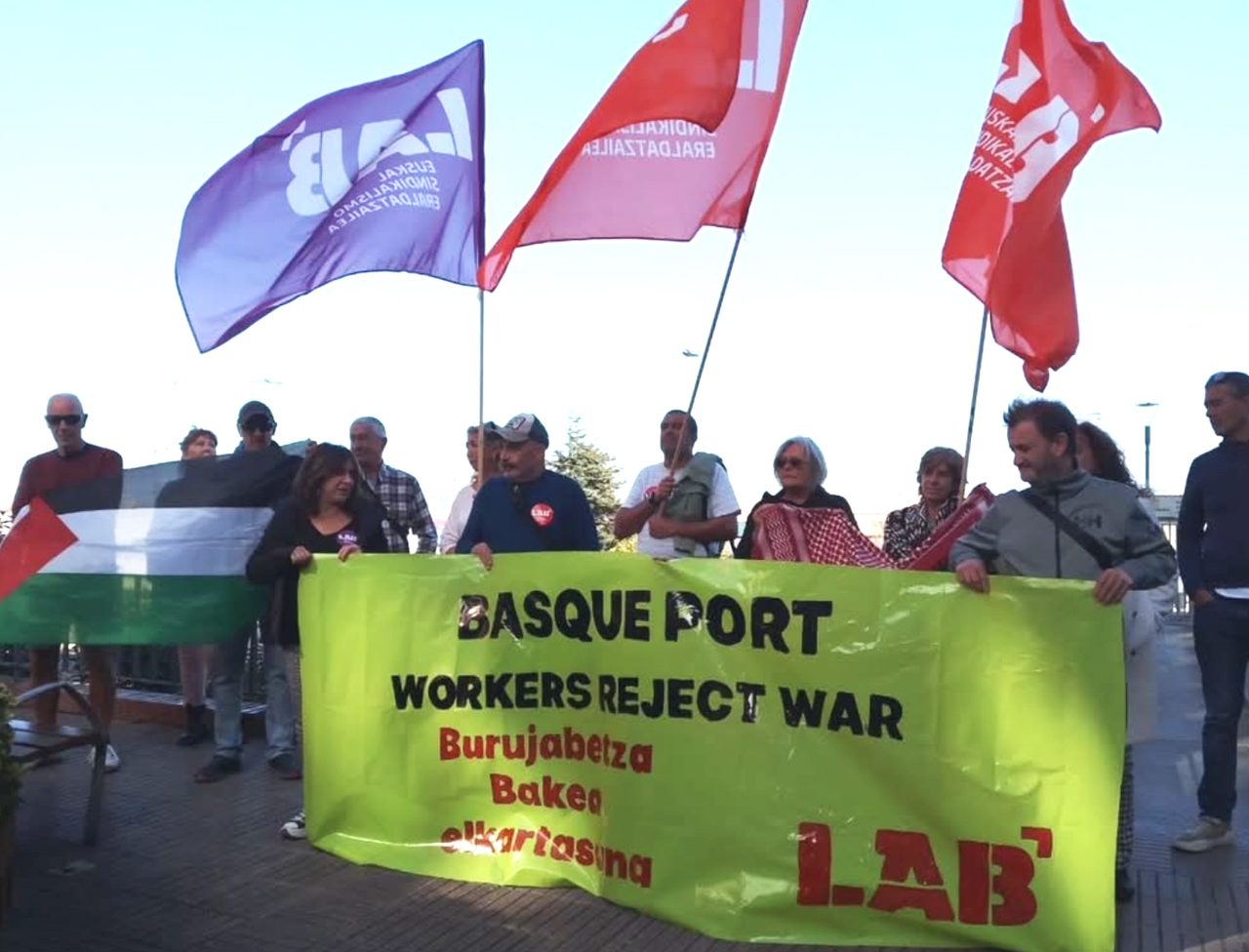
On 30 October, dockworkers stopped work for two hours (1-3pm) in most ports across the Spanish state. The two main unions taking action were La Coordinadora (CETM), the historically anarcho-syndicalist union that represents 70-80% of Spanish dockworkers, and the Basque LAB. Stoppages and lunchtime rallies affected 16 ports across the Spanish state, including Barcelona, Valencia and the huge transhipment port of Algeciras, as well as the ports of Bilbao (Santurtzi) and Pasaia in the Basque Country.
In November 2023, dockers in the port of Barcelona pledged to not load or unload ships containing war material. The decision was taken at an assembly of the Organisation of Port Dockers of Barcelona (OEPB), the union representing a majority of Barcelona’s 1200 dockworkers and a key member of La Coordinadora. The smaller Port Workers’ Union (USTP), another La Coordinadora affiliate, took a similar decision two days later.
The port of Barcelona has become an important launch point for the Global Sumud Flotilla, with many of the boats heading to Gaza setting sail from there in August/September 2025 and April 2026.
Türkiye: Dockworkers rally against war
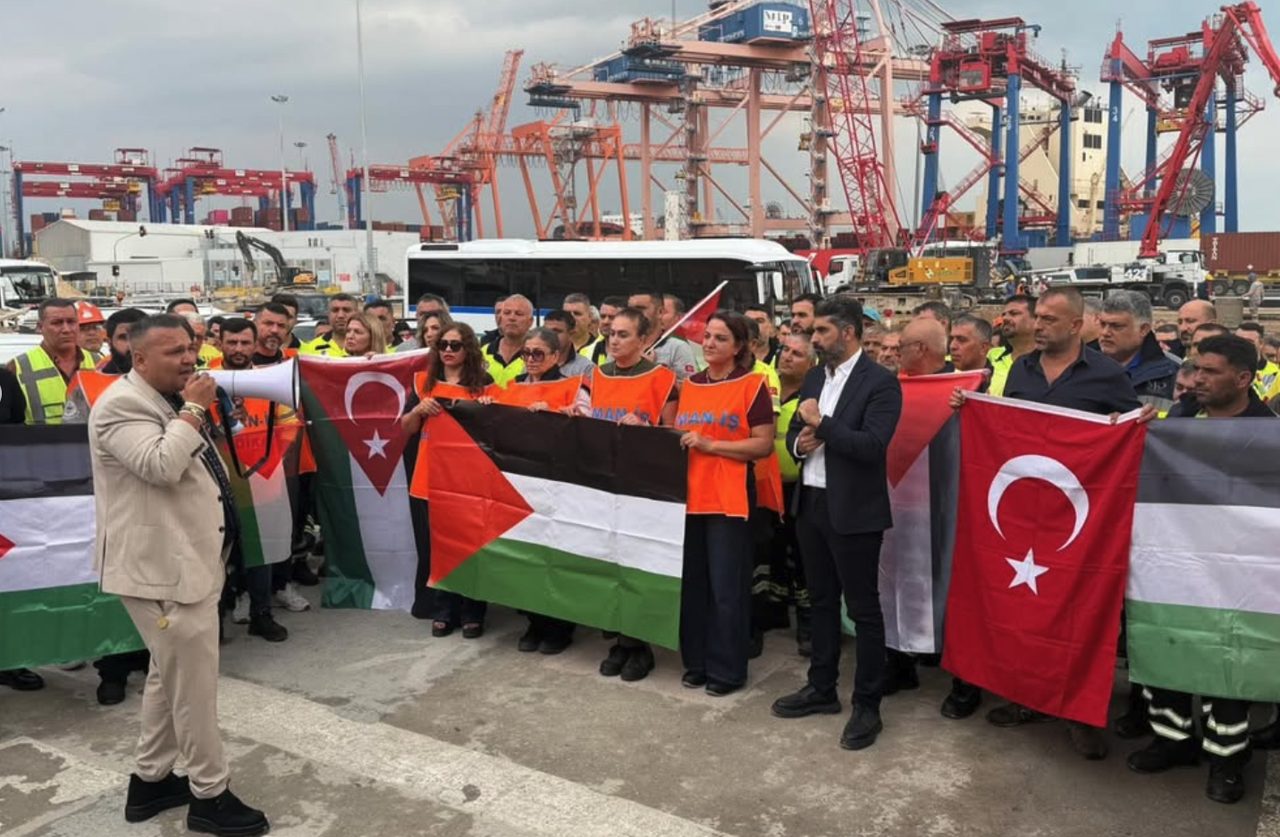
Dockers’ unions in Türkiye marked 30 October by holding demonstrations and press conferences outside the country’s major ports and in the capital Ankara. The Liman-İş union took action at the ports of Haydarpaşa in Istanbul, Antalya, Mersin and Gemlik. The Limter-İş union organised a separate rally at Haydarpaşa.
Reports have emerged of a 24-hour strike at the port of Haydarpaşa on 30 October. However, the local press including liberal newspapers such as Cumhuriyet (Republic) and Evrensel (Universal), alternative outlets like Sendika.org, and the left press such as the Communist Sol (Left) [see here and here] and the Trotskyist Gerçek (Truth) make no mention of any form industrial action taking place on the day.
India: dockers and seafarers unite
The Water Transport Workers Federation of India (WTWFI) and the Forward Seamen’s Union of India (FSUI) held rallies and demonstrations in more than a dozen ports across India. Both the WTWFI, which represents around 3,500 workers across 11 major Indian ports, and the FSUI are a part of the Centre of Indian Trade Unions (CITU). The CITU is the union confederation of the Communist Party of India (Marxist), which with around a million members is India’s largest Communist Party.
Reports circulated of 24-hour port strikes taking place either across India or solely in Mumbai’s port of Nhava Sheva. These appear to be the product of miscommunication. On 31 October, the Italian USB federation noted that “the strike originally called by the WTWFI federation in 11 Indian ports was suspended due to adverse weather conditions”. However, WTWFI general secretary T. Narendra Rao told Indian news outlet The Wire that the federation had planned no strikes, just demonstrations as the Indian Labour Code requires 14 days’ notice of any strike.
In February 2024, the WTWFI issued a statement announcing its decision “to refuse to load or unload weaponised cargoes from Israel or any other country which could handle military equipments and its allied cargo for war in Palestine”. This was a message that the federation reiterated to the Indian government on 30 October.
A day of global protest
The 30 October dockworkers’ international day of action had a truly worldwide reach. A range of other dockworkers’ unions across the globe organised demonstrations in dozens of other ports. Some of these include the Moroccan ODT union which took action in the ports of Casablanca and Tangier, the SEGDAMELIN-PEO of Cyprus that demonstrated in the ports of Limassol and Larnaca, the Portuguese FNSTP rallied in five different ports, the Swedish Dockworkers’ Union (HAMN) in almost a dozen, the Irish SIPTU union demonstrated outside the ports in Dublin and Cork and ILWU Locals 10 and 34 held lunchtime rallies outside the ports of Oakland and San Francisco. Dockers’ unions in Brazil and Mexico also marked the day with rallies and meetings. And all of this does not include the rallies and demonstrations organised by Palestine solidarity groups and other activists in cities around the world to mark the day.
MUA largely MIA
As for the Maritime Union of Australia, reports of the union’s participation in the events of 30 October were greatly exaggerated (to borrow a phrase from Mark Twain). Despite reports to the contrary, apart from some militant-sounding social media posts, the MUA took no active part in this dockworkers’ day of action.
The MUA did release a solidarity statement a few days before 30 October. The union’s National Council met in late October and on 26 October released a statement entitled “No war cargo through our ports. No support for genocide”. The statement expressed the MUA’s “solidarity with dockworkers and port workers internationally who are organising” for the “30 October 2026 day of action” and suggested that the “MUA National Council endorse that branches take measures to support these actions”.
Despite these fine words, the MUA had no intention of organising any real action for 30 October. This is clear from the fact that at MUA stop work meetings held in various Melbourne and Sydney container terminals between 26 and 30 October, the dockworkers’ day of action was either not mentioned at all by the MUA national and branch officials in attendance, or was brought up by members from the floor only to be quickly brushed aside.
MUA action on 30 October was essentially limited to social media. MUA Sydney Branch Secretary Paul “Keato” Keating posted a solidarity video taken at Patrick Port Botany. And the MUA national office produced a short video about the international day of action featuring MUA seafarer and detained Global Sumud Flotilla activist Hamish Paterson calling on MUA members to “demand the manifest” i.e. check the cargo. But that was about as far as things went. No doubt well intentioned by these comrades, but not amounting to any industrial action.
Yet somehow the MUA was added to the list of unions taking action on 30 October. A press release produced by the Italian USB on 28 October placed Melbourne and the MUA at the top of the list of ports taking action. Another USB article even suggested that the 30 October day of action was going to begin at “6:00 a.m. in the port of Melbourne, Australia”. Similarly, the No Harbour for Genocide website added the port of Melbourne to its online map with the message “Time and meeting point to come. Union: Maritime Union of Australia”. This has since been removed (see the Internet Archive capture taken on 29 October).
This was all a mistake. In correspondence with Labor Tribune, MUA Victorian Branch Secretary Robert Lumsden has confirmed that no form of MUA-sponsored action took place in Melbourne or anywhere in Victoria on 30 October.
As if taking their cue from the MUA, both the International Transport Workers’ Federation (ITF) and the International Dockworkers’ Council (IDC) released separate solidarity statements a day or two before 30 October. The ITF, led by former MUA supremo Paddy Crumlin and the now infamous Steve Cotton, released its statement on 28 October. The IDC then followed suit with its own resolution. These statements can only be read as face saving measures by union federations caught out by the breadth of support for the 30 October international dockworkers’ day of action.
In an April 2025 statement to unions in the US, the Palestinian General Federation of Trade Unions-Gaza reminded us that “[t]rue labour solidarity is demonstrated through actions, not just words, and we count on your awareness and determination to take concrete steps to end this tragedy”. The tragedy in Gaza and Palestine will not be ended with the fine words of the MUA, the ITF and the IDC.
Dockworkers around the world are becoming increasingly aware of their own role in the international arms trade. As a result, they are becoming increasingly willing to take concrete action in solidarity with Palestine and against imperialist war. This is because, in the words of José Nivoi from Genoa’s Autonomous Dockworkers’ Collective (CALP): “Dockworkers want their hands dirty with grease, not with blood”.