
David Lockwood warns against simplistic responses to the rise of rightwing populism.
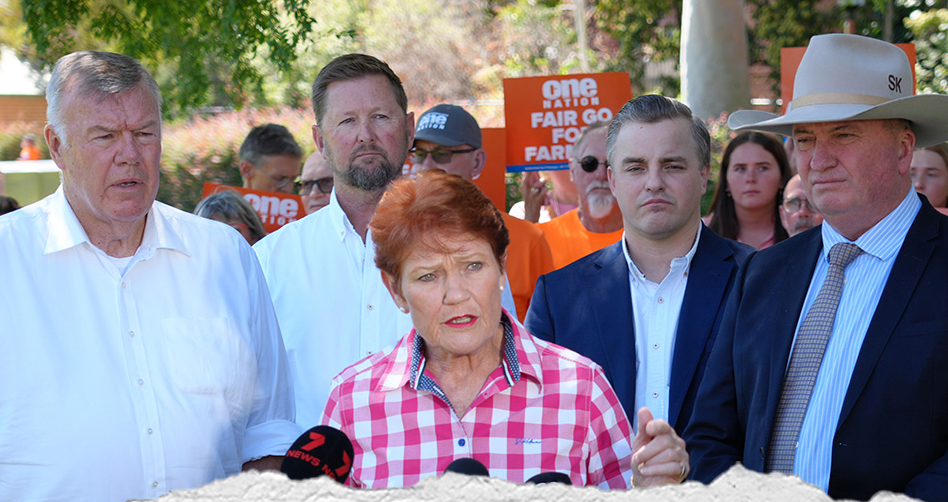
As widely expected, One Nation won the Farrer byelection last month, providing them with one more MP, its first elected in its own name to the House of Representatives.[1] This occasioned much hoop-la in One Nation land and corresponding gloom on the left, which soon turned to urgent calls to resist the far right at all costs. “One Nation must be fought relentlessly,” wrote Mick Armstrong in Red Flag (11 May); “a line has to be drawn”.
“One Nation are not the same as the Liberals,” added Solidarity (26 March). “One Nation’s racism is beyond the pale.” (26 March)
Admittedly, the F word (fascist) has not been used thus far, but you can see where this sort of commentary is heading. Towards the idea that One Nation is something different in Australian politics and that its members/supporters are a homogenously hateful group – “beyond the pale”.
The urge from comrades in Solidarity or Socialist Alternative to suggest One Nation are qualitatively different to say, National Party leader Matt Canavan, or former prime ministers Tony Abbott or John Howard, is to fall into line with a banal liberalism that ‘normalises’ the reactionary politics of the Liberal and National parties. Presumably they are ‘inside the pale’ of bourgeois respectability. Remember, Howard has declared he has “always had trouble” with the concept of multiculturalism.
Undoubtedly, One Nation is to the right of mainstream Australian politics. It is their anti-establishment schtick that appeals to increasingly marginalised parts of the electorate, despite their pro-Gina-Rinehart, pro-big-business, pro-Trump-war reality. Even so, they are not that far to the right. We may speculate that many of its supporters have it in for the latest wave of immigrants (Asians from the 1970s, Muslims thereafter), but that hardly marks them out as unique in Australian history or in contemporary society.
In racist terms, much of the case swirls around Hanson’s various pronouncements, from her first speech in 1996 (“I believe we are in danger of being swamped by Asians”) to a call to ban Muslim immigrants 20 years later (“a culture and ideology that is incompatible with our own”). One Nation supporters are undoubtedly national chauvinist, anti-immigrant, reactionary and right wing, led from the top by clear racists and spreading out around the edges into various forms of ultra-rightism. But does this make them so very different from the rest of the right?
Their policy tells us that “Australia’s immigration system is broken”, which means “our population has surged past 27 million”. This is now “overwhelming housing, infrastructure and essential services”. It has also led to wage stagnation, an end to home ownership and competition with cheap foreign labour.
The solution? Deport 75,000 ‘illegal’ immigrants, cut immigration from current levels and conduct a harsh administrative tightening-up of the system (rorts, student loopholes, no refugees from ‘extremist’ nations, withdraw from UN Refugee Convention and so on).
Immigration is not the limit of One Nation’s policy ambitions. There’s a dose of virulent economic nationalism as well. Hanson told the adoring crowd at the Farrer victory celebration that, having “consulted with the industry [naturally] … I want to put money back into our pockets from the gas industry. They are our resources and they are being given away”.
She doubled down on this at a recent speech to the Australian Energy Producers conference in Adelaide that the Guardian reported was for a “Norway-inspired gas policy”.

The problems these policies purport to remedy – housing, services, wages, ownership of resources, to name a few – are real enough. To fight One Nation, the left has to address them. Which means going beyond simple denunciation and requires actively proposing a coherent alternative, not just to One Nation, but more importantly an alternative to mainstream capitalist managerialism.
Even on immigration, One Nation’s positions are becoming less and less unique. After his speech on immigration policy last March, Hanson thanked Angus Taylor for picking up a couple of her policies. Taylor declared that immigration numbers must be drastically reduced “to protect our way of life – and to restore Australia’s standard of living”.
Under a Liberal government, immigrants would be judged on the basis of their beliefs and that judgement would be used as a control mechanism. He asserted that “those who migrate from liberal democracies have a greater likelihood of subscribing to Australian values compared to those migrating from places ruled by fundamentalists, extremists, and dictators”. The overt racism wasn’t there, but the implication for Arabs and Muslims certainly was.
More recently, the Liberals have warned that under their government non-citizens (permanent residents) will be barred from access to welfare payments (as yet unspecified) and future eligibility for the NDIS. (That’s 1.2 million people since 2000 alone.) Taylor’s budget reply maintained that “taxpayer funded support should be there first and foremost for Australians” (He did not note that permanent residents pay taxes.)
On such matters, perhaps One Nation are not so very different after all.
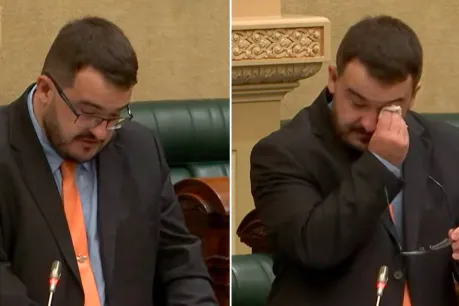
Photo: YouTube
In a stunning speech to the South Australian parliament, new One Nation MP Jason Virgo proudly discussed his relationship with a male Muslim partner who is a migrant from Indonesia. “I love migrants,” he told the parliament. “The overwhelming majority are simply searching for a better life. But two things can be true at once and I do believe migration levels in recent years have been too high.”
As One Nation ‘surges’, all manner of people could be washed into parliaments. Some of them might even remain One Nation MPs. While that is a circle for Pauline Hanson to square, it shows that One Nation is not simply attracting racist boneheads. To build a coherent response to One Nation, the left must understand this.
Because if One Nation was simply attracting racists and semi-nazis – if a line has to be drawn and no quarter given – then the implication may be that the way we oppose them has to be different as well. If we are dealing with squads of middle-aged regional neonazis who are ‘beyond the pale’, perhaps appeals to reason and determined organisation in marginal and working class communities may not be the correct response. What could be called for is the mobilisation (on the streets of course) of all decent elements of society against ‘The Fascists’ wherever they raise their heads. Popular fronts could raise their head.
While this approach might work to coalesce new student recruits who want to ‘fight the right’, it is no way to address the emergence of far-right populism. While much of the shift to One Nation is Pauline Hanson cannibalising the Liberal and National voter base, there is some shift from Anglo and more recent immigrant working class voters and, as Jason Virgo shows, all manner of political viewpoints disillusioned with the establishment.
Given this complexity, we would suggest that simply mobilising on the streets to ‘fight the right’ and shouting ‘racists’ at every One Nation election volunteer is what not to do. Such a simplistic approach concedes the argument around housing, services and wages to the right.
We have solutions to these problems that require a socialist society and those solutions should be the main focus of our attack. Secondly, by demonising One Nation supporters and their concerns about life in capitalist Australia it becomes more difficult to undermine their prejudices about immigrants. Thirdly, the voting figures indicate that One Nation has some support among workers and immigrants. This cannot be wished away by one more march or rally.
[1] Bernard Keane comments: ‘… it will never hold the seat for a full term. As is now well known, the chances are against Pauline Hanson’s party even holding the seat until the next general election, given the long history of its successful electoral candidates departing in a huff.’ (Bernard Keane, ‘One Nation’s bubble hasn’t burst’, Crikey 5 May 2026). We shall see.