
David Lockwood searches the foreign policy section of the proposed ALP National Platform – but finds almost nothing there.
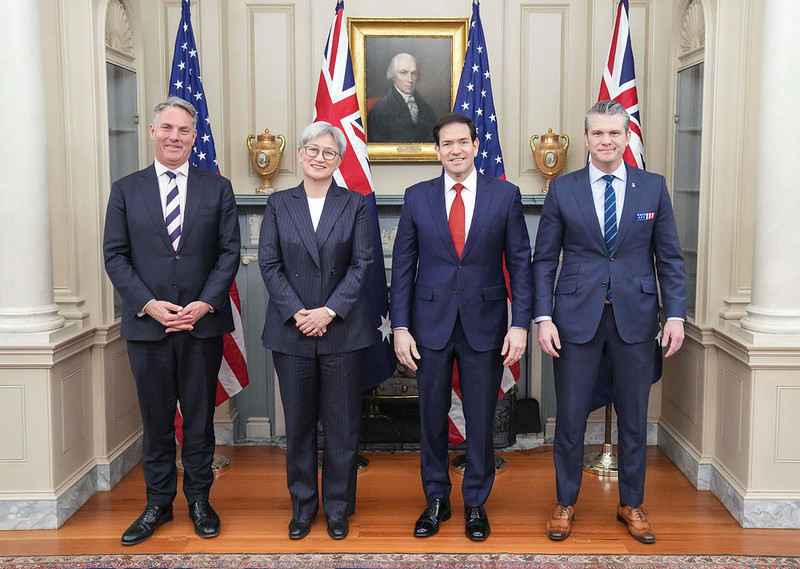
In the section of the ALP Draft Platform (for consideration at the July Conference) on “Australia’s Place in a Changing World”, there is no mention of Israel’s genocide in Gaza. Nor of the US war against Iran. Nor of the aggressively erratic behaviour of the Trump administration.
Instead, the National Platform takes an Olympian attitude to foreign policy, gazing beatifically down on the world and dispensing sermons about the unpleasantness of international conflict. It resembles nothing more than a rather dusty seminar paper written in quite another era. It portrays a world benignly guided by “rules that keep us safe” which “Labor will continue to safeguard and uphold”. In that world, order prevails as long as everyone sticks to the rules. If they don’t, then “Australia’s closest security ally” (guess who) will step in and put things right. Meanwhile, Australia (under Labor) will get on with promoting our “national interests, values and sovereignty”.
This is the most dreadful nonsense. Unhappily for the whole scheme, the lynchpin of the operation – the US administration itself – knows that it is nonsense and has taken to loudly proclaiming the fact. In January, the US War Secretary, Pete Hegseth, described the rules-based international order as a “cloud-castle abstraction” on which the US had “squandered our military advantages and the lives, good will, and resources of our people” (and we might note, those of many other peoples as well).
Clear, one would think. Yet the Platform authors blithely ignore this and the behaviour of the US (both with and without Trump) in order to pretend that the “rules” (which never really existed) are still operating. Fantastically, they suggest that as long as we stick with our Great and Powerful Ally, follow its foreign policy closely and embrace its war-making demands, all will be well. In our region, this will “contribute to a favourable balance so no country dominates, and no country is dominated”. So it’s really all in our best interests … you see?
Reality is not so easily ignored.
Let’s start with “the rules that keep us safe” which a Labor government is pledged to “safeguard and uphold”. The authors themselves then provide a devastating account (paragraph 3) of how these rules are no longer in operation: military build-up, strategic competition, territorial disputes, extremist incidents.
By their own account, any notion that there are “rules” operating here – beyond the general concept that “to the strongest belong the spoils” – let alone what those rules might be or who devised them is clearly fanciful. So the Draft Platform – and most of Penny Wong’s speeches – are based on an illusion. What’s the reality?
The Platform policy does not, as it falsely claims, derive from “Australia’s national interests, values and sovereignty”. It is based on Australian capital’s need for the alliance with the US, “our principal strategic partner and largest source of investment”. This used to be a simple matter (certainly under Coalition governments and most of the time under Labor) of following the US militarily and then arranging a suitable foreign policy to justify the results. Thus Australia was hot-foot behind the US into Korea, Vietnam, the Gulf, Afghanistan and Iraq. None of these escapades had anything to do with national interest, values or sovereignty. They had everything to do with keeping the US as our ally, maintaining its interest in our region and hoping that the protective shield of the US war machine would warn off hostile elements.
Today however, we are not allegedly threatened by communists from the north, or Arab dictators, or Islamic terrorists. And yet, the Platform tells us, once again we are facing “the most challenging strategic environment since the Second World War” (again). It’s difficult to blame a “strategic environment” on anyone in particular of course, but the chapter does wag a rules-based finger at Russia and China.
The purpose of this build-up of fear is to create the conditions for an endorsement of US policy, further increases in defence spending and a reassertion of Australia’s “forward defence attempts” in the Indo-Pacific.
The mercurial nature of the US President’s policy and his inability to stick to a single version of any decision for longer than a couple of days has made the follow-the-leader game much more complicated. Nick Bisley notes that Trump’s policy seems to oscillate between a “spheres of influence” approach and a return to isolationism. “In the first six months”, he notes, “the administration has displayed elements of all these strands”. He says “For Australia, the foremost challenge is discerning the direction of US international policy”. The difficulty is in the discernment. After that, we know what to do.
In the meantime, says the Platform, Australia should be the best ally (for pointers on this, watch Richard Marles), spend as much as we can on defence and strengthen our role in the Pacific. In the latter case, “We will maintain Australia’s position as a partner of choice to Pacific nations” (even, as seems to have been the case in Samoa, Vanuatu and PNG, where they don’t want us to).
In sum, the Platform attempts to beautify slavish adherence to American positions with pretty phrases about rules and order. Nowhere is this more evident than on the question of Palestine. Palestine waits until paragraph 19 for a mention – to be dismissed, as noted above, with the two-state solution. No mention of the genocide, the tens of thousands of Palestinian dead, the invasion of Lebanon, the war on Iran. Where was international law during these events? Where was the rules-based order?
And where is Labor’s position on this question?
The Draft Platform notices the Palestine disaster but does not deign to comment. Like an objective academic, it notes and moves on. This is not what Labor Party policy is meant to do. Dozens of motions from Labor Party branches condemning Israel and its US backers find no echo in this document.
The whole chapter is a mealy-mouthed exercise in commentary, designed to justify the utterly spineless nature of the Labor government’s foreign policy to date with a confected gravitas taking the place of original and independent ideas.
A Labor policy on international affairs would, at the very least, condemn imperialism and declare our intention to break with it. It would call for:
- An independent, nuclear-free non-militaristic foreign policy based on solidarity.
- Fair trade and support for international development.
- Support countries under threat from the impacts of climate change.
- Cooperation with Asia-Pacific countries; towards a confederation of South East Asia and the Pacific.