
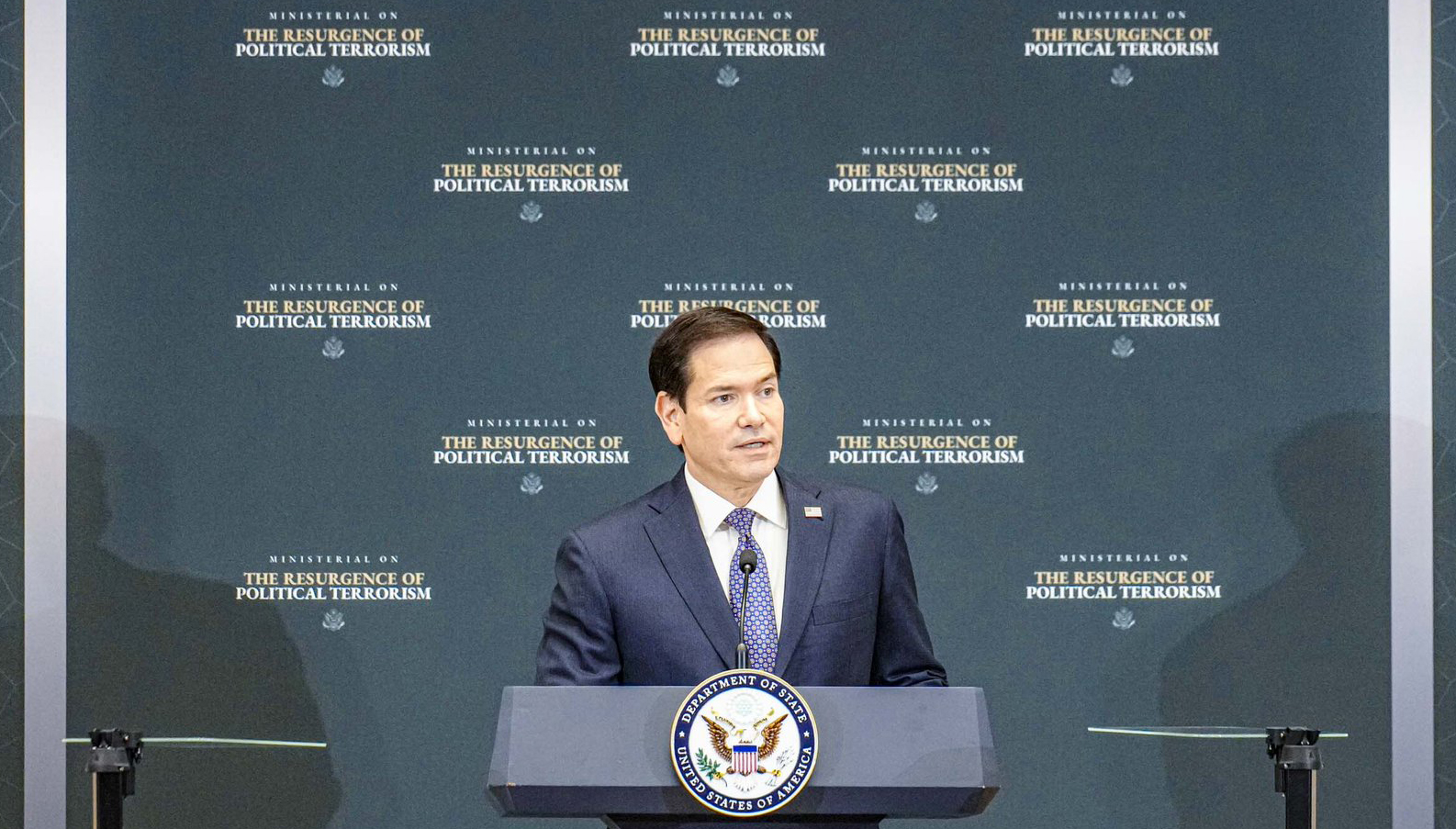
Richard Stone takes a look at the ‘Ministerial on the Resurgence of Political Terrorism’ jamboree in Washington in July and finds Cold War rhetoric aimed at perceived enemies at home and abroad.
The motives behind a recent international forum convened by the Trump administration in Washington has left little to the imagination. The so-called Ministerial on the Resurgence of Political Terrorism followed a classic Cold War agenda. The timing of the forum also proved revealing: amid real-war scenarios, uncertainty and high-level diplomacy in the Middle East, and massive opposition to the Trump administration at home and overseas. Some agenda items raised at the forum, however, were not so well publicised; concerns have arisen following massive intelligence-gathering and threats to traditional US-led hegemonic positions.
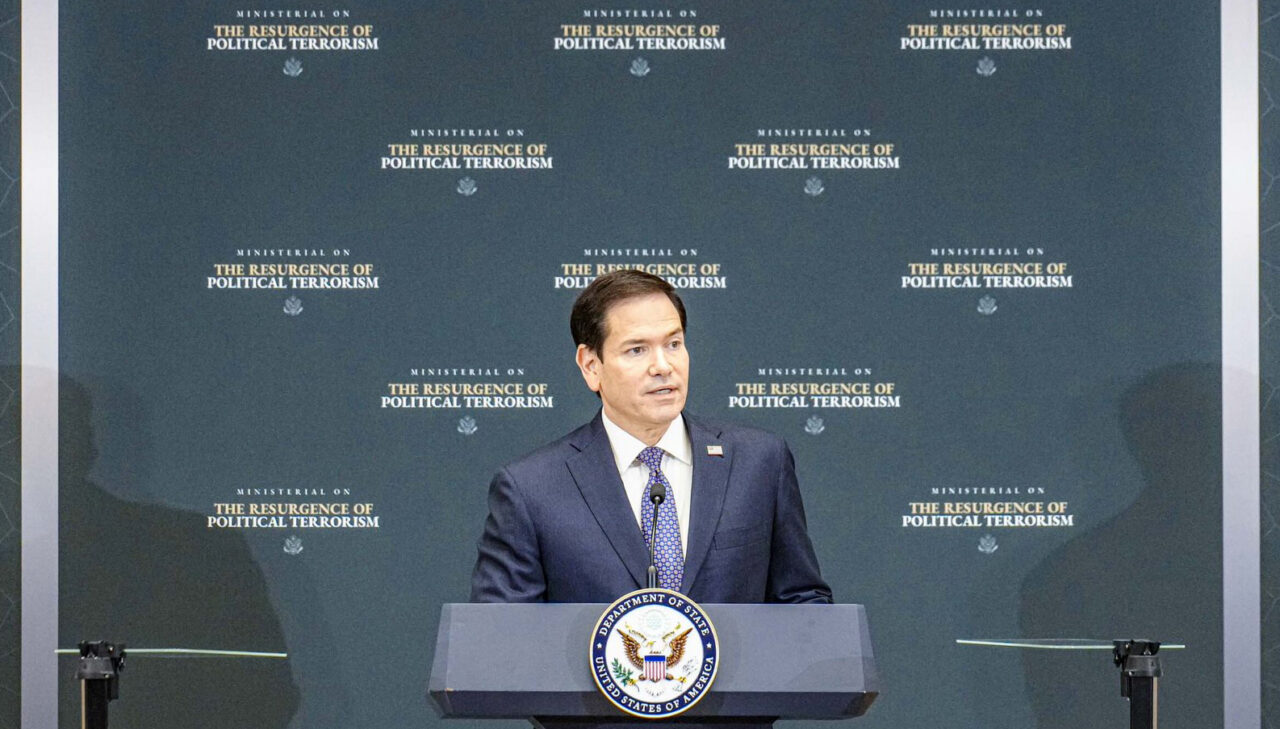
On 16 July the Trump administration hosted a diplomatic forum attended by 66 countries, including Australia1. To what extent the official Australian diplomatic presence was linked directly to the US military footprint in Australia, was not specified in forum publications2. The so-called ‘alliance’, nevertheless, remains a major factor.
Pillars 1 and 2 of the AUKUS agreement, moreover, have included extensive US involvement into Australia, particularly with US software corporations which use advanced cyber systems and AI through Australian-based military facilities3. The surveillance of Australian residents and citizens by the US intelligence services, likewise, is regarded as being both commonplace and widespread4. It is not difficult to detect.
Some of those attending the forum, interestingly, also did not necessarily represent specific countries and retained their anonymity; reference was made, for example, to ‘Mr Kurd is here from Kurdistan’5. Who was he or she, who did they really represent?
The main item of forum business, likewise, was also questionable: an official diplomatic statement about the ministerial forum included references directed toward “far-left political terrorism”; intelligence-gathering was dealt with along the lines of “addressing it before it metastasises”, revealing surveillance of persons of interest6.
The Trump administration, following its far-right political course, has become obsessed with what has been labelled ‘cultural Marxism’; a loosely knit collection of political opposition figures and ideas referred to by the White House as ‘woke’. There is little doubt the Trump administration has already targeted political opposition figures and movements and subsequently labelled them as “terrorist” along lines of political expediency.
Ahead of the mid-term elections, the administration is busy painting the Democratic Socialists of America as “communist” and highlighting some of its factions, such as the Marxist Unity Group.
The fact the one-day forum coincided with an official high-level diplomatic visit to the US by Israeli PM Benjamin Netanyahu, has also raised questions about the shadowy Jonathan Institute used by the US and Israel for surveillance purposes of opposition figures and Palestinian activists. It has been noted, for example, the institute was founded by Netanyahu in 1979 specifically to pursue a perceived joint war against terrorism with the US; it retains strong links with the intelligence services and is his personal power-base of support7. Just what makes a terrorist for the US administration, we have seen is a fluid exercise in real-politik. Yesterday’s ‘freedom fighters’ can become today’s terrorists – and vice versa, depending on perceived foreign policy priorities in Washington.
Other official statements, interestingly, drew attention to three specific areas of interest by the forum: Islamic considerations, narcotics-related matters, left-wing political extremism with specific reference to anarchism and anti-fascism, without any reference to the far right8. Oliver North, the main figure of the notorious Iran-Contra Scandal, would have had a great deal to state about such matters. He was not, however, in attendance; being employed elsewhere by his long-time paymasters.
With such shadow boxing against enemies invented, perceived or real, it is as if nothing has changed since the previous Cold War, over half a century ago.
Some of the declassified documents from the previous Cold War make interesting reading; studies of the US Army Foreign Intelligence Assistance Program, for example, reveal a common pattern of targeting the left-wing and democratic procedures, as they were regarded as obstacles confronting US interests. One collection of declassified documents from the period revealed the US intelligence services targeted “worldwide … those who oppose the US Defence Department”9. That target would appear very large indeed.
Whole subject populations were profiled during the period and placed on lists.
The use of the internet in recent times has merely heightened the ability of the US to stray further into the private lives of civilian populations in the name of intelligence-gathering.
Revelations that the US National Security Agency (NSA) researched “ways to exploit the global reach of Google, Microsoft, Verizon and other US technological powers”, would leave little to the imagination about the real nature of espionage10. The back-door into the internet was left unlocked for those silently seeking access.
It is now possible for governments to use AI programs for profiling. The uses and abuses of data-centres, therefore, is a very real threat, particularly those with military applications and facilities11. Numerous alerts are provided by governments to publicise foreign powers and adversaries using the same intelligence-gathering techniques. The wholesale erosion of civil liberties in countries such as Australia, however, has become a major consideration; civil liberties include safeguards to protect personal information. Questions therefore arise about the motives of those responsible for enabling the intelligence-gathering practices.
Whether foreign powers and adversaries have become convenient false flags to enable the US and allies to mine vast troves of data remains a point in question; computer hacking has increased alongside the establishment and expansion of data centres12.
The recent hacking of Origin, for example, was not taken seriously by the corporate entity for almost three weeks. The fact that the hackers successfully removed nearly a million customer records including the last four digits of credit card details, the last three digits of bank accounts, names, dates of birth, billing histories and phone numbers, has raised serious issues regarding cyber security13. In fact, an official explanation from Origin stated that it “initially believed the threat was not credible”14. A far more plausible explanation for the response by Origin could, however, be the sophisticated nature of the hacking using seemingly benign techniques of access and entry inside the system.
Studies of the energy use of customers can be used as part of a basis for profiling: during the height of the previous Cold War in Central America, for example, Guatemala fell under scrutiny being regarded by the US as a strategic asset. The ruling military elite of the country used an Israeli-installed computer system to monitor electricity and telephone usage together with individual movements through police and military checkpoints with access and egress into areas of interest15.
A computer matrix had been devised to establish and track contacts between individuals and groups of interest to the military elite, including that of ‘safe-houses’, clandestine political organisation and communication conduits16. The matrix was a tool of repression.
The profiling was subsequently used by the military, working alongside Police Intelligence G2, to identify what was regarded as abnormal electricity and telephone usage as a link toward unwanted left-wing opposition political activism17.
Other, similar, hacking events, including against Australia’s Medibank Private, also carried an almost dismissive approach by those in officialdom; they were noticeably nonchalant.
With a global tide of opposition against both the US and Israel growing, the recent forum in Washington can, perhaps, be viewed as an indication the US takes the problem very seriously. They represent the most aggressive side of the military-industrial complex and Wall Street, and will clearly wish to identify and demonise any opposition.
We clearly live in troubled times with the ascendency of the far-right, openly supported by the Trump administration. It would appear they are busy assessing what they regard as obstacles to their agendas, which operate under the guise of ‘US interests’.
1. Data Centres, www.Renegadeactivists.org (July 2026), and, US hosts conference, Time Magazine, 17 July 2026.
2. See: The Heavy US Military Footprint on Australia, IPAN publication, 2026.
3. Ibid., pp. 6-7.
4. See: The CIA’s Australian Connection, Denis Freney, (NSW, 1977).
5. Results, US Department of State (Washington), 20 July 2026.
6. Ibid., and, ‘Mortal Threat’, CNN., 17 July 2026.
7. See: Covert Action, Edited by Ellen Ray and Wm. H. Schaap, (Victoria, 2003), page 51 and page 164.
8. US hosts global meet on ‘left-wing terror’, al-Jazeera, 16 July 2026.
9. US Army Regulation: 381-20, Section 1.5, Mission and Policy, Page 1, (Declassified: 15 November 1993)
10. See: The intelligence coup of the century, The Washington Post, 11 February 2020.
11. Data Centres, both their physical and software components fall under the Defence and Security List Part 2, Categories 4 and 5, Data Centres publication, op.cit., July 2026.
12. See: Tech titians as potent as nations: MI6 chief, The Australian, 17 December 2025.
13. Origin dismissed hack as ‘not credible’, The Australian, 29 July 2026.
14. Origin dismissed hack as ‘not a credible’ threat, The Australian, 29 July 2026.
15. See: The Garrison State, Steve Goldfield, Palestine Focus Publications, San Francisco, CA., 1985.
16. Ibid.
17. Ibid.