
David Lockwood looks at the remarkable transformation of a tweet into a mass movement that removed India’s education minister.
Prime Minister Anthony Albanese was given the opportunity to bask in the reflected glory of a somewhat more important ‘world leader’ (and attract the attention of thousands of Indian voters ahead of the Victorian election), when the Indian Prime Minister, Narendra Modi, visited Melbourne in July.
Narendra Modi was able to soak up the adoration of the Indian middle-class diaspora, while shaking off his murky reputation as an authoritarian and a communalist.
Back home, things weren’t going so smoothly. When he returned to India, Modi’s BJP government found it necessary to smash up a mass student protest in Delhi, refuse talks with student leaders, temporarily close parliament and arrest the two most important opposition leaders and a number of other MPs.
Back in May, the Chief Justice of the Indian Supreme Court, Surya Kant, issued his opinion on India’s young unemployed from the bench. He said that they often became “activists” and he described them as “cockroaches” and “parasites” (Times Now, 16 May 2026).
“There are youngsters like cockroaches who don’t get any employment or have any place in [a] profession,” he said.
Two points to note here. Surya’s comment might have been dismissed as an intemperate remark by a crusty old judge. But the Modi regime has worked assiduously to eat away at the independence of the Indian judiciary so that now the latter is regarded as a front for the former. Secondly, graduate unemployment is an enormous problem in India. For the 8 or 9 million graduates annually, it’s estimated that there are only 2.8 million jobs. And the system keeps on churning out more graduates, year after year. 40% of the 15-25 age group are unemployed (India Today, 21 July 2026).
Weakening state capacity (a result of neoliberal policies) leaves few tools to remedy the problem. The expansion of universities (for those who can afford them) has created large numbers of educated youth who cannot find work. Some of these are pushed into jobs offshore, an option many are beginning to resist.
Many more can only find work in the informal sector – the ‘gig economy’. Meanwhile, the expansion of agribusiness and the destruction of small farms pushes youth into the cities, where they join the ranks of the potentially insurgent unemployed.
The university educated youth of the Global South and those pushed into manual jobs labouring in the Middle East or elsewhere as guest workers, makes this generation a truly international grouping, with experiences across the globe.
So, in view of the potential size of this discontented cohort, for a leading judge to issue such un insulting broadside was unwise, to say the least.
More than 11,000 kilometres away, in Boston (US), Abhijeet Dipke, a master’s student in public relations and marketing, noticed Surya’s comment. He tweeted in response: “What would happen if all the cockroaches got together?”
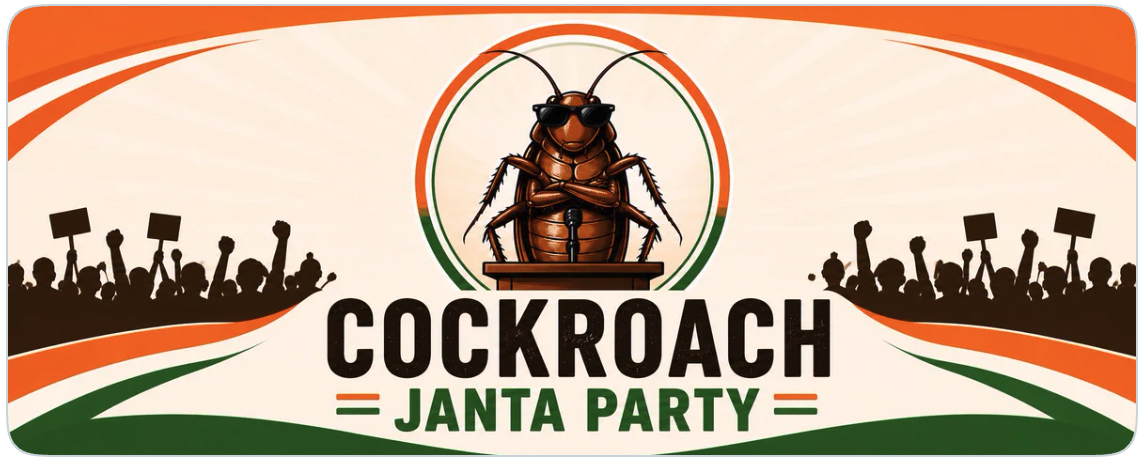
The message went viral and Dipke – clearly no slouch in these matters – had soon established a website and an online ‘political party’, the Cockroach Janta Party. This party was to be “secular, socialist, democratic and lazy”.
Its original five demands took aim at senior judges, opposed Modi’s attack on the electoral system, demanded that 50% of the parliament and cabinet be women and sought the exclusion of the Adani and Reliance corporations from media ownership.
These demands were swiftly overshadowed by what became the main focus of the campaign: the abolition of the India-wide examinations that it is necessary to pass in order to get into the professions (doctors, engineers) and government positions. These exams are a nightmare for their candidates, requiring months and sometimes years of preparation, along with expensive special coaching.
For decades, these exams have been mired in an extensive network of corruption and bribery. Over the past few years, the exams have been further sabotaged by the papers being leaked – followed by demands that the exam is cancelled or called off altogether.
And while these tests are not taking place, or the results not being released, the mountain of the graduate unemployed gets higher and higher.
In recent months, with further revelations of cheating and abuse, there was a general sense that the government, the education department and its BJP minister, Dharmendra Pradhan, had entirely lost control of the graduate education system and so the demand for Pradhan’s resignation came to dominate the Cockroach Party’s agenda.
Cue an extraordinary outflow of Cockroach online propaganda – manifestos, demands, cartoons, memes – together with a certain amount of support from the Great and the Good (film-stars, ‘personalities’, non-BJP politicians etc.). The government at first tried to ignore the phenomenon and then tried to shut it down electronically. Neither worked.
There followed an interesting lesson for those who promote ‘online activism’. This movement (for such it had become) started to burst out of its internet fetters and surge into physical manifestation. The Cockroach leaders (for such they were) had to give it human form. They called for a public demonstration in support of the Cockroach Party demands at Jantar Mantar [1] in Delhi. By this stage the demand for Pradhan’s resignation or sacking had overtaken everything else and many thousands gathered to press it home.
Dipke flew in from the US on the day. In an act of supreme recklessness, the government did not arrest him on the spot and he led the demonstration, which turned into a familiar Gen-Z-type revolving occupation.
Several activists from left youth organisations (particularly the All India Students Association, which is attached to the Communist Party of India (Marxist-Leninist) Liberation) declared a hunger strike. A well-known environmental activist and social campaigner, Sonam Wangchuk, joined the demonstration and the hunger strike. His hunger strike became the centre of attention.
And so, for two more weeks. Until the Cockroach Party leaders very sensibly realised that the movement was stagnating and called for a march on 20 July beyond the Jantar Mantar confines to the parliament building. The movement was revitalised as people began to pour in once again with the intention of marching.
Cue the panic among India’s rulers. Having a few hundred students milling around a small park in Delhi was one thing. Having many, many more marching on parliament was quite another. Negotiations were out of the question. That’s not the Modi way. When the size of what was going to occur became apparent, something had to be done. Calculating that Sonam Wangchuk was the focal point (that’s what the mainstream media said, after all) the government sent in a snatch squad on 18 July and bundled him off to hospital.
Game over? No such luck for the BJP. This action simply infuriated the protestors and set things up for a huge demonstration on Monday 20 July.
And so it was. The demonstrators managed to break through the police barricades that were hemming them in (no mean feat) and started marching towards parliament. They didn’t make it because of the massive lathi-charge and teargas offensive that the riot squad unleashed. After several hours of fighting (and many injuries) the Cockroach Party leaders again demonstrated their good sense, calling their supporters to fall back to Jantar Mantar, where they re-established the protest camp. The numbers steadily increased over the next day or so until it was bigger than ever.
Inspiring as it is, our admiration for this movement cannot be uncritical. Before we bring the story right up to date, there are a few aspects that deserve critical examination.
Strategy
Of course, this suffered from being made on the run, under the pressure of fast-moving events. My guess is that the Cockroach Party leaders did not set out to form a party (such as it is), nor to conjure up thousands of supporters, nor to threaten the BJP government. Initially, the plan had Gen Z written all over it: from the web network to the occupation to the hunger strike. On the choice of Jantar Mantar, Anand Teltumbde writes in Frontline magazine:
“Over the decades, countless movements have been born there, only to fade into political oblivion. The venue possesses symbolic significance, but it also represents the domestication of dissent. The State has effectively designated a zone where citizens may protest without threatening the normal functioning of power. Governments have become adept at handling demonstrations there. The police know how to regulate them. Television channels know how to package them.” [2]
There was a naivety about the Cockroach Party’s demands. This was evident in the original five (see above). Teltumbde again:
“The five-point manifesto … read like the output of any reformist organisation … These are reasonable demands. They are not transformative ones. A country where the state apparatus has been captured by a single political formation … does not need another five-point manifesto. It needs a thoroughgoing reimagination of the relationship between the state and the citizen.” [3]
And clearly, as the movement continued and the government remained intransigent, the Cockroach Party demands were progressively diluted. During the Delhi battle, a couple of CJP leaders offered the government a settlement on the basis of Pradhan’s resignation, compensation for exam-suicide victims and the release of Wangchuk from hospital. Thankfully, the government was stupid enough to reject this and the struggle continued – but now under the aegis of these three (much diminished) demands.
And as we now know it was the achievement of only one of them – the minister’s resignation – which cause the Cockroach Party leaders to claim victory.
Leadership
As is often the case, the existence of a leadership was sometimes denied, but still exercised – originally, it seems, by Dipke himself and then by a group of perhaps a dozen around him. Unlike in other Gen Z events, it could be seen and its decisions felt. The movement was ‘horizontal’ in name alone.
A leadership decided to transform the Cockroach Party from the electronic to the human; it decided on the first demonstration and the occupation of Jantar Mantar; it decided on the hunger strike, the timing of the second demonstration and the reconsolidation at Jantar Mantar. All well and good. We have no problems with leadership. But it should be fully visible, transparent and accountable. This means, I’m afraid, that if it is to continue the CJP needs boring old democratic structures.
Politics
At its beginning, the CJP (Gen Z-style) claimed to be non-political and shied away from contact with India’s leftwing political parties. Of course, the whole project was deeply political from the start.
“The examination schedules are not simply the product of one minister’s failures. They are symptoms of a deeper malaise – the degradation of public institutions, the commodification of education, the erosion of accountability and a political culture that treats governance as spectacle. Replacing Pradhan would leave these structural foundations entirely intact,” [4] wrote Teltumbde in Frontline.
The Cockroaches’ attitude softened somewhat in view of the enthusiastic support extended by the left parties and their youth organisations. The Indian National Congress (the main opposition party) had, in fact, launched a movement around student unemployment (‘Chhatra Ki Goonj’ – Student Outcry) at the same time as the Cockroaches kicked off, holding massive protests in Kota and Dehradun in June and July. Congress also brought the opening sessions of parliament to a standstill, demanding that the student demands be discussed. Finally, the two main Congress leaders, Rahul and Priyanka Gandhi, were arrested in a protest outside Modi’s house on 21 July. But a somewhat aloof and distancing attitude on the part of the Cockroaches, wary of ‘takeover’, persisted.
Diversions
The lack of long-term strategy, of acknowledged and accountable leadership and of politics meant that the movement thus far was all too easily diverted into side issues, aided and abetted by India’s sensation-seeking and pro-Modi media.
Look at the hunger strikers! Is Sonam Wangchuk dying? Why hasn’t Rahul Gandhi visited Jantar Mantar?
The original demands, which were far more political, were eventually lost in all this and at times it seemed as though these side issues would bury the movement entirely. By the end, only Pradhan’s resignation remained. But the CJP seemed firm on that – and the government seemed firmly against it.
After the first waves, increased numbers of demonstrators flowed back to Jantar Mantar after the battles in the streets of Delhi. The CJP leadership remained in control of the movement. The education minister remained in office. And the BJP government retained power.
But on 25 July, Pradhan resigned. For the moment, it was all over. The protest camp packed up, people went home. There was much rejoicing. The CJP negotiators maintained that the two remaining demands (compensation for suicides’ families and withdrawal of legal action against arrested protestors) are still on the table. But, having sacrificed Pradhan and cleared Delhi of protests, it would seem that the government can safely kick both of those into the long grass.
Nonetheless, multiple pundits since, from inside India and to the Financial Times, have commented that the Cockroach movement has dented Modi’s veneer of indestructibility.
To state the obvious, if the movement is to survive, it needs to spread again beyond Delhi and beyond post-graduate students. It is a truism, but needs stating. In a country like India, without a movement shifting from the middle classes to the urban and rural workers and farmers, long-lasting democratic change is not possible.
It’s worth noting that while this campaign was on, a large farmers’ demonstration was threatening to march on the capital for its own demands. And another demonstration erupted in Delhi demanding statehood for Kashmir. While Janata Mantar was occupied there were solidarity demonstrations in Kolkata, Chennai and parts of Kerala and Maharashtra.
Our friends in most of the Anglophone left cheered the ‘spontaneous’ student protests, reflecting much of their own social base. But in India and here, we need a political strategy that goes beyond streets, strikes and protests.
Drawing such movements together requires a program and an organisation – a party. Neither of these will emerge spontaneously on the streets in moments of social protest – no matter how militant, prolonged or egalitarian they are.
For success, they have to be built before things reach that point.
[1] Jantar Mantar is an ancient astrological observatory in Delhi. The grounds next to it are often used for demonstrations.
[2] Frontline, 8 July 2026. Frontline is associated with the Hindu Group, a media house loosely associated with the Communist Party of India (Marxist).
[3] Frontline, 8 July 2026.
[4] Frontline, 8 July 2026.