
Bob Sparks looks at the two competing tickets fighting for control of one of Australia’s biggest unions.
The United Workers Union (UWU) is in the middle of a bitter election battle. This fight sees the top two leaders of one of Australia’s biggest unions now facing off against one another. On one side is UWU national secretary Tim Kennedy and the Members First ticket. On the other, UWU national president Jo Schofield and the United For You ticket. The election begins on 30 April and voting will run for 28 days.
This election battle is described by some as a fight between Kennedy’s “older model” of “CFMEU-style unionism” and its use of industrial action, and Schofield’s “model of a 21st century union” with its cultivation of a political voice in the corridors of power. Some on the left go so far as to describe it as “a fight for the soul” of the UWU that “will see members choose between militancy and the status quo”.
The thinking here goes that a victory by Members’ First, even if its promises for more militant union action are just election posturing, will create a space for more militant rank-and-file action by members. But this would only be the case if there were an organised militant rank-and-file to fill this space, which there is not.
Another school of thought is that a defeat for the left-aligned United For You ticket would see Albanese lose his grip on the political direction of the ALP, creating space for a more leftwing push inside the party itself. But again, this would require a seriously organised militant working-class alternative in the ALP, which there currently is not.
If it were measured on rhetoric alone, you could understand why class-conscious workers would vote Members First, but it is vital that socialists look deeper to find out what is going on.
At the heart of this battle is a fight for political control of the United Workers Union. Two groups of long-term union careerists have fallen out with one another and are now slugging it out for control of the union.
The formation of the UWU in 2019, a merger of the traditionally Labor right-aligned National Union of Workers (NUW) and United Voice (UV) on the ‘Albanese left’ papered over some very real divisions between the two unions’ leaderships. For instance, while UWU national secretary Tim Kennedy hailed from the NUW, a comfortable majority of the new union’s leadership bodies was held by former UV officials. The divisions that amalgamation tried to smooth over soon started to reappear.
NUW and United Voice divisions reappear
In early 2023, UWU national secretary and former NUW leader Tim Kennedy was stripped of his governance and finance powers by the union’s national executive. These powers were handed over to former UV leader and Labor left political powerbroker Gary Bullock. Two years later, a UWU internal investigation pointed to Kennedy’s continued involvement in the election slush fund known as IR21 Limited. This saw Kennedy censured in a union leadership vote of no confidence in August 2025.
The division ran both ways. Former NUW officials have criticised the UWU’s lack of investment in organising capacity, the scrapping of the union’s in-house delegate training and the $8.5 million assigned to Bullock’s political power portfolio in 2024-25.
These divisions have primarily played themselves out in the union’s two highest leadership bodies, the national executive and its member council. A look at their composition is instructive.
In 2022, 17 members were elected to the UWU national executive. Eleven former United Voice officials and six former NUW officials all based in Victoria (Tim Kennedy, Sam Roberts, Caterina Cinanni, Dario Mujkic, Godfrey Moase and Paul Richardson) were all elected unopposed. A number of resignations (and one death) has left just eight former UV officials and four former NUW officials on the current national executive. Similarly, the 50-strong member council elected in 2022 saw former United Voice members outnumber their NUW counterparts by around two to one. Voting on these bodies might not always align with previous union affiliation. But it will always place Kennedy and his former NUW allies in a minority when it does.
The two sides have now formalised their divisions and formed two separate election tickets. In part, these tickets reflect the different approaches of the UWU’s two component unions. The former NUW’s base in warehouses, distribution centres, logistics and food manufacturing lends itself to industrial union organisation and action. On the other hand, many of the jobs once covered by United Voice, such as early childhood educators, aged-care workers and cleaners are dispersed in smaller workforces and often directly or indirectly funded by government. So political lobbying for piecemeal improvements here makes some sense.
Ultimately, the election battle in the UWU is a fight for the political control of the union. Previous articles have documented both the political influence that the UWU currently wields within the Labor Party and government (primarily through its United Voice predecessor) and the power of the National Union of Workers (NUW) and its forebears in days gone by. It is this prize that both UWU tickets are now fighting to win.
Members First
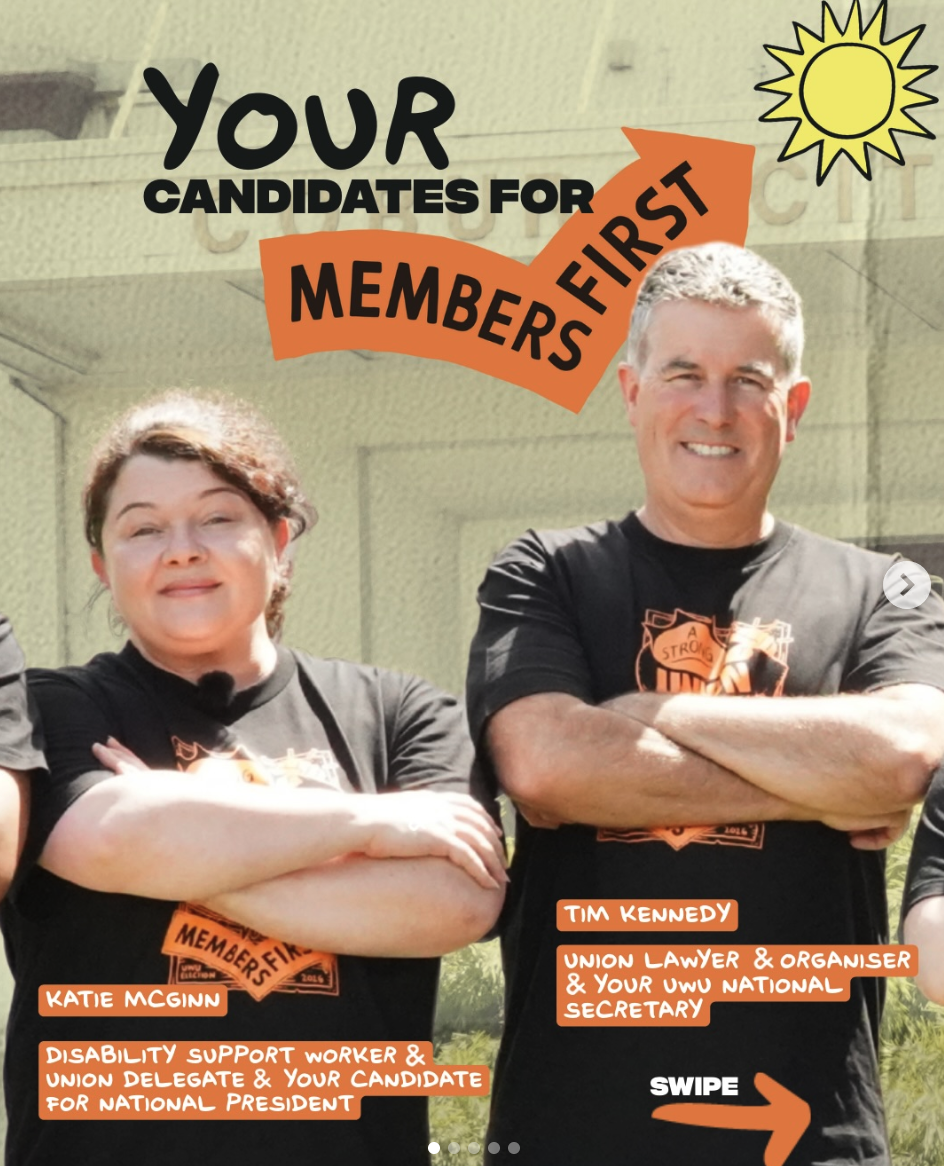
Members First looks like a rank-and-file ticket. But looks can be deceiving. For all its talk of the need to “put our union back in the hands of members” and the eye catching artwork of radical artist Sam Wallman, the resumes of Members First candidates tell a different story.
Katie McGinn is the Members First candidate for national president. McGinn currently works as a disability support worker in South Australia, a job she returned to after working as a UWU organiser for five years. Given her previous stint as a union organiser, talk of McGinn potentially becoming “the union’s first rank-and-file national president” is a touch disingenuous.
Tim Kennedy is the Members First candidate for national secretary. His long union career is downplayed by the ticket, which simply describes him as having spent “more than a decade in a national leadership role for the union”. Not only is Kennedy the UWU’s current national secretary. He is also the former general secretary of the National Union of Workers (NUW) and has been a serious player in the Labor Party right in Victoria for years.
Members First candidates for most other state secretary spots are also long-serving officials and organisers. Caterina Cinanni (Victoria) hails from the Victorian NUW and served as that union’s general president before it became part of the UWU. Cinanni is also the current second principal vice-president of the International Union of Food Workers (IUF). Louise Dillon (Western Australia) has worked for more than 20 years as an organiser with several unions, most recently with the Australian Medical Association and Professionals Australia. Claire Lewis (South Australia) started at the Victorian NUW around a decade ago, moving from inbound calls to organiser and union educator. Sajit Shakya (New South Wales) is a long-term UWU lead organiser from a United Voice background.
For all its talk of “transformational change”, the Members First platform outlines a list of quite moderate demands. The focus is on improving the UWU’s organising capacity with measures such as increased investment in organisers, more training for union staff, bringing delegate training in-house and more regional organisers and organising. Other pledges include the creation of a $1 million strike fund, a freeze on union fee rises and improved financial transparency. A dot point on “member-led politics” refers to the union’s support for the Labor Party not simply being a “blank cheque”, and not much else.
Modest democratic measures include the reintroduction of statewide and industry delegates conventions and the removal of union directors from the UWU’s member council (which just happens to target current director and political powerbroker Gary Bullock). These demands are all supportable in and of themselves. But they are far removed from anything resembling “transformational change”. It is the minimum workers should expect – and demand – of their unions.
United For You
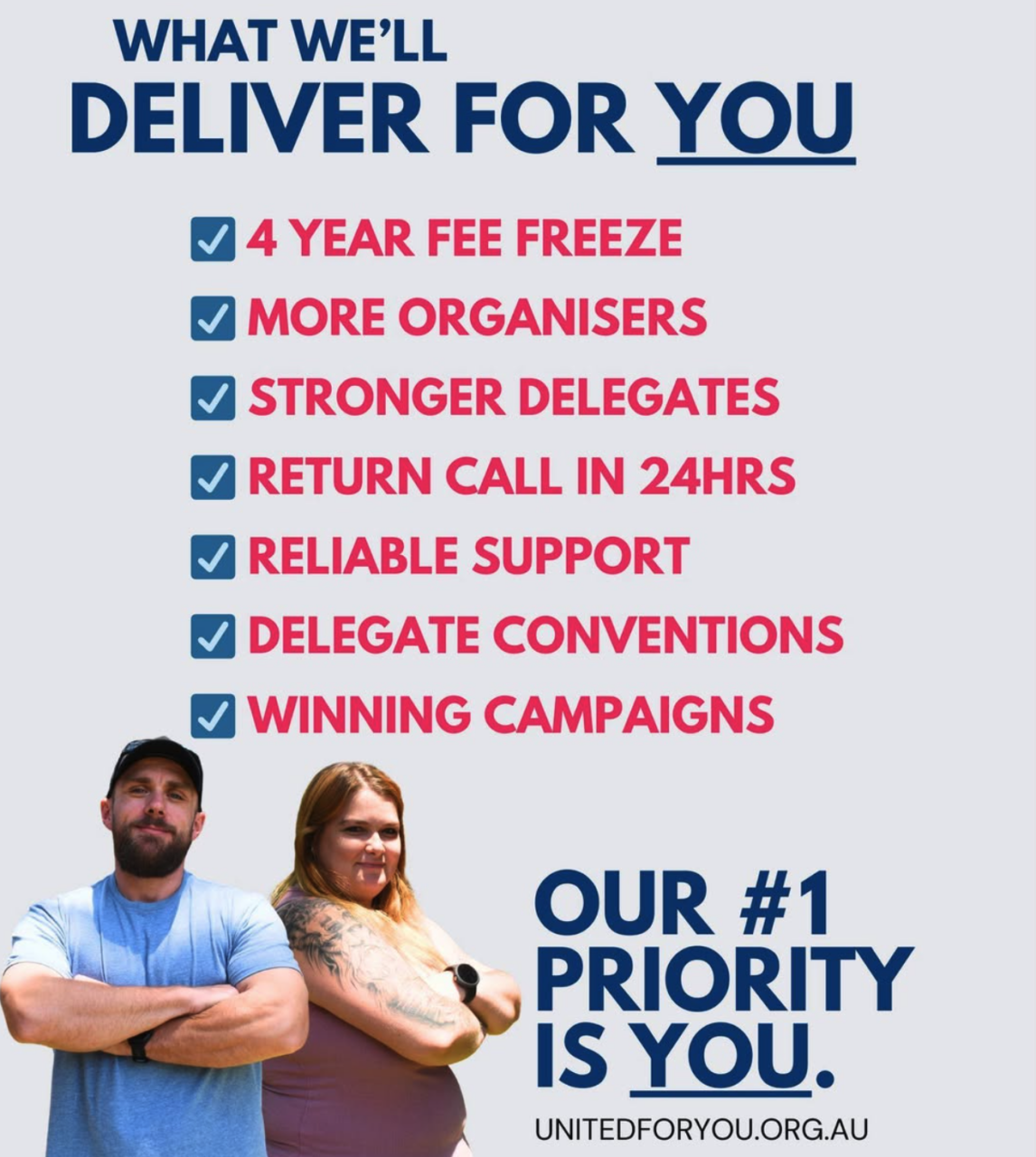
It’s all but impossible to confuse United For You with a rank-and-file ticket. Its overriding message is strong, stable leadership and steady-as-she-goes corporate unionism. The currently held positions of nearly all serving UWU officials are prominently displayed on its website, which also warns that “[g]etting wins for members isn’t about just getting angry. It’s about using every tool we have … and running campaigns that actually deliver results”.
The United For You ticket is a veritable who’s who of former United Voice (UV) national and state officials. In Western Australia there is left power broker and former UV state secretary Carolyn Smith and other former UV state officials. Former UV state secretary and political kingmaker Gary Bullock is running in Queensland. In South Australia there is former UV assistant national secretary Helen Gibbons and former UV state official Demi Pnevmatikos. In New South Wales the five lead candidates include the former national secretary, NSW branch secretary, ACT branch secretary and ACT branch vice-president of United Voice.
For all intents and purposes, United For You ticket is the ticket of the former United Voice leadership.
Industrial militancy is not enough
The Members First ticket is, with varying degrees of enthusiasm and criticism, supported by much of the far-left. Most prettify the use of industrial action by one section of the UWU, while pooh-poohing the reliance on political lobbying by the other. This not only ignores some of the very real results achieved by the former United Voice forces. It also highlights the militant economism that taints much of the far-left today.
Political lobbying has achieved real results for UWU members. In 2024, a sustained campaign by the UWU and other unions in the aged-care sector won wage rises of between 18 and 28%, a substantial win for around 200,000 poorly paid, predominantly female workers. A combination of a long-running work value case in the Fair Work Commission (FWC) and the securing of extra government funding sealed the deal.
More recently, hundreds of privately contracted school cleaners in NSW are being offered public sector jobs for the first time. These jobs are now being brought in-house after being contracted out for 30 years.
Industrial action has also achieved real results. The former NUW section of the union has seen workers in warehouses, distribution centres, poultry processing plants, dairies and the long-neglected farm sector take strike action and chalk up valuable wins (see a partial list here).
However, for much of the far-left it seems that “going out on the grass” is the only way that workers can win. But surely effective unionism is about using all the tools at hand, both industrial and political, to achieve change for working people. But for the far-left, striking is the strategy; the vehicle that magically conjures the class consciousness needed to trigger a general strike and an insurrection that will propel their small group to power. Fantasy politics.
Critics point to the UWU’s early childhood sector pay campaign as an example of what to expect under a United For You leadership. This campaign was brought to an end when UWU leaders cancelled the planned staff walkout on International Women’s Day in March 2024 and then settled for a 15% pay rise instead of 25%. But what they can’t explain is why they think the Members First leadership would act any differently. Any number of strikes in the union’s former NUW sector have been left isolated, quickly wound up and sold short by UWU officials. A verbal commitment to “put our union back in the hands of members” is simply no guarantee that similar campaigns and struggles won’t be undermined by a Members First-led union in the future.
Some on the far-left seem to equate industrial militancy with political radicalism. They shouldn’t. One example is provided by the NUW itself. The old union regularly combined militant strike action (particularly its NSW branch led its maverick leader Frank Belan) with the crassest manoeuvres within the Labor Party right.
Another example is provided by the Builders Labourers Federation (BLF), a union synonymous with militant industrial action. Having avoided de-registration in 1986, the Queensland and Western Australian branches of the BLF soon became serious factional players on the ALP right. BLF WA state secretary Kevin Reynolds cobbled together the so-called “Third Floor Alliance” with the Transport Workers Union (TWU), while BLF QLD leader David Hanna led the Labor Unity (“Old Guard”) faction and even did a stint as vice-president of the Queensland ALP. These two BLF branches proved that even industrial “Maoism” can co-exist with bog standard right-wing ALP factional manoeuvres.
And as previously outlined in Labor Tribune, Members First leader Tim Kennedy is a long-term player within the Victorian Labor right, was elected in 2015 to the Labor Party’s all-powerful National Executive and only missed out on reelection in December 2018 because of a split within the right.
At its heart, the support offered to the Members First ticket by much of the far-left is a reflection of the latter’s militant economism. In their eyes, as Members First seems more willing to engage in industrial action, it must be the better of the two UWU tickets. But neither the Members First ticket nor the United For You ticket have anything like the adequate industrial and political platform required.
Any movement to transform the trade union movement into a political movement against the state, must go hand-in-hand with the fight for a political party that can lead such a movement. Syndicalism alone cannot win the battle for socialism. Such a fight considers industrial and political tactics as just that: tactics. The far-left, however, generally seeks to elevate industrial action into the strategy, downplaying the importance of political intervention.
Despite the rhetoric, Members First and its promises of “transformational change” and the United For You ticket with its “clear vision” are not so different. The platforms of both tickets are a long way removed from what is required to take UWU members forward.
Such a platform could include the following points:
1. Overhaul the UWU’s Union Electorate system
The UWU’s current system of Union Electorates divides unionists working in the same workplace into different electorates. As a previous article has explained, this system atomises union members and dilutes worker power.
At the very minimum, Union Electorates must be based on where union members work, not where they live. While talk of statewide and industry delegates conventions is to be welcomed, the Union Electorate system needs to be replaced by one that unites workers by workplace, industry and city/region and allows them to vote for their industry, state and national leaderships on that basis.
2. Abolish the Fair Work Act
According to the International Labour Organization (ILO), the Fair Work Act breaches international labour standards and contains some of the severest restrictions on the right to strike of any industrialised country.
The Fair Work Act needs to be repealed, the right to strike guaranteed and all restrictions on pattern bargaining, secondary boycotts and other anti-labour provisions removed.
3. Wages must at least keep pace with inflation
The COVID-19 pandemic led to a spike in inflation, with the consumer price index (CPI) climbing to almost 8%. The US-Israeli attacks on Iran will likely lead to another spike. Wages should never fall behind inflation again.
All future UWU agreements must contain a cost-of-living clause that, at the very minimum, ensures that all wage rises are pegged to increases in CPI. The Labor government must also be pressured to legislate similar cost of living measures for all workers.
4. Union officials to earn no more than the wage of a skilled worker
Union officials should take home a wage in line with those of the workers they represent. Yet in the financial year ending June 2025, Kennedy earned over $286,000 and Schofield over $244,000. While UWU officials earn what are in effect executive salaries, around 400,000 early childhood educators, aged-care and home-care workers are lucky to earn between one quarter and one third of these figures.
5. Election of all UWU delegates to state and federal ALP conferences
The union bloc vote allows the UWU and other unions to wield influence at state and federal Labor Party conferences. The bloc vote is the preserve of union leaders, who handpick union delegations and ensure that they vote in whatever fashion the union leaders demand.
If “member-led politics” mean anything, it means giving union members the right to vote for who represents them at state and federal Labor Party conferences, and not leave that power in the hands of the union officials.
6. Bring childcare and aged care into the public sector
The government pumps more than $50 billion a year into the childcare and aged-care sectors. Yet large chunks of these sectors are privately owned and run for profit. Too many private providers penny pinch on feeding vulnerable children and the elderly and understaff their facilities at the same time as they rake in billions in profits, pay little or no corporate tax and gift their CEOs million dollar salaries.
The childcare and aged-care sectors need to be brought into public hands as a matter of urgency.
7. Peace is union business
The ongoing genocide in Gaza, the recent US-Israeli attack on Iran or Australia’s connections to Donald Trump, AUKUS and the US imperialist war machine are not so much as mentioned by either ticket. These questions don’t just concern the type of jobs that Australian workers do. Increasingly, they also question the very survival of the planet.
UWU leaders from both sides have done little in this regard. Kennedy did publically back the “courageous stand” of former UWU and Senator Fatima Payman in favour of the recognition of Palestine. But others have urged UWU staff not to attend pro-Palestine rallies outside the offices of Labor MPs, while the UWU and other unions on the “Albanese left” quietly boycotted last year’s Peace is Union Business conference.
Ensuring that “peace is union business” is not just in the best traditions of the union movement, it is also in the best interests of working people.