
Bob Sparks assesses the politics of the Communist Party of Greece and the Communist Party of Australia. While both are ‘official communist’ parties, their differences reveal deeper problems in the erstwhile ‘international communist movement’.
The Communist Party of Greece (KKE) and the Communist Party of Australia (CPA) held their respective national congresses earlier this year. While both “official communist” parties describe themselves as being “guided by Marxism-Leninism”, their conferences reached very different conclusions on crucial issues such as the current state of the official communist movement and the transition from capitalism to socialism.
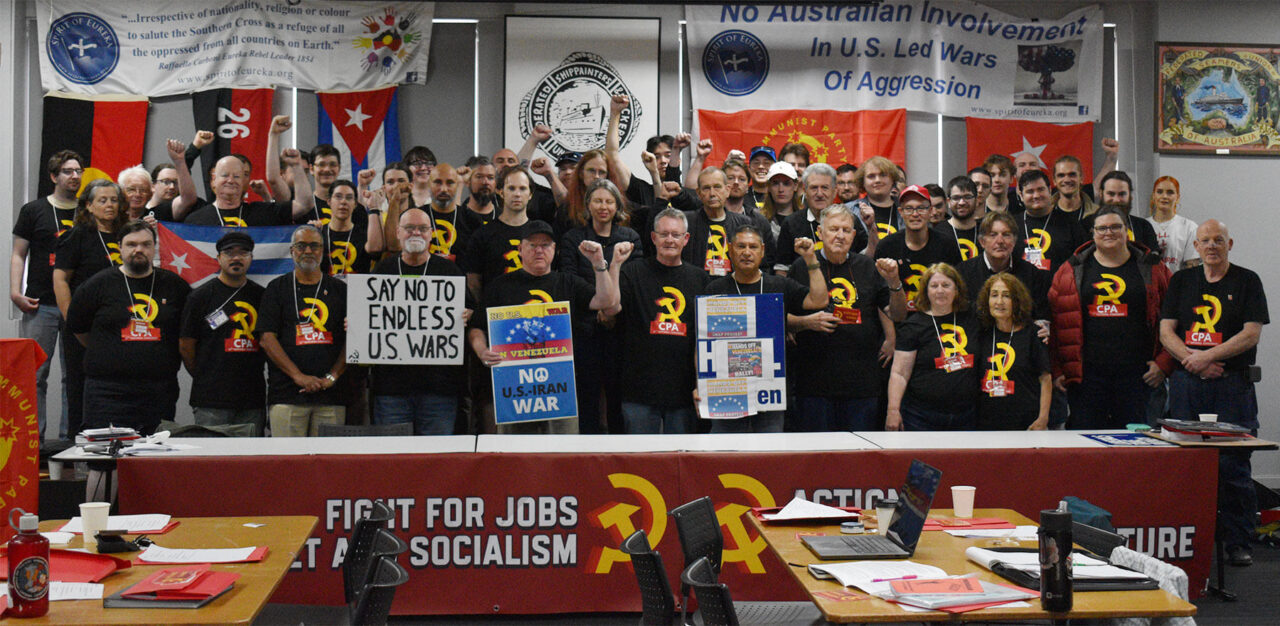
The Communist Party of Greece (KKE) launched its 22nd Congress in late January with a grand opening ceremony that filled the 6,000 Galatsi Olympic Hall in suburban Athens. One month later, the 15th National Congress of the Communist Party of Australia (CPA) brought together around 60 delegates and observers at the Victorian office of the Maritime Union of Australia (MUA) in West Melbourne.
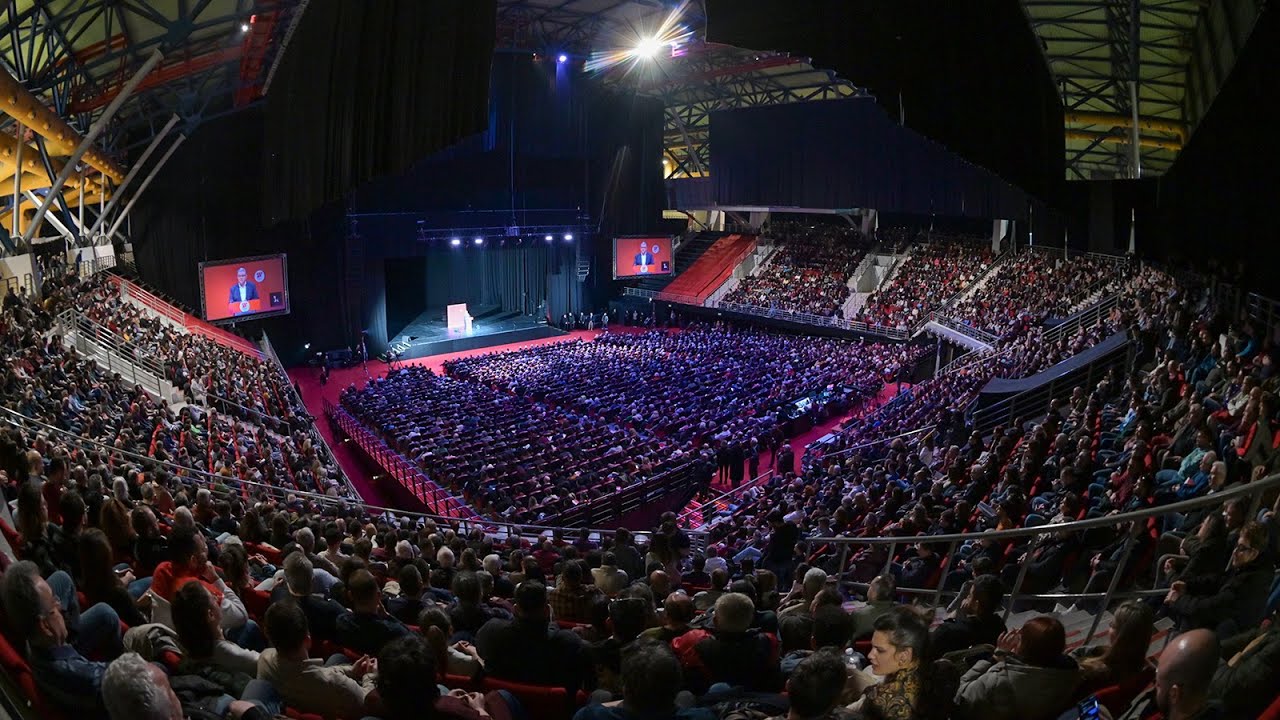
It is self evident that the KKE and CPA are quantitatively and qualitatively very different organisations. The KKE, despite being outlawed from the end of 1947 to 1974, was the hegemonic force within that country’s left for decades. The KKE weathered the storm of 1989-1991, when the demise of the Eastern Bloc and the party’s decision to join two short-lived coalition governments with the centre-right New Democracy triggered a series of mass resignations and purges. The party lost its general secretary, over a dozen central committee members, nearly half of its party membership and a large majority of its Communist Youth of Greece (KNE) youth organisation which the party was forced to rebuild almost from scratch. Yet the KKE managed to not only survive when other Communist Parties dissolved or transformed into social-democratic parties, but it continues to be a mass party with tens of thousands of members, elected deputies in the Greek and European parliaments and serious influence among the country’s broad working class vanguard.
Today’s CPA is a mere shadow of its original namesake. At its post-WWII peak, the old CPA had more than 20,000 members and controlled unions of coal miners, ironworkers, seafarers and waterside workers. But as wide-ranging as the CPA’s influence was, it was never able to break the Labor Party’s hegemonic influence over the organised working class. The CPA of today traces its origins to a minority of Moscow-line CPA members who formed the Socialist Party of Australia (SPA) in 1971 and then reclaimed the Communist Party of Australia label after the original CPA dissolved in 1991. The current CPA has just a few hundred members, barely a toehold in the labour movement and is forced to compete with a number of similarly sized Trotskyist groups for the allegiance of the newly radicalised.
In recent years, two small splits from the CPA have weakened it further and added the Australian Communist Party (ACP) and the New Communist Party of Australia (NCPA), the latter formed by mainly Greek and Cypriot communists, to the cluttered constellation of the far-left.
The KKE and CPA are not only very different organisations in terms of their size and influence. They also hold very different political positions on some critical questions in the international communist movement, as can be seen in the documents produced by the two parties’ respective conferences. The KKE’s 22nd Congress adopted a central committee report, an excerpt of which appears in English as “On the International Communist Movement”, while the CPA’s 15th National Congress adopted a Political Resolution which rests politically on the party’s Program last amended in 2017. These three documents provide a useful insight into the very different political positions held by these two “official communist” organisations.
The state of the international communist movement
When it comes to the state of the international communist movement, the KKE central committee report pulls no punches. The report argues that the official communist movement is in a state of ideological crisis.
“The International Communist Movement is facing a chronic and profound ideological, political, and organizational crisis. A significant number of Communist Parties … have been unable to draw conclusions regarding the programmatic causes of the counter-revolutionary overthrows [and] formulate their strategy accordingly – a strategy that reflects the contemporary needs of the class struggle, the struggle for socialist revolution, the overthrow of capitalism, and the construction of socialism-communism”.
The report continues: “This negative situation has had a catalytic effect on the International Meetings of Communist and Workers’ Parties (IMCWP), which were initiated by the KKE but have gradually lost momentum … They have increasingly become a space of intense, fruitless confrontations, recycling the crisis of the communist movement. At the same time, serious and unresolved operational problems remain, mainly of an ideological and political nature, especially following the outbreak of the imperialist war in Ukraine.”
The KKE should know. The party has for decades invested real resources into bringing Communist and Workers’ parties together. The KKE first initiated the formation of the International Meeting of Communist and Workers’ Parties (IMCWP) back in 1998 and hosted its first seven international meetings in Athens. The IMCWP, also known as the Solidarity Network (SolidNet), brings together a wide range of Communist Parties – both mass and minor – with several countries being represented by two, three or even four different communist organisations. For decades, IMCWP annual meetings have been fairly run-of-the-mill diplomatic affairs. Grey and predictable diplomatic internationalism rather than robust proletarian internationalism. But the war in Ukraine changed all that.
The 22nd meeting of the IMCWP held in Havana, Cuba in October 2022 produced two very different statements on the war in Ukraine. One statement promoted by groups of Russian and Ukrainian communists was essentially pro-Russian. This statement contained no criticism of Vladimir Putin and labelled the Russian invasion a “just anti-Fascist struggle”. The second statement supported by the KKE correctly described the conflict as an imperialist war which Communists should take no sides in and argued that it was “criminal for communists … to trail behind the governments of bourgeois countries and work for the interests of their national bourgeoisie”. The Final Declaration of the 22nd IMCWP meeting was a diplomatic fudge which refused to mention the deep divide among conference participants and skirted over the war in Ukraine.
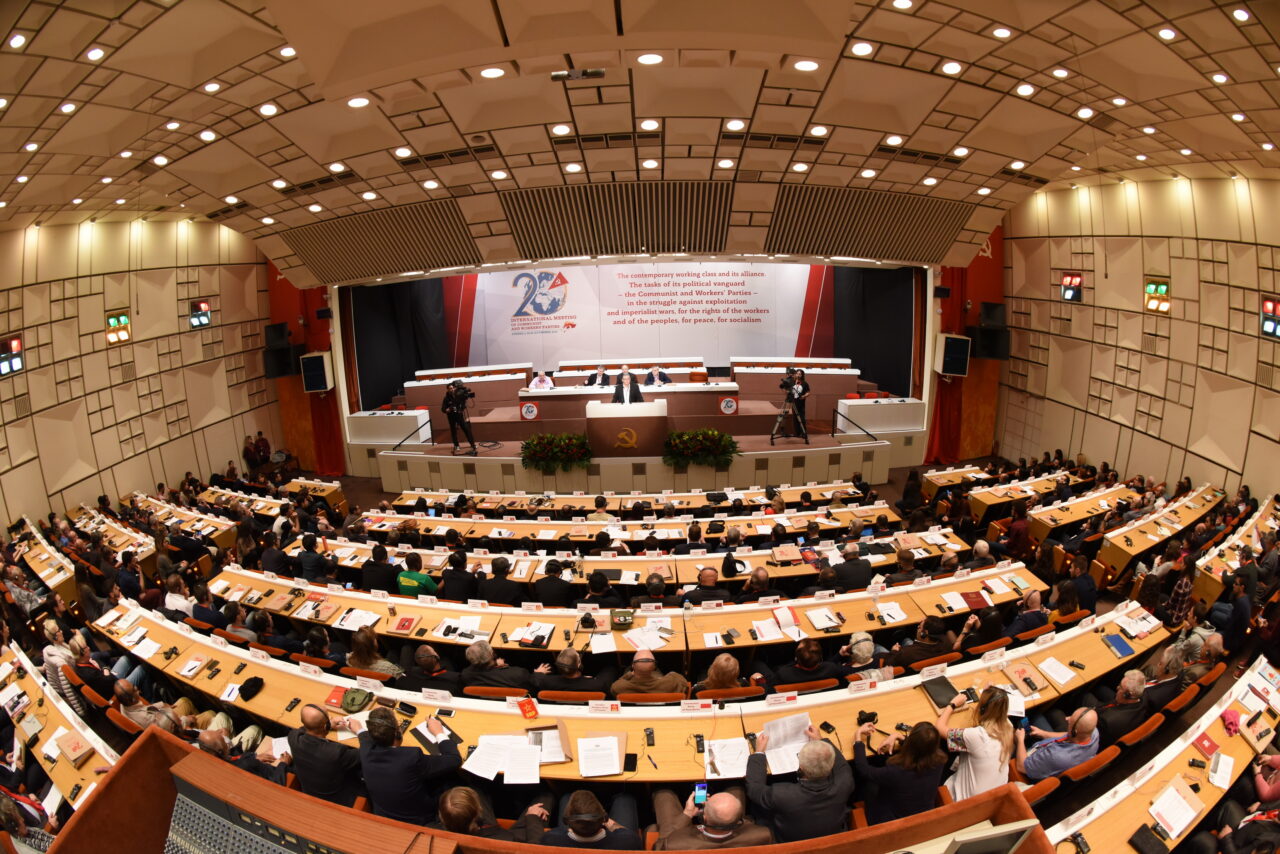
Of interest to readers in Australia, the CPA attended the 22nd IMCWP meeting in Havana but appears not to have signed either of the two statements dealing with the war in Ukraine.
Other KKE initiatives have run into similar problems caused by the war in Ukraine. In 2013 the KKE helped to form the European Communist Initiative (ECI) which brought together over two dozen communist parties from across Europe and Eurasia. However, the ECI was wound up in September 2023 after “important ideological and political differences” aggravated by the war in Ukraine created “insurmountable obstacles for the continuation of the ECI”. In November 2023 the ECI was replaced by European Communist Action (ECA) which unites the KKE with a smaller number of more ideologically aligned, but generally marginal, communist partners from across Europe.
The KKE was also the driving force behind the establishment of the International Communist Review (ICR) in 2009, the annual publication of which was interrupted in 2023 by the war in Ukraine. When the ICR reappeared in 2024, it carried an editorial which spoke of “a necessary recomposition of the journal” after “the outbreak of the imperialist war in Ukraine” which had “triggered an intense debate and the sharpening of the political confrontation in the ranks of the international communist movement and in the ranks of our journal”. The ICR’s new editorial board is made up of representatives from the KKE and smaller communist organisations from Spain, Turkey, Ukraine, Mexico and Venezuela.
The war in Ukraine has clearly led to an ideological crisis within the official communist movement. But for the Communist Party of Australia, this crisis either does not exist or the party refuses to acknowledge it. According to the CPA’s 2026 Political Resolution, “[m]ember parties of our fraternal group, the International Meeting of Communist and Workers’ Parties (IMCWP), are growing” with “[m]any forces in the IMCWP … experiencing moderate to rapid growth”. Not only that, but a “new International is emerging which is seeing renewed growth in Communist and Workers’ Parties around the world”. In the blinkered view of the CPA, the international communist movement is going along swimmingly.
China: capitalist or socialist?
The crisis within the official Communist movement is not the only issue the KKE and CPA don’t see eye to eye on. The two parties also have diametrically opposing views on the nature of the Chinese state.
For the KKE, China is now a capitalist state. Its congress document calls out those Communist Parties that have “abandoned fundamental communist principles” to become “supporters of Chinese capitalism”, falsely “equate the aspirations of the [Chinese] bourgeoisie … with the interests of the working class” and even see China as part of an imaginary “anti-imperialist axis”. For the KKE, this is nothing new. The party has referred to the “dominance of capitalist relations in China” since at least 2011.
On the other hand, the CPA holds that China is still a socialist state. According to the CPA Political Resolution, the “five countries [including China] that are led by communist and workers’ parties … continue to make strides in resisting the reactionary forces of the West and advancing the interests of their respective working class. China especially, has emerged as the world’s most dynamic major economy while seeking global peace and prosperity”.
It continues: “Socialism is a work-in-progress in these countries” which nevertheless “remain a beacon for social justice, holding high the banner of communism and the Communist Party, socialism in power, and Marxism-Leninism in the twenty-first century”.
The transition from capitalism to socialism
According to the KKE’s central committee report, the party appears to have empirically moved away from the old two-stage theory of revolution so emblematic of Stalinism, or ‘official communism’. The KKE report chastises other Communist Parties that “fail to interpret the character of our era – an era of transition from capitalism to socialism – and the character of the revolution as socialist in an objective manner. They remain stuck in the strategy of intermediate transitional stages within the framework of capitalism … and in chasing the chimera of “anti-imperialist”, “anti-monopoly”, “national liberation”, or other stages toward socialism”.
While the CPA’s latest Political Resolution does not refer to this question, the CPA Program certainly does. The latter states that the “CPA is of the view that society will change from its present capitalist mode of production toward socialism through a series of stages. We contend that society will progress through an anti-monopoly, anti-imperialist democratic stage prior to the working class winning power and creating a socialist state”. The Program goes on to identify an “anti-monopoly, anti-imperialist democratic government” as “the first stage of revolutionary change”.
The CPA’s stagism leads it to the non-Marxist idea that bourgeois parliaments can be democratised and transformed into institutions that can represent the will of society’s working class majority. In practice it leads to tail-ending the petty-bourgeois Greens party on most political questions.
The CPA Program argues: “With the victory [of an anti-monopoly, anti-imperialist democratic government], parliaments and councils could be transformed into institutions which … [express] the will of the overwhelming majority of the people and become, thereby, more democratic”, that this “new government would need to begin a process of democratization” which will make it “answerable to the people’s needs” and that “[a]mendments would have to be written into Federal and State constitutions” in order to do this.
The CPA’s concept of democratising and transforming bourgeois parliaments runs counter to the writings of Lenin and the early Communist International. In Lenin’s “The State and Revolution” (1917), he scathingly describes the parliamentarism of bourgeois society as “venal and rotten” and encapsulates its essence in the idea that “the oppressed are allowed once every few years to decide which particular representatives of the oppressing class shall represent and repress them in parliament”. For Lenin, the aim of Marxists is “not to “shift the balance of forces”, but to overthrow the bourgeoisie, to destroy bourgeois parliamentarism for a democratic republic after the type of the Commune, or a republic of Soviets of Workers’ and Soldiers’ Deputies” [emphasis in original].
The early Communist International was equally clear on the need to destroy bourgeois parliaments and replace them with organs of working class power. In 1920, the Second Congress of the Communist International drew up its “Theses on the Communist Parties and Parliamentarism” which states that “bourgeois parliaments, one of the most important apparatuses of the bourgeois state machine, cannot as such in the long run be taken over … The task of the proletariat consists in breaking up the bourgeois state machine, destroying it, and with it the parliamentary institutions, be they republican or a constitutional monarchy”. The Theses goes on to say that it is “no different with the local government institutions of the bourgeoisie … In reality they are similar apparatuses of the state machine of the bourgeoisie, which must be destroyed by the revolutionary proletariat”.
Joseph Stalin and Australia’s Path to Socialism
The CPA’s concept of democratising and transforming bourgeois parliaments can be traced back to Joseph Stalin himself, who introduced it to English-speaking Communist Parties back in the early 1950s.
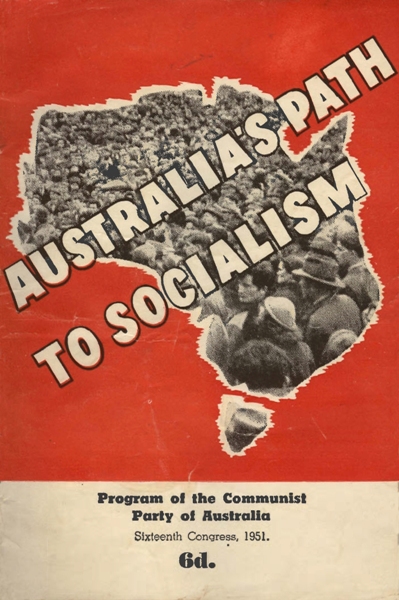
As Joe and John Pateman conclusively argue in “J.V. Stalin and The British Road to Socialism” (2021), it was Soviet dictator Joseph Stalin who argued for the program of the Communist Party of Great Britain (CPGB) to adopt the concept of the ‘parliamentary road to socialism’. The CPGB did just that when it published its new program The British Road to Socialism in January 1951. Other Communist Parties in the United States, Canada, Australia and New Zealand were encouraged to do likewise, which the CPA did when it adopted its new program Australia’s Path to Socialism in August 1951.
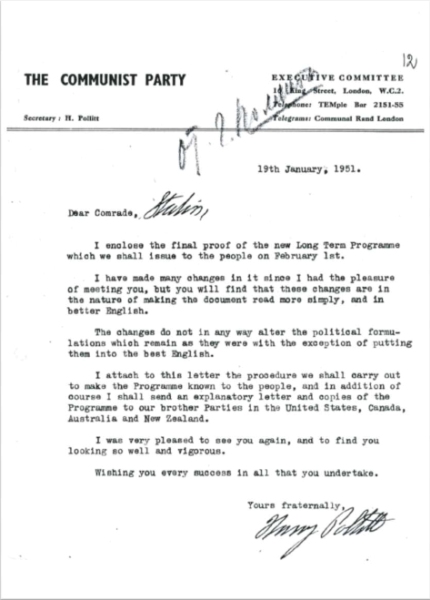
This shift began in 1950 with meetings and correspondence between Stalin and CPGB general secretary Harry Pollitt. For example, Stalin wrote in a letter to Pollitt dated 28 September 1950 that “it should be very clearly and definitely stated that the English Communists are not going to delegitimise Parliament, that England shall come to socialism through its own path and not through Soviet Power, but through Peoples’ Democracy that would be guided by peoples’ power and not by capitalists … The Communists must declare that this power shall act through the Parliament”.
The CPGB leadership soon codified this new outlook in The British Road to Socialism (January 1951): “The enemies of Communism accuse the Communist Party of aiming to introduce Soviet Power in Britain and abolish Parliament. This is a slanderous misrepresentation of our policy. […] British Communists declare that the people of Britain can transform capitalist democracy into a real People’s Democracy, transforming Parliament … into the democratic instrument of the will of the vast majority of her people”.
The CPA followed suit just months later. In Australia’s Path to Socialism, the program adopted by the CPA in August 1951, we read that with “real people’s political power and a people’s Government”, “[t]he machinery of State will be transformed and the agents of Collins House and B.H.P. in positions of authority in the civil service, police, judiciary and the armed forces will be replaced by determined and loyal supporters of the people’s power”, that parliament will be transformed “into a genuine instrument of the working people” and “filled by true representatives of the people’s movement … subject to recall at any time”.
First introduced by Stalin in 1950 and codified by the CPGB in 1951, the non-Marxist idea that bourgeois parliaments can be democratised and transformed into institutions that can represent the will of the working class majority has been a constant in the programs of not only the original “revisionist” CPA, but also the “anti-revisionist” SPA and its rebadged CPA successor today.
The KKE may have empirically shifted away from Stalinism’s traditional stages theory of revolution, but it would baulk at the idea that it was Stalin himself that introduced the idea of a ‘parliamentary road to socialism’ into the communist movement in the early 1950s. There is clearly much to admire about the KKE, but it is very much a Stalinist party and a particularly sectarian, dogmatic and isolationist one at that.
KKE’s ‘go-it-alone’ sectarianism
One of the KKE’s most damaging acts of sectarianism was its abstentionist approach to the July 2015 Greek bailout referendum. The party called for a ‘blank vote’ in the referendum on whether to accept or reject the austerity measures set by the “Troika” (the European Commission, the European Central Bank and the IMF) as part of the deal to bail out the debt-ridden Greek government. The left-wing, anti-austerity SYRIZA government elected earlier that year called the referendum and (half-heartedly) campaigned for a ‘No’ vote i.e. for the rejection of the bailout’s austerity measures. A largely spontaneous movement for a ‘No’ vote blossomed with massive demonstrations, local committees and neighbourhood assemblies – and won 61 percent of the vote in the referendum. Yet just days after this victory, the SYRIZA government reached a bailout deal with the Troika that contained even harsher austerity measures than the original.
The KKE’s decision to call for a ‘blank vote’ in the referendum put the party on the side lines of a decisive battle. Some have suggested that the reason the KKE abstained was that it “feared that a ‘No’ outcome would jeopardise their position on the far-left of the ideological spectrum and lead to the ideological hegemony of SYRIZA”. Whatever the reason, it’s clear that in “[r]efusing to co-lead the No forces, the KKE shied away from joining the social struggle that arose between the working class and the petty bourgeois strata on the one hand … and the upper classes on the other”.
This decision fits the KKE pattern of generally avoiding common action with others on the political left. During the war in Iraq in 2003, the party held antiwar demonstrations that were completely separate from other forces opposing the war. This isolationist practice continues today, with the KKE regularly calling its own separate pro-Palestine and anti-war rallies in the name of its various labour, women’s and peace campaign fronts.
The KKE takes a similar separatist, sectarian approach in the labor movement. The KKE-led trade union front, the All Workers Militant Front (PAME), has serious influence in the two main union federations, the private sector GSEE and the public sector ADEDY. In the last year, PAME-led coalitions increased their representation on both federation’s leadership bodies to 26.5 percent for the GSEE and 25 percent for the ADEDY. Yet time and again, PAME insists on organising rallies and strikes that are totally separate from those of the GSEE and ADEDY. As recently as May Day 2026, Athens saw the GSEE and ADEDY hold a joint rally in Klafthmonos Square while the PAME held its own rally starting 30 minutes earlier at Syntagma Square, less than one kilometer away from the GSEE-ADEDY rally.
Along with its often separatist, sectarian approach, the KKE also holds conservative and almost puritanical positions on a range of social questions. The party’s commitment to ‘traditional values’ has seen its deputies vote against same-sex marriage bills in 2015 and 2024 and its vehement opposition to all drug use and the legalisation of drugs.
For the working class in the twenty-first century to develop a new program and a new internationalist movement to overthrow capitalism and destroy imperialist militarism, we need to study the failures and successes of the official communist movement. We cannot simply ignore ‘Stalinism’, despite its many, many errors – and indeed crimes. The mass communist parties of the last century show that we can rebuild the mass idea that a democratic and socialist society beyond capitalism is not only needed – but possible.