

With One Nation on the rise and immigration under scrutiny, David Lockwood says the working class must fight national chauvinism and racist scapegoating.

The Labor Party’s Draft National Platform (for the national conference in July) is a singularly colourless document. It does not take up important national debates. Instead, it paints a picture of a calm and serious Australia, united behind a calm and serious government, addressing policy questions in a calm and serious – and uncontroversial – way. There is no attempt to argue for policy in the interests of the labour movement. Or to argue against its opponents.
Take immigration, for example.[1] The Draft National Platform confirms that immigration is Good Thing for Australia’s economy and its diversity. Permanent immigration is better than temporary migration. Immigration numbers should correspond to economic need. We’re against people smuggling.
And that’s it really. One advantage of this vague sort of approach is that it dispenses with the need for any real policy (something as vulgar as numbers for example – or even an admission that numbers are impossible to predict). This in turn gives a future Labor government as much flexibility as possible to do anything, or nothing. (This is a criticism that could be levelled at the platform as a whole.)
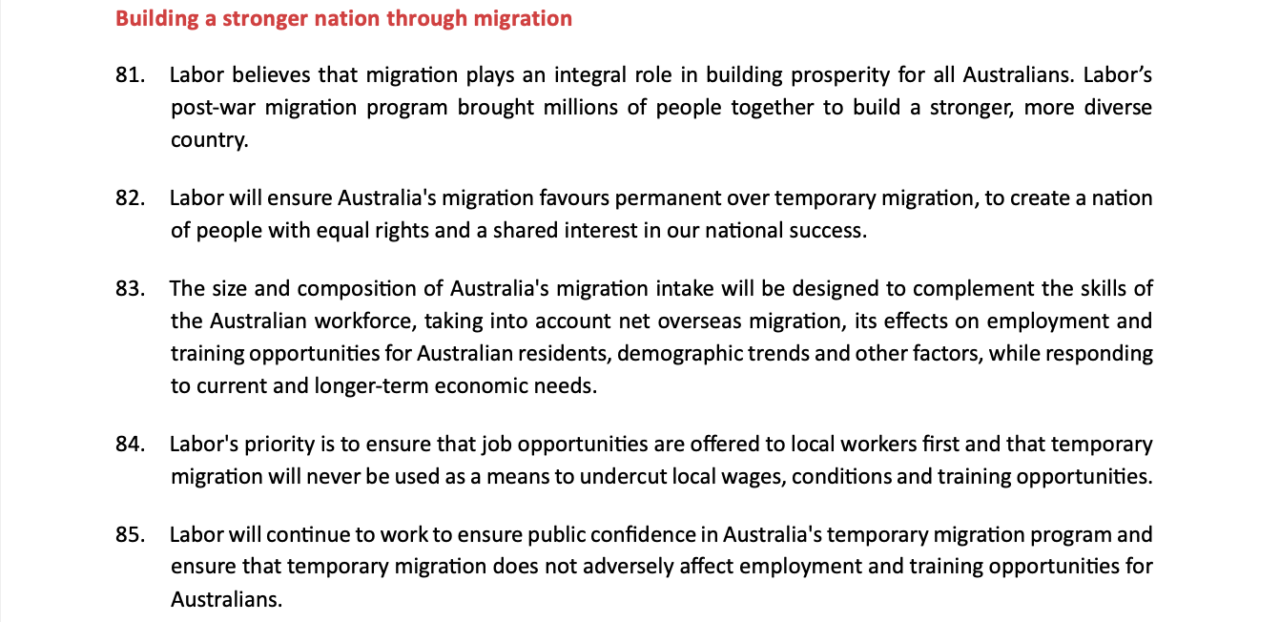
The National Platform shuts its eyes to the debate on immigration in Australia and to the competing positions of its political rivals in that debate. Far less does it attempt to take them on.
Yet that debate is all around us – signposted most recently by the ‘surge’ in support for One Nation and Angus Taylor’s imprecations against immigrants from ‘bad countries’ last month. Immigration will be a central issue at the next federal election. If the National Platform is anything to go by, Labor will be entering the lists with a weapon which is insipid, to say the least.
Immigration fell sharply during the COVID pandemic. It then moved sharply back to its previous levels. It is now dropping again. The intake of permanent immigrants has been capped at around 185,000 a year for the last decade or so. For 2025-26, it is made up of 132,200 skilled and 52,500 family reunion immigrants, plus a humanitarian intake of 20,000.
The issue of temporary visas is more flexible. In 2024-25, 363,000 immigrants entered on temporary visas (down from 458,000 the previous year). Temporary visas now dominate the immigration programme, largely due to the policies of past Coalition governments. The Labor government has tightened up the temporary system. (Patrick Commins, ‘Do as I say’, Guardian Australia, 30 November 2025.)
Capitalism needs migrants
The debate over immigration takes place at three levels in Australia. From the top downwards, the first of these circulates around the needs of Australian capitalism. This is expressed in its purest form by the Business Council of Australia (BCA), which tells us “Australia needs an efficient and well-functioning skilled immigration program as part of a long-term economic strategy to increase prosperity for all Australians”. To this end, the BCA is strongly in favour of an immigration system planned according to the needs of Australian capital, organised along non-discriminatory lines (except in terms of skill) and controlled by the state. Within that framework, it calls for an intake of permanent immigrants of 190,000 a year and looks forward to a population of 36 million by 2050. (This necessitates immigration because natural population increase won’t do the job.) (Submission on the Department of Immigration and Border Protection Proposal Paper, February 2025; BCA, The Value of Skilled Migration to Australia, January 2026.)
The BCA does not trouble itself with the problems that mass immigration may entail, nor with its effect on the existing population. In its January 2026 submission to the Joint Standing Committee, it devoted a scant one page to ‘Infrastructure, Housing and Population Policy’. This is largely an endorsement of current government schemes, which are woefully inadequate.
It is at this level of the debate that the Labor government and leadership feel most comfortable. A smoothly operating immigration system that clicks neatly with an operating capitalist economy. This is what the National Platform reflects. The Labor leadership is confined to immigration that suits the needs of capitalism because to do otherwise – to advocate the free movement of labour for example – would be to challenge capital’s control over workers. The platform therefore advocates nothing but the status quo – no improvement, no aspiration for something better. And no struggle against the advocates of something worse.
Which brings us to the other two levels of debate.
The second level is the general ‘common sense’ attitude of many Australians that there are ‘too many immigrants’. (This probably dates from the arrival of the Second Fleet in 1790.) Recent polling by the Lowy Institute indicates that 53% of Australians view the total number of immigrants is too high (although 45% thought is was about right or too low). From this proceeds the ‘blame the immigrants’ approach to domestic economic and infrastructural problems: cost of living, stagnant wages, housing, crowded transport and so on and on. This addresses (but blames the wrong people for) real problems, some of which could be alleviated even under capitalism by changes in government spending priorities. Abolishing the Australian Defence Force for a democratic citizen army and taxing multinational corporations come to mind. But we will find none of this – and no recognition of the problem – in the Draft National Platform.
Which, unfortunately, is where One Nation comes in.
Eschewing the comforting graphs of the BCA and the management-speak of the ALP leadership, One Nation plunges straight into what many consider is the heart of the matter. “Australia’s immigration system is broken”, they tell us, which means “our population has surged past 27 million”. This is now “overwhelming housing, infrastructure and essential services”. It has also led to wage stagnation, an end to home ownership and competition with cheap foreign labour.
The solution? Deport 75,000 ‘illegal’ immigrants, cut immigration from current levels and conduct a harsh administrative tightening-up of the system (rorts, student loopholes, no refugees from ‘extremist’ nations, withdraw from UN Refugee Convention and so on).
One Nation demonises immigrants (and refugees) and its solutions are a combination of the reactionary and the bizarre. But the problems that One Nation raises – housing, declining social services, wages – are real enough. The Draft National Platform ignores them at the Labor Party’s peril. It should acknowledge that problems exist and confront One Nation’s (non)solutions to those problems with its own. Immigrants and immigration are not to blame – the priorities of a system base on profit and a world divided into hostile national states are.
National chauvinism and racism
The third level of debate is the one that involves racism – currently against Muslims (previously Asians). Those that oppose immigration on these grounds do so on the basis that Muslims (and others) will not assimilate and are, in any case, inherently dangerous people who threaten our way of life. Once again, One Nation is to the fore, from Hanson’s maiden speech in 1996 (“I believe we are in danger of being swamped by Asians”) to a call to ban Muslim immigrants 20 years later (“a culture and ideology that is incompatible with our own”).[2]
The Liberal Party has also dipped its toe into this fetid swamp. In March, Angus Taylor announced a ‘values-based’ immigration policy. He asserted that immigration numbers have to be reduced “to protect our way of life – and to restore Australia’s standard of living”. As usual, how the former would produce the latter was not explained. But Taylor was clear that the reduction should be a judgement on the suitability of immigrants on the basis of their beliefs and the use of that judgement as a control mechanism. While this has some racist application, its ideological driving force is nationalism and national chauvinism: if you assimilate to ‘our’ values and behave yourselves, we don’t care what colour you are, is the thinking here.
If that immigration control is not done, Taylor argued, then “our door will be opened to migrants of subversive intent”. And the Opposition Leader knows where they come from. He said: “Those who migrate from liberal democracies have a greater likelihood of subscribing to Australian values compared to those migrating from places ruled by fundamentalists, extremists, and dictators.” The racist dog-whistle to exclude Arabs and Muslims from the Middle East was clear, but the door seems open to immigrants from India, Indonesia, the Philippines.
But the authors of the Draft National Platform and the leadership that has approved it float above the debate on immigration. They do not dirty their hands with the actual issues which many, however mistakenly, see as linked to the numbers of immigrants. The Labor platform should confront this – by tackling these arguments and linking this to radical socialist proposals in the health, transport and services sections.
More is required. Much more.
Migration, by choice or enforced by privation or war is a global problem under capitalism which demands global solutions.
Naturally, what this debate avoids completely is that immigration and migration are completely normal human activities. Humans have been migrating for hundreds of thousands of years since we emerged from Africa to occupy almost all the world’s land mass (to varying densities).
For a world of free and open migration for all
As capitalism has created a truly global market, it has accelerated human migration exponentially. Given capitalism’s central contradictions of being a global and socialised mode of production based on the private accumulation of wealth, the migration ‘problem’ cannot be solved by hostile national states intent on keeping their own populations locked up and other populations excluded.
As well as taking on the national chauvinists and the outright racists, the Labor Party should at the very least aspire to the movement of labour not being subject to the whims of global and national capital.
Migration will continue – and that is a good thing. We favour the emergence of a truly human global culture based on mutual solidarity. And that is why we favour a world of free and open migration for all.
As a minimum towards achieving this global aim, the Labor Party should support the unrestricted right to emigrate and the right to immigrate. All migrants and refugees to Australia should receive citizenship after six months. Immigrant labour should not be scapegoated by racists or the capitalist class. All immigrants should be employed at trade union rates and integrated into the workers’ movement. The Party should also demand the closure of offshore and onshore detention camps and fight for democratic integration of all migrants, for their right to learn English, and their right to use community languages.
[1] There is a terminological twist here, which is worth noting. The Labor Party no longer refers to ‘immigrants’, but only to ‘migrants’. As far as I’m aware, ‘migrant’ means someone who moves around, but has yet to find a final destination. ‘Immigrant’ means a person who goes somewhere with the object of residing there permanently. The designation of immigrants to Australia as ‘migrants’ may reflect capital’s desire for an infinitely flexible workforce with no permanent destination. But I may be overthinking this. Anyway, in this article I shall call immigrants immigrants.
[2] There is however no mention of it on the ON Immigration policy webpage.