

The Enhanced Games reveal the fusion of capital-technology-science in the 21st century, write Jack Hynes and Thomas Heenan.
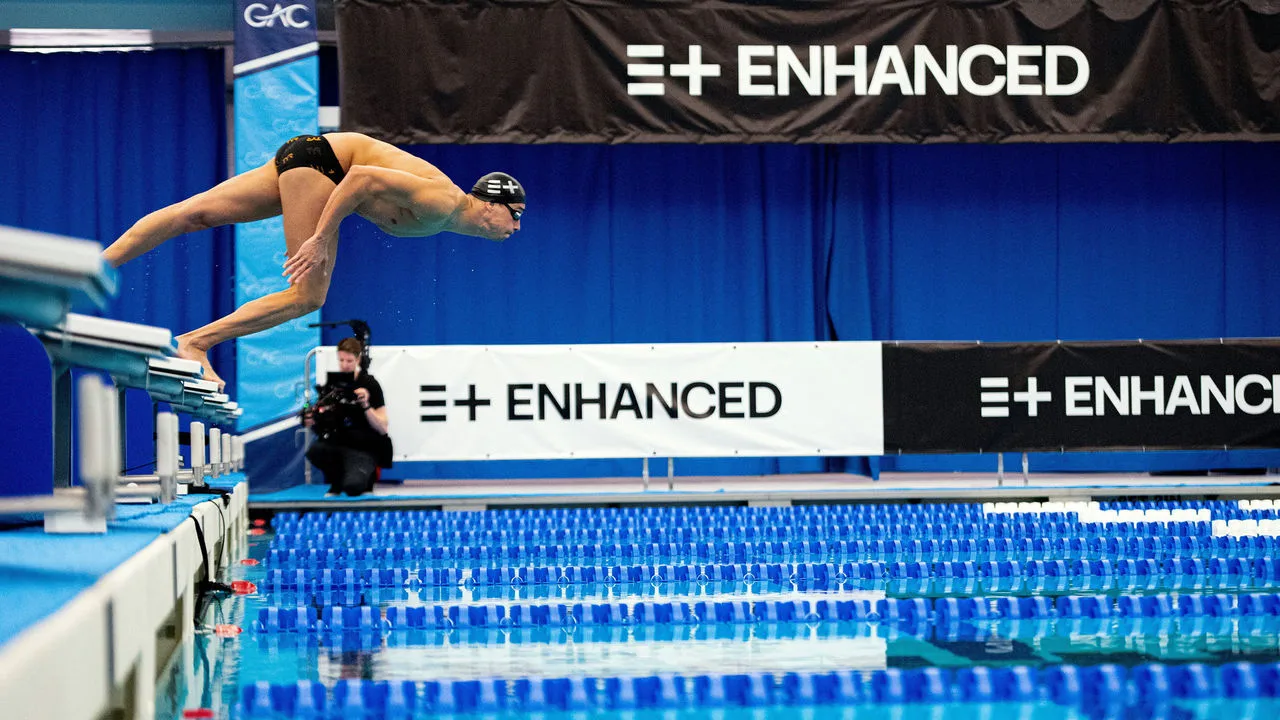
The idea of a future society where techno-scientific capitalism re-engineers society on biological lines is not new. It has been explored in science-fiction films like Gattaca (1997) and Elysium (2013). But the Enhanced Games, which are taking place in late May in the home of infinite possibilities, Las Vegas, may bring this sci-fi scenario closer to a dystopian reality.
The Enhanced Games have been touted as an alternative to the Olympics. Athletes will push the limits of human possibilities to break as many records as possible across weightlifting, track and field, and swimming. In contrast to the Olympics, Enhanced Games athletes will not be prohibited from taking performance-enhancing drugs listed by the World Anti-Doping Agency (WADA).
The Enhanced Games are the brainchild of Australian capitalist Aron D’Souza. He is a graduate of Monash, Melbourne and Oxford universities, and an entrepreneur with dizzying visions and enough high-tech connections to realise them. Now enmeshed with Silicon Valley’s elites, where reactionary thought-bubbles spread like contagion, D’Souza founded the Enhanced Games to explore the limits of human achievement. For D’Souza they are less about sport, or even money, and more about ushering in a new Promethean era in which science and technology, via a totally deregulated market, will unleash human potential and create boundless biological and social transformations.
D’Souza views ageing as a disease and believes with a quasi-religious zeal that science and technology will reverse it. The Enhanced Games are the initial stage in his quest for an ageless, superhuman nirvana. As he explains: “Our stated goal is to bring mankind (sic) into an age of superhumanity, where our biology is no longer our limit.” He is critical of the Olympics and the anti-doping regulations that stop athletes from achieving their ‘fullest potential’. With the Olympics beset by financial and environmental costs, infringements on civil liberties and all-to-numerous doping scandals, D’Souza’s Enhanced Games come at opportune time and with significant backing from venture capitalists who share his vision.
No longer is the Olympian goal of faster, higher, stronger good enough. D’Souza wants to challenge the Olympian gods by pushing human potential to attain techno-scientific perfection.
As nutty as D’Souza’s vision seems, he may have a point. The Olympics and sport in general have been tainted by doping. As the Lance Armstrong case in cycling highlighted, the peloton has consistently doped. Athletes in the old East Germany were subjected to a state-sponsored doping program. Sprinter, Ben Johnson, and his fellow dopers provided one of the greatest sub-10-second moments in sporting history at the 1988 Seoul Olympics. Johnson may have been ‘on the juice’, but like Armstrong, he gave us a moment of near perfection. It may have been ‘the dirtiest race in history’ but it was still 10 seconds to savor. D’Souza’s Enhanced Games offer the possibility of more of these envelope-pushing moments, albeit in a supposedly strict, medically controlled environment and supported by some of the astute minds in sport.
He argues that his Games offer greater certainty and integrity than the Olympics, and elite sport in general, where dopers have been ahead of anti-doping authorities. But is there more to D’Souza’s vision than meets the eye?
For starters, D’Souza is challenging the traditional ethos of sport. His Games are not about muscular Christianity and ‘fair play’. Instead, they are a bio-tech, libertarian experiment that broaches the wider question of what it is to be human in late-capitalist sport and society. His starting point is the Olympic Games. Whereas the Olympic movement’s founding father, Baron Pierre de Coubertin, sought the moral improvement of humanity through the discipline of sport, the libertarian, boundary-pushing D’Souza wants to transcend such constraints.
Science and technology, he believes, promise a future where humans can manipulate nature and select traits to enhance their physical and mental capacities and advance the species. Hence, he compares his Enhanced Games to the Moon landing, with gene-edited athletes, fine-tuned to achieve their full physical potential, reaching for the sporting stars in the not-too-distant future. But this is only the beginning. As techno-science shifts from a mastery over the external world towards the reconstitution of human life, capitalism will re-engineer the class structure along genetic lines, producing superhumans who will replace and control “human 1.0”, as D’Souza puts it.
This is dizzying stuff, moving sport beyond the Olympic movement’s more modest goals of faster, higher, stronger. But will the Enhanced Games prove to be the historic rupture in the organisation of global sport, or just another billionaire’s ‘life on Mars-type’ folly?
The Enhanced Games will be held at Las Vegas’s Resorts World on 24 May with more than 40 athletes competing. Vegas was built on mobster money, gambling and entertainment, and the belief that anything was possible. It has diversified its economy into sport after the global financial crisis and is now home to NFL and NHL teams, hosted the 2024 Super Bowl, and has a US$1.9 billion, state-of-the-art stadium a short walk from the Strip. The Australian National Rugby League competition now kicks off its season in Las Vegas each year.
This transformation of Las Vegas is indicative of broader cultural shifts in the United States. Legal restrictions have been loosened. Previously prohibited sports betting, which stigmatised Vegas in the eyes of major sport leagues, have been lifted. The combination of sport, gambling, entertainment and garish spectacle has solidified Las Vegas’s reputation as a tourism hot-spot for capital investment and a playground sold on fantasies of infinite pleasures without moral constraints. What happens in Vegas, stays in Vegas is the moral code underlying this ethos.
Las Vegas seems well suited to host D’Souza’s fantasy, even if most spectators will view the Games in a digitally repackaged, commodified form.
Advocates of the Enhanced Games claim that it will unleash human potential and provide the scientific stimulus to break world records. Former Olympic swimmer, Kristian Gkolomeev, became one of Enhanced Games’ early success stories, breaking the 50-metre freestyle world record time of 20.89 seconds last February. For his scientifically ‘souped-up’ swim, he received US$1 million from the Games’ organisers, far more than the estimated US$200,000 he earned during his 14-year professional career, including four Olympic competitions. At the Paris 2024 Olympics, he swam the 50-metre freestyle in 21.59 seconds, narrowly missing out on the podium. But he suspected that the Olympics was not a level playing field, especially after 23 Chinese swimmers tested positive for a banned substance ahead of the 2021 Tokyo Olympics.
All were subsequently cleared by the WADA and several went on to win gold medals at the Tokyo Olympics. In November 2024, Gkolomeev signed up for the Enhanced Games. Under medical supervision, he found that the use of steroid hormones, metabolic regulators and Food and Drug Administration (FDA) approved growth hormones allowed him to train more intensely and assisted his recovery between sessions. As his world record was assisted by banned substances, it is not recognised and he now faces banishment from officially sanctioned swimming competitions.
Sporting organisations across the world have roundly condemned the Enhanced Games and the athletes who have indicated they will participate. Nonetheless, sport fans have shown that they are willing to watch doped sport. Writing in The Conversation, Byron Hyde suggests that fans are willing to suspend judgement on the risks to athlete’s health if the sporting ‘content’ is entertaining. Hyde draws a parallel with boxing in which long-term health risks from head blows are considered legitimate. He argues:
“The moral panic about chemical enhancement seems inconsistent with society’s silence about the proven harms in so many of the sports people already love.”
Byron Hyde
Through disavowing all responsibility for the health and wellbeing of competitors, the fans, sporting organisations and critics of the Enhanced Games absolve themselves of complicity and responsibility. Therefore, he asks, why not have open and transparent assessments of the potential harm to athletes, and evaluate whether the benefits justify the risks?
Hyde’s argument aligns with D’Souza’s mobilisation of individual choice and bodily autonomy to justify the use of performance enhancing drugs. In a 2025 interview with podcaster Joe Rogan, D’Souza explained that “it comes down to a fundamental philosophical question: shouldn’t an individual with free and informed consent – an adult – be able to make choices about their own body?” But as Richard King relates in his book Here Be Monsters (2023), this proposition is simplistic and inhuman. Such libertarian framings, according to King, foreclose deeper questions about the effects of new technologies on fundamental aspects of what it is to be human.
The Enhanced Games is not about sport. The athletes are simply lab-rats in an ahuman, techno-scientific capitalist experiment. At the Enhanced Games’ First Conference on Human Enhancement in 2024 ageing was viewed as a disease, while performance enhancing medicines and anti-ageing technologies were touted as economic drivers.
The coupling of capitalism, anti-ageing and performance enhancement is telling. The Enhanced Games should be viewed as a platform for marketing a range of anti-ageing and longevity products. Already ‘Enhanced Longevity Tailored to You’ flashes across the top of the products page on the Games website. Below it is a range of advertisements for testosterone and hormone therapies, NAD+, sermorelin, and other products designed to help consumers live an “enhanced life” by working harder, living longer and looking younger. Such advertisements tap into popular fantasies of immortality and transcend the messy material realities of everyday life and death.
Humans will become more machine-like as they merge with technologies that are sold as extensions of their eternally ageless selves. Silicon Valley’s tech-head elites will profit immensely as humans are technologically re-engineered to fit into the dominant structures of high-tech capitalism and its transhumanist visionaries.
As D’Souza explained, in his new transhumanist society, “nothing will improve productivity … more than preventing ageing”. The Enhanced Games is the start of a century-long project which sells the simplistic promise of scientifically induced enhancements and agelessness for a future dystopia in which the human body becomes infinitely more malleable, if not ultimately expendable.
The athletes are vulnerable guinea pigs in this transhumanist experiment. Seemingly, all desire to perform at their very best and will do anything to make it happen. But they are the launch pads in a pharmacological and genetic arms race that the Harvard philosopher, Michael Sandel, suggests will not only re-engineer humans with no biological limit, but will also distort the joy, humility and social solidarity of sport which must be kept within moral confines.
“There is something unsettling about the spectre of genetically altered athletes lifting SUVs or hitting 650-foot home runs or running a three-minute mile.” he noted in The Case Against Perfection; Ethics in the Age of Genetic Engineering (2007). Once we accept the achievements of D’Souza’s genetically modified athletes, our admiration for sport performance will shift from the athlete to the scientific-capitalist elite who re-engineered the athlete’s body, mind and soul. This descent into a biologically induced spectacle requires deep reflection on the conditions and developments within contemporary sport and high-tech capitalism that have pushed us towards this Promethean future.
As Sandel notes, we must critically reflect on what we value as being human and organise society in ways that accommodate human imperfections. The Enhanced Games, with its fusion of capital and techno-scientifically re-engineered athletes, ignores these imperfections in its downstream quest for bodily transcendence. In doing so, the Games will strip sport of its human and creative essences.
Sport history suggests that money and geopolitical competition provide the structural incentives for producing the very superhumans D’Souza dreams of. He has courted the MAGA (Make America Great Again) movement and tech-head billionaires like the venture capitalist and founder of PayPal and Plantier, Peter Thiel. Donald Trump Jnr has also invested in the Enhanced Games through his association with the venture capitalist firm, 1789 Capital Management.
Trump Jnr has praised the Enhanced Games, declaring they are “about excellence, innovation and American dominance on the world stage – something the MAGA movement is all about”. No doubt Trump Jnr’s American exceptionalist views are shared by the anti-ageing advocate and US Secretary of Health, Robert Kennedy Jnr.
This high-powered support occurs at a time when the Trump administration has since 2024 withheld its annual US$3.6 million payments to WADA because of the latter’s decision to rescind bans on the 23 Chinese swimmers of doping in 2021.
All this suggests both an ahuman and amoral shift in sport funded by high-tech venture capitalists with tacit support from the Trump administration. This movement seeks to challenge the traditional order that has governed world sport and replace it with its libertarian, market-driven, dope-enhanced games.
One of Trump’s admirers, the venture capitalist and biotech entrepreneur, Christian Angermeyer, has invested in the Games. He suggests that ultimately the consumer will decide the future of sport. Angermeyer’s reductionist banality masks the Enhanced Games’ real purpose: a future techno-scientific dystopia that will extend the commodification and rationalisation of human bodies to promote disembodied ways of life and reconstitute people as atomised consumers. This fantasy that technological and scientific advancement is the central marker of human progress will only intensify the logic of capital and, ultimately, usher in D’Souza’s ageless, superhuman dystopia.
Humanity as it currently stands, with such imperfections as death and taxes, is preferable. The tech-head elite seem to want to avoid both in their search for an ageless, high-tech nirvana.
Thomas Heenan writes and teaches sport, Australian and global studies at Monash University.
Jack Hynes writes about sport and society.