
ETU’s Michael Wright on Sovereign Power, public ownership and Australia’s energy future. An interview with Labor Tribune editor, Marcus Strom.
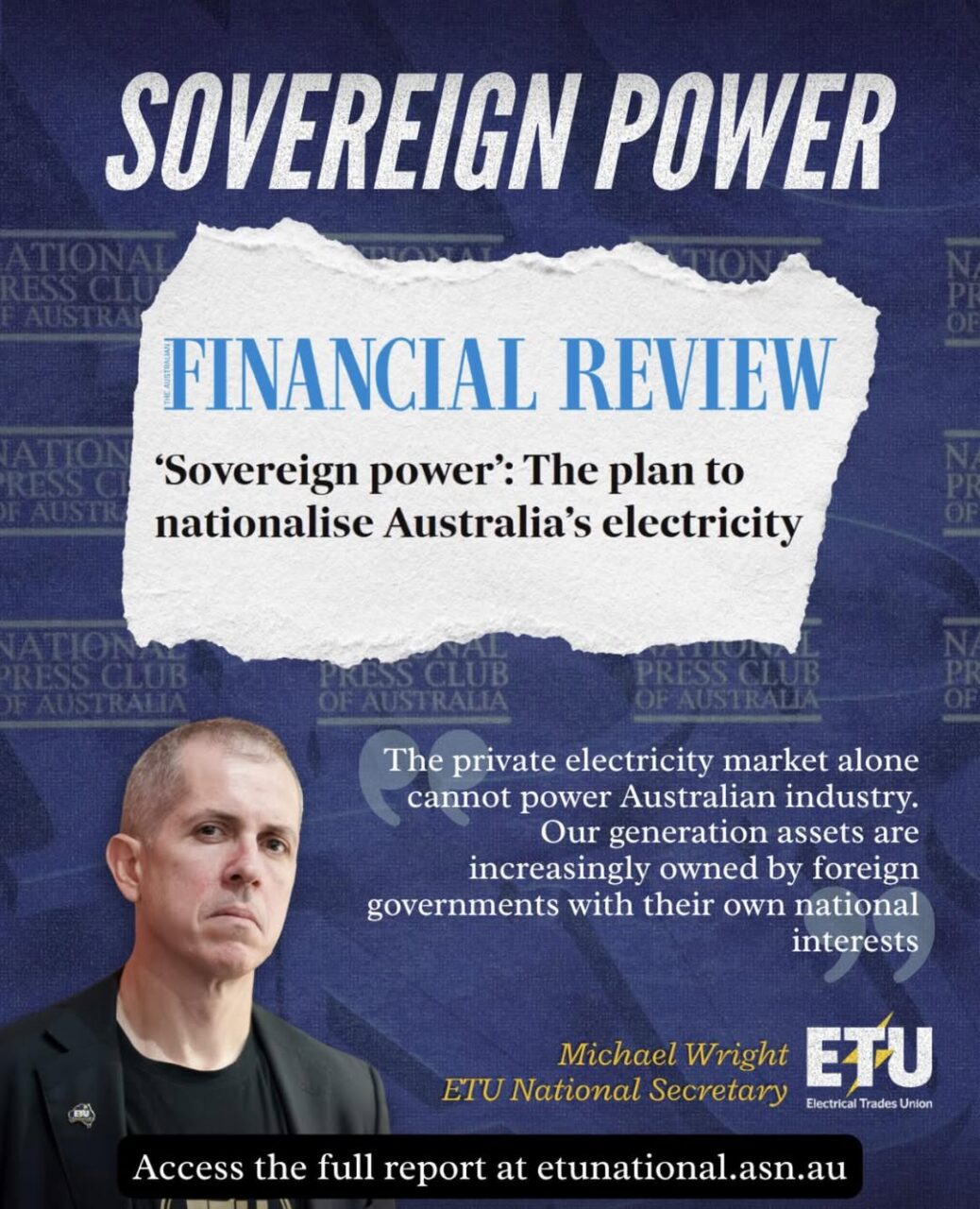
The Electrical Trades Union’s new Sovereign Power campaign is one of the most ambitious policy proposals to emerge from the Australian labour movement in years. It is based on a report from the McKell Institute, Powering Australia’s Future.
It calls for the federal government to establish a publicly owned energy agency that would build and own renewable energy projects dedicated to supplying cheap electricity to Australia’s heavy industries.
At one level, it is an industry policy designed to provide jobs and secure the future of sectors such as steel, aluminium and manufacturing. But in conversation with Labor Tribune, ETU national secretary Michael Wright sketches a broader vision: public ownership of renewable energy, a rapid energy transition, new industrial development and, ultimately, a future where Australians may no longer pay power bills at all.
The discussion ranged from industrial policy and privatisation to regional politics, union strategy, international solidarity and the limits imposed by Australia’s industrial laws.
Marcus Strom
Thanks for talking with Labor Tribune, Michael. Can you start by explaining what Sovereign Power is and the union’s motivation for proposing it now.
Michael Wright
This government has done an enormous amount of work on the energy transition. There’s just no real denying that. From the capacity investment scheme to the battery rollout to what they’ve been doing with EVs, it’s just a lot.
Now, there’s debate about whether we’re on track to hit our 2030 climate targets by 82%. Unfortunately, we also have a climate timeline beyond that.
Separate to that, we have the timeline that industry in this country is on. Site after site, we are seeing a lack of projects hitting FID [final investment decision] because for many, the price of electricity is too high.
Australia’s heavy industry history is predicated on cheap power, publicly owned cheap power. That’s why there is industry in the Latrobe Valley and why Tomago, Australia’s biggest aluminium refinery, is in the Hunter. It got started with a stable, 20-year contract for cheap, publicly owned power.
Sovereign Power is an attempt to learn from that history and give it a future.
The basic model is that government enters into long-term contracts – power purchase agreements – with heavy industry and then builds the renewables to match.
So, we wind up with publicly owned renewables powering our heavy industry.
Fundamentally, the reason we have heavy industry in this country wasn’t because of short-term government finance. It wasn’t because of bailouts. It was because initially they had cheap power.
We have a highly skilled workforce, a stable economy in which to invest – and the third ingredient, the secret sauce we need, has to be cheap electricity.
I’m sick of taking delegations of workers through parliaments around the country, trying to save their jobs in keystone sectors that should actually be economic powerhouses, but wind up getting treated as this legacy baggage.
Strom
The proposal isn’t about government manufacturing solar panels or wind turbines. What exactly would government own?
Wright
The concept is that the government owns the energy provision.
We aren’t saying there will be a Commonwealth Department of Public Works building wind, battery or solar projects. They would be built by private contractors.
But the Commonwealth would own the outcome.
This is a model that already works in Australia with Snowy Hydro. The difference is that we’re explicitly linking new renewable generation to heavy industry.
We aren’t saying the government needs to pick winners and losers in industry. Just pick electricity – it’s quite popular. And if a company can’t thrive with our skilled workforce and cheap, publicly provided power, it was never going to make it.
Strom
Do you see this as a challenge to the neoliberal assumption that everything should be privatised? A potential model for other parts of the economy?
Wright
Absolutely. The traditional neoliberal argument is premised on the private sector being more efficient than the public sector.
Now, as I understand efficiency in that context, it’s defined as sacking workers and failing to invest in ongoing maintenance, which then leads to massive bushfires that kill people throughout Victoria. Is that efficiency?
But even if you take that argument as true, somebody will need to explain to me how the ownership structure of a solar farm impacts cloud cover.
We’re talking fundamentally about panels in a paddock and turbines on a hill.
My union, the Electrical Trades Union, has a long and proud history of fighting for public ownership, particularly of power generation. But the sad truth in Australia is that our opportunity to do this energy transition early was taken from us when Tony Abbott tore up the ETS back in 2013 and critically didn’t replace it with anything.
Whatever you think of the ETS or CPRS, that was eight-and-a-half wasted years.
Now we need to be going hell for leather to build renewables as the bedrock for industry.
Strom
As a socialist, one concern I have is that governments repeatedly step in to support industry while ownership and profits remain private. Isn’t this just an extension of ‘socialise the costs, privatise the profits’?
Wright
There are really three options before us to decarbonise the economy, to shift to renewable electricity.
We race towards our carbon targets through mass deindustrialisation. We’ve seen some countries do this through massive offshoring. But that is just a trick of national accounting, offshoring our emissions.
That’s not the country I want to live in.
The second is socialising heavy industry itself. That’s a position some of us have pushed for in cases like the Whyalla steel works. But we haven’t won that argument.
The third option is ongoing government support for privately owned industry. Governments of all stripes have clearly chosen the third option.
Given that reality then Sovereign Power is a better way of doing this.
This is an opportunity to take industry out of the endless washing machine cycle of bailout after subsidy and into certainty.
The first question is whether Australia wants heavy industry at all.
If the answer is yes, then we need a framework that allows those industries and their workers to survive and transition.
The reality is that we’re already seeing governments scrambling to save jobs at facilities that should be keystone industries and keystone employers for their local communities.
This is an opportunity to put those industries on a more stable footing.
This is an alternative to the seemingly never-ending cycle of bailouts.
And part of the point of Sovereign Energy is if you can make electricity cheap enough, the companies will figure out how to decarbonise themselves.
The most persuasive argument you can ever make to a homeowner about why they should go induction instead of gas for a cooktop is to show them the power bill.
That’s true for manufacturing and smelting as well.
The opportunities for this, for us to re-industrialise Australia with green iron, green steel, are there to be taken. The fact that we are exporting our raw materials at the heaviest point is like a beggar’s belief.
Strom
One striking thing you’ve said about this proposal is that Australia should move towards abolishing power bills. Is this just rhetoric, akin to Harold Wilson declaring nuclear would fuel the ‘white heat’ of technology for Britain in the 1960s?
Wright
I am an optimist. And I think we should be moving towards abolishing power bills for people.
We can have energy abundance. There is no country on Earth with better access to renewables than us. And there is no marginal cost to renewables.
Part of it is the decentralisation that comes with rooftop solar and home battery systems. You are already seeing more and more people with either no power bill or a very low power bill.
But there is also a class aspect to it.
Typically, the people who benefit most are the ones who can afford the upfront investment. Lower-income people, pensioners and renters, people living in home units, don’t get the same benefits.
But I also find that public discussion around the energy transition is very doomerist. It’s presented as eating your vegetables.
We don’t spend enough time talking about how good this country could be. The benefits of less pollution, less asthma from gas, quieter streets from EVs.
We don’t talk enough about the opportunities because we’re fixated on fighting climate change. And that’s not irrational – there are no jobs on a dead planet; urgent climate action is needed. But it’s harder to build political momentum if we only ever talk about the threat and not the possibilities.
So we should come out and say ‘I think we should abolish power bills’. That’s the opportunity before us.
Strom
Renewables are inherently more decentralised than coal-fired generation.
Could public ownership of renewable projects also become part of a political fightback in regional Australia, including against support for One Nation?
Wright
The research we’ve seen is that there is resistance and scepticism in the regions towards the energy transition when it’s privately owned.
The polling shows that even among One Nation voters there is support for publicly owned renewables.
A big part of the concern in the bush is that these projects are seen as private profit and public pain.
This is an opportunity to show that renewables are for the public good because they’re owned by the people.
That also gives the energy transition greater political resilience.
Strom
The ETU proposal raises concerns about foreign ownership of energy assets.
But does nationality really matter? Would it be any better if Gina Rinehart owned those assets rather than a multinational corporation?
Wright
I think what matters is the public-private divide much more.
The polling we’ve seen indicates support for publicly owned renewables.
I would say the concern from communities in the bush and the regions is equal towards multinationals as it is for Australian billionaires.
Part of the problem with the energy transition has been that it has included privatisation by stealth. This is an opportunity to turn that around.
Strom
Could Sovereign Power become part of a different relationship with our region — one based on cooperation and international solidarity rather than national security competition?
Wright
There is such an opportunity for Australia to be the battery of the Pacific.
Now, that’s a bit pie in the sky at this point. We need to get our own house in order first.
And if Sovereign Power started off by exporting this cheap renewable energy rather than using it domestically, that could undercut its political resilience. But there is certainly an opportunity there down the track.
Strom
The ETU is taking this proposal to Labor’s National Conference in July. How are the numbers looking?
Wright
Look, so far we’ve had a lot of really good engagement. We’re not getting told no.
But to be perfectly blunt, the numbers are one thing. I don’t just want to win this at conference. I want to win it in reality.
Whether there’s 50 per cent plus one on the conference floor in Adelaide is by the by.
If we haven’t won hearts and minds with decision-makers, then conference alone won’t achieve what we’re trying to achieve.
Conference is an important opportunity for us to make the case and build a groundswell within the parliamentary caucus and within the party.
But it is only part of the game.
Strom
Let’s say you get the policy through conference. What happens next? We know the parliamentary party is a beast unto itself and treats the implementation of conference policy to be determined by cabinet, not the membership. So, how do you make this more than a policy resolution?
Wright
We’re separately building alliances with civil society and with investor groups.
They’re not natural bedfellows. But if an investor group turns up with the ETU and says public ownership is a good idea, that carries a certain credibility because people assume they’re arguing against their immediate interests.
The Sovereign Power campaign coming out of conference will be about that broader community alliance, that broader civil society alliance.
Getting environmental groups involved. Getting industry groups involved. Because this should have, and does have, a broad base of support.
It’s about making that argument again and again.
Yes, it’s about delegations to parliament. It’s always important to put real human beings in front of politicians or else they just spend their days dealing with lobbyists in suits.
But it’s also about maintaining public pressure and building the media narrative through national media, social media and local media.
Strom
What about the ETU membership itself? Is there a grassroots campaign among members?
Wright
We’ll be launching our campaign immediately prior to conference.
At the moment we’re going around the country talking to members about it.
And bearing in mind that this very much comes out of 123 years of engaging with these issues. It’s not like we just woke up and decided public ownership was a good idea and we’d let the members know in an email.
This is the synthesis of what we’ve been getting from our membership for a long time now.
It’s about building momentum within our membership and within their communities.
That also provides us with a firewall against future conservative governments.
In terms of an industrial angle, it’s not something that naturally lends itself to enterprise bargaining or those sorts of vectors.
But in terms of community campaigning, political campaigning and media campaigning, absolutely — this is going to be what we’re about.
Strom
One strategic difficulty for you is that the ETU is affiliated to the Labor Party but not affiliated to the ACTU, having withdrawn over the ACTU’s support for the parliamentary decision to put the CFMEU into administration.
Does it make sense to be in the ALP and not the ACTU? Doesn’t that make it harder to advance a proposal like this?
Wright
The Electrical Trades Union isn’t affiliated with the ACTU currently. But we are actively engaging with other unions, particularly unions for whom this is directly relevant.
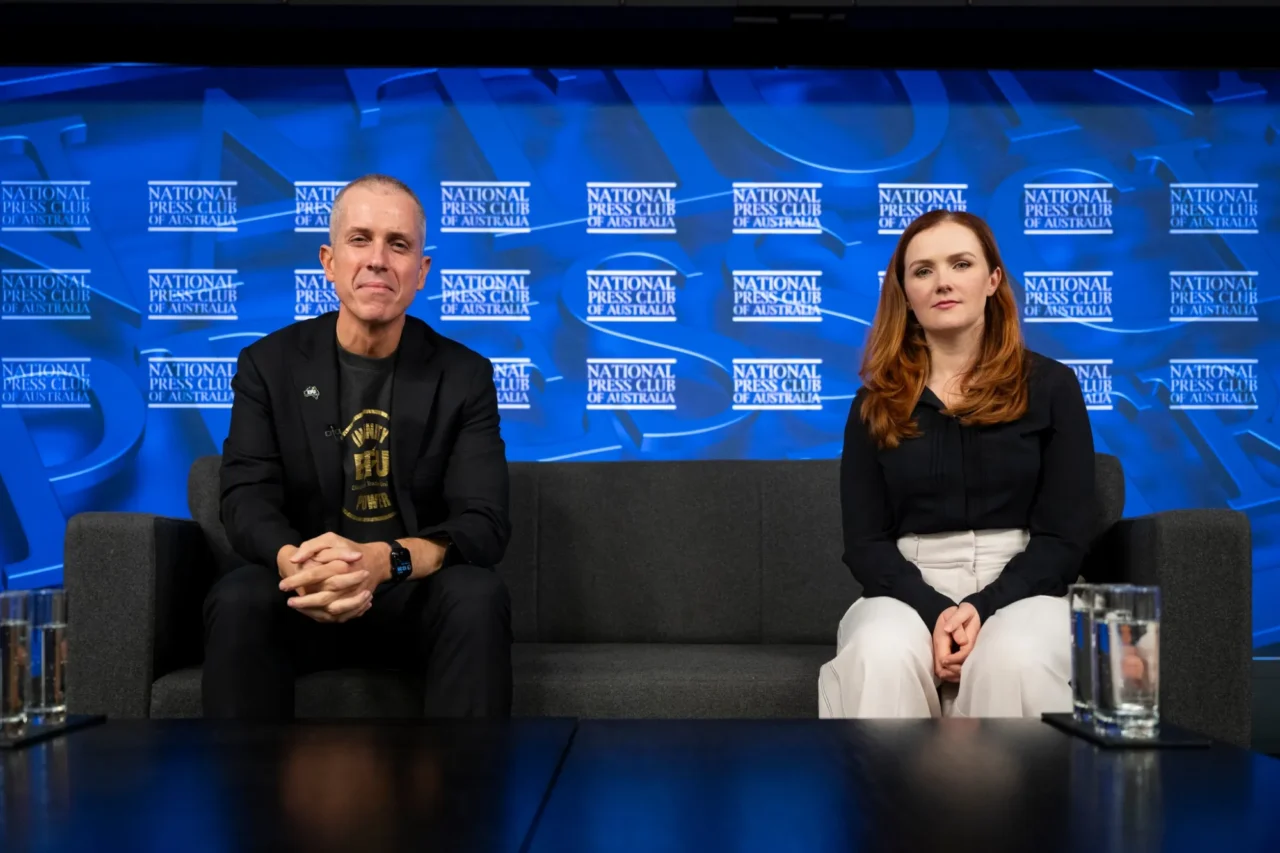
At the Press Club launch there were representatives from the Mining and Energy Union, the Maritime Union of Australia, the AWU and the AMWU.
We’re continuing to engage with them and work on the policy in a way that ensures we’re meeting all of our interests.
Should the ACTU ultimately take it up through one of those affiliates, we’d be more than happy.
Strom
The ETU was involved in the Trade Unions for Democracy summit following the government’s intervention into the CFMEU. That initiative seems to have faded from public view. What happened?
Wright
To be crystal clear, the ETU never opposed administration of the CFMEU. What we opposed was legislated administration.
There were live court proceedings that would have allowed the principles of natural justice to be applied. Consistent with the rule of law, it should have been determined by the courts, not by parliament.
And sadly, when it comes to the construction industry, things are now manifestly worse than they were.
It’s not as though we’ve seen a decline in criminality. If anything, quite the opposite.
Strom
One challenge with Sovereign Power is that it is fundamentally a political campaign rather than an industrial one.
Given the restrictions in the Fair Work Act, there is no obvious way for workers to take industrial action around a proposal like this. How can you engage members in their workplaces with these restrictions?
To me that points to a broader problem. By making allowable matters very narrow in terms of industrial action, the law has effectively rendered other forms of collective action even more unlawful.
The Green Bans, land rights solidarity campaigns and political strikes were often unlawful in their own time, but tolerated within civil society. Today they attract far greater penalties.
Wright
It always baffled me that we had an ABCC and still have Fair Work laws that, if they had been in place and enforced in the 1970s and 1980s, then we wouldn’t have The Rocks in Sydney. We wouldn’t have Centennial Park.
All of the Green Bans would have attracted hundreds of thousands or millions of dollars in penalties.
It’s one thing for people to turn up and fondly remember the Green Bans today. But if they don’t realise that the laws on the books would render that action illegal, that’s a contradiction.
Strom
Those actions were unlawful then anyway. It’s just that by making a small number of industrial acts lawful, the law has effectively made the rest even more unlawful.
Secondary boycotts, political strikes and solidarity action have all been pushed further outside the accepted boundaries of industrial action.
Wright
Yes, it is a sad state of affairs.
For the ETU, Sovereign Power begins as a proposal for publicly owned renewable energy. But the discussion it opens extends much further: into questions of public ownership, industrial strategy, democratic control and whether Australia’s extraordinary renewable resources should be organised primarily for private profit or public benefit.
At the heart of Wright’s argument is a simple proposition. Australia has abundant renewable energy resources. The challenge is not whether that abundance exists, but who benefits from it.