

As the World Cup enters the knock-out stage, David Clarke – lover of football, a member of the NSW Teachers Federation and NSW Socialists – looks at the world game in all its glorious contradictions.
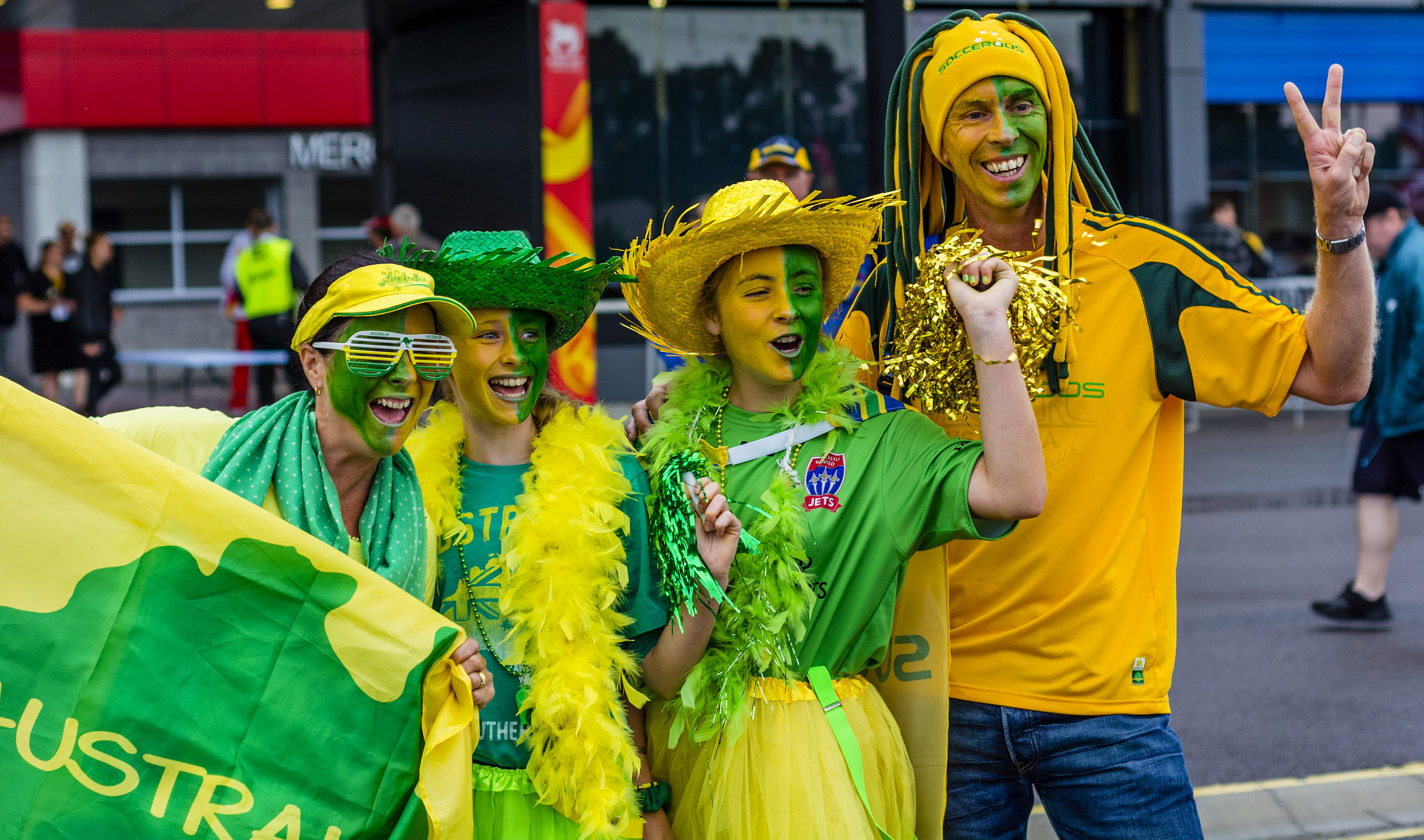
Are you allowed to like the Socceroos and still be suspicious of the politics wrapped around them? Of course you are. In fact, if you are a socialist, you should be.
There is nothing reactionary about taking pleasure in a team that reflects the actual composition of working class Australia: migrant, mixed, multilingual, shaped by successive waves of dispossession and arrival. There is nothing wrong with celebrating a side that makes Pauline Hanson uncomfortable, at least until she figures out a way to try to incorporate it into her own politics, which, as usual, she already has.
That is the point. The Socceroos are now routinely presented, by liberals and much of the left, as the ideal image of “modern Australia”: diverse, anti-racist, inclusive, united in green and gold. And yes, that image is preferable to the old White Australia mythologies. But Marxists should be wary when any ruling class starts congratulating itself for how inclusive its nationalism has become.
Anti-racism, after all, is not the property of the socialist left. It is the official ideology of most advanced capitalist states. Not because the ruling class has transcended exploitation, not because racism has disappeared but because a managed top-down anti-racism is useful: it helps cohere a working class population around the nation state while leaving class power fundamentally untouched. Migrant ‘identities’ become fractured supplicants to the state, whereas working class anti-racism is about uniting people against the state.
You can be included in the ‘national story’ and still be exploited by your boss, gouged by your landlord, and brutalised by the state.
That is why the celebration of the Socceroos is politically contradictory. On one level, it reflects something real and progressive: football in Australia has long been carried by migrant communities, by workers, by those looked down upon by the old Anglo sporting establishment. On another level, the team is constantly recruited into a familiar ideological project: to tell us that “we” are all one, that the nation has solved its tensions, that class antagonism can be dissolved in a montage of flags, families and final whistles.
Even Hanson can see the utility of that story. Her grotesque notion of “monoculture” is revealing precisely because it adapts itself to multicultural reality rather than simply denying it. Different backgrounds, one flag. Different histories, one nation. Diversity, yes, but only as raw material for a stronger Australian nationalism. This is not anti-racism as liberation. It is anti-racism as incorporation.
Marxists should reject both poles of the argument offered by the political mainstream. We do not have to choose between chauvinist monoculture and a slick, market-friendly multicultural nationalism. Our task is not to decide which branding exercise better serves the Australian state. Our task is to ask: what forms of solidarity are being encouraged, and in whose interests?
This is where football matters.
Association football may have been codified in 1848 by young men at Cambridge under the so-called Cambridge Rules, but like so many modern cultural forms, it escaped its origins. It became a mass working-class game because the working class made it one. It became the world game because workers, migrants and the poor turned it into a common language across borders. That is why the World Cup, for all its corporate filth, still exerts such power. FIFA is corrupt. The host states are cynical. The sponsors are obscene. And yet millions continue to invest emotionally because beneath and against all that commercial junk there remains a glimpse of genuine international culture.
That is the key distinction. The best thing about football is not that it teaches us to love our nation more effectively. It is that it allows ordinary people to recognise themselves in one another across nations. The chant, the skill, the heartbreak, the drama: these are shared forms of human expression that cut against the idea that we are sealed into rival national containers. The World Cup is compelling not because it perfects nationalism, but because it sits uneasily between nationalism and internationalism. It stages competition between nations, yes, but it also produces identification that exceeds them.
That is why Labor Tribune is right to insist that Marxists are not national nihilists. National cultures exist. They are real terrains of struggle. The question is not whether national culture should exist, but what content it takes, which class shapes it, and whether its best elements can be integrated into a democratic global culture.
The progressive content of national culture is not flag worship. It is what ordinary people create: music, language, humour, memory, forms of cooperation, and sport itself. These things can be turned into ruling-class ideology, but they can also be turned outward, toward solidarity. Simply put, internationalism is the best of who we can be.
So yes, celebrate the Socceroos. Celebrate the migrant histories that made Australian football possible. Celebrate the fact that reactionaries cannot easily retreat to an uncomplicated white nationalism when the national team so obviously refutes it. But do not stop there. Refuse the sentimental lie that the nation is the highest form of community we can know.
The real lesson of football is bigger than Australia. Bigger than any flag. Bigger, even, than the teams we love. It is that working people, from different languages, religions and histories, can recognise one another in a common cultural life. Not because the state tells them to. Not because a marketing department has discovered diversity. But because international solidarity is not a slogan imposed from above. It is a possibility generated from below.
And that, not nationalism with better optics, is the side socialists should be on.